

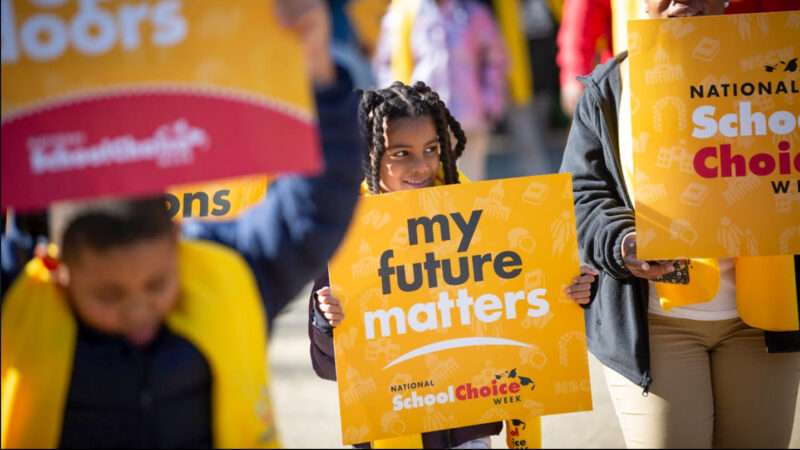
Starting next year, school choice will be a more attainable option for many American families.
Beginning in 2027, the IRS will offer the Education Freedom Tax Credit (EFTC), a tax refund for donations to K–12 scholarship programs. The tax credit, which was introduced in the One Big Beautiful Bill Act last year, represents a massive shift in the federal government's approach to the education system. The Trump administration touts it as an unprecedented expansion of school choice and in that respect, it's right.
The EFTC allows individuals to claim a dollar-for-dollar federal tax credit for donations of up to $1,700—or $3,400 for married couples filing jointly—to scholarship-granting organizations (SGOs) to help families earning "no more than 300 percent of the area's median gross income" cover K–12 expenses. This includes private school tuition, tutoring, special-needs services, and supplies. EdChoice estimates that across all private school choice programs in the U.S.—including vouchers, education savings accounts, and tax-credit scholarships—about $10.6 billion went to students in 2025, an increase of 29 percent from the previous year. The Treasury Department and IRS estimate that the EFTC could support up to 700 SGOs—there are an estimated 531 in the U.S. today—and raise $26 billion in annual contributions by 2030.
While making it easier for parents to exercise greater control over their kids' education shouldn't be a partisan issue, the tax credit has not been universally well received. So far, 30 states have opted into the program, and of the 20 that have yet to join, 19 have Democratic governors. In March, Wisconsin Gov. Tony Evers vetoed a bill requiring his state to opt into the program. In his veto message, he argued that the credit redirects public resources toward private education without sufficient academic accountability, stating, "Public funds should go to public schools. Period."
Randi Weingarten, president of the American Federation of Teachers, released a statement last week, urging governors to reject the program. She called the tax credit "yet another cruel chapter in the Trump's [sic] administration's war on families."
"This scheme is a poison pill for the 90 percent of American children who attend public schools," she said. "Instead of strengthening public education, President [Donald] Trump is diverting $500 billion in taxpayer cash into private hands, with everyone else left fighting for scraps in a real-life Hunger Games."
Evers and Weingarten's statements reflect a broader sentiment that federal education funds allocated to anything other than public education betray the everyday families who rely on the public school system. This school of thought (no pun intended) has largely guided federal education funding for decades, keeping education dollars under public school systems' control, leaving parents dependent on administrators' spending decisions.
The Children's Scholarship Fund (CSF), a nonprofit that helps families access educational options, sees the program much differently. "The Federal Scholarship Tax Credit will be a real game-changer for school choice and philanthropy, putting parents in charge," Elizabeth Toomey, communications director at CSF, tells Reason. "We believe it will be a real step forward in empowering and engaging parents fully in their own children's education. Ultimately, that's how real change and reform in education can come about."
The framing that the tax credit benefits private schools at the expense of public school students is also misleading. As Toomey explains, the tax credit is "far from pulling resources away from public schools." STC-funded scholarships support public school students through tutoring, after-school programs, summer enhancement programs, SAT prep courses, and other programs. "It puts money in the hands of the people who should have the most to say about their children's education—parents."
Polling figures from EdChoice suggest that parents overwhelmingly support school choice programs. Since 2014, parental support for mechanisms like vouchers hasn't slipped below 60 percent. Today, over 70 percent of parents support federal tax-credit scholarships. Additionally, most parents think K-12 education is headed in the wrong direction, a view that has remained fairly consistent over the past decade.
States refusing to join the program are fighting a losing and largely futile battle. Donors in states that don't opt in can still receive the tax credit; they simply can't fund residents in that state, meaning states that reject the program will only bar families residing there from receiving benefits and divert more funding to states that have opted in. At the same time, the broader scope of the tax credit will remain unaffected.
For decades, Washington has been pouring more and more funding into education through school systems, yet this effort has failed to make a real dent in student outcomes or public sentiment. One can question the efficacy of a tax credit while recognizing that giving parents more control over their kids' education is a worthwhile change from the status quo.
The post The Biggest Expansion of School Choice Yet Is Coming in January appeared first on Reason Magazine.




 Bengali (Bangladesh) ·
  English (United States) ·