
 43 minutes ago
4


If you claim the Earned Income Tax Credit (EITC) or the Additional Child Tax Credit (ACTC), your 2027 refund can’t go out before February 15. The PATH Act requires the IRS to hold the entire refund until then, even if you file on opening day. Based on how past seasons played out, we expect most early PATH Act refunds to land in the first week of March 2027.
Millions of families are in this group. About 23.5 million workers and families received roughly $68.5 billion in EITC for tax year 2024, according to the IRS. Our chart below shows when PATH Act refunds should arrive for each week of acceptances, and our main IRS tax refund calendar covers everyone else.
The IRS hasn’t announced its 2027 dates yet. We expect e-filing to open Monday, January 25, 2027. We’ll update this page when the IRS confirms its PATH Act timing, usually in late January. Our page on when IRS e-file opens tracks the opening-day announcement.
2027 PATH Act Refund Chart
If you claim the EITC or ACTC and e-file before mid-February 2027, expect your refund between March 1 and March 5. The date the IRS accepts your return matters less than usual, because every early PATH Act return waits for the same February 15 release. Returns accepted after mid-February move back onto the regular refund schedule.
These are estimates based on past IRS release dates, not IRS promises. They assume you e-file, choose direct deposit and have no problems on your tax return. Use the date finder for your own date, or find your acceptance week in the chart.
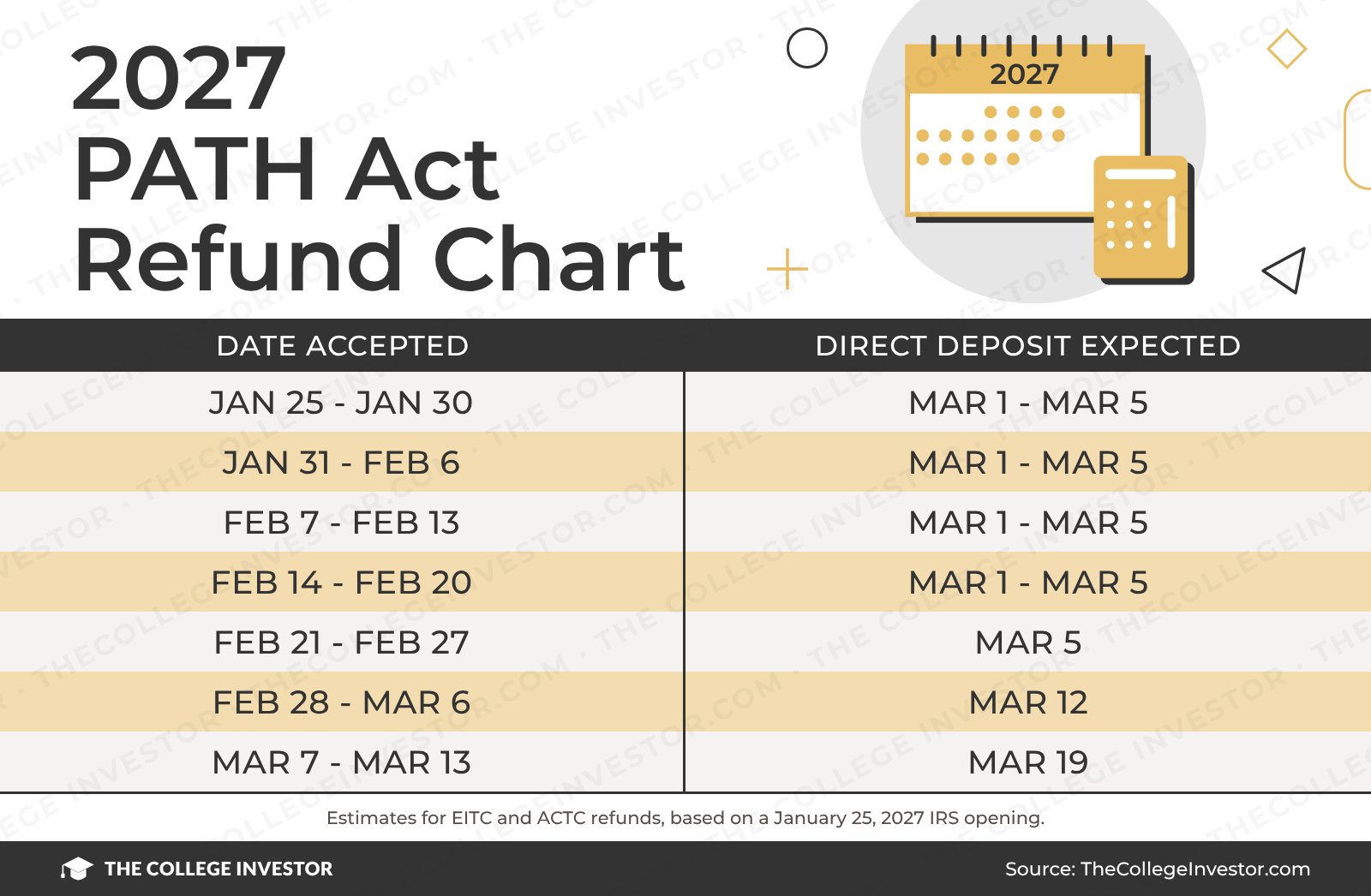
Want a printable copy? Download the 2027 PATH Act refund chart (PDF File). It includes the key dates for EITC and ACTC filers. Here’s the same chart as a table, and our tax center has more filing season tools.
| Jan 25 – Jan 30, 2027 | Mar 1 – Mar 5, 2027 |
| Jan 31 – Feb 6, 2027 | Mar 1 – Mar 5, 2027 |
| Feb 7 – Feb 13, 2027 | Mar 1 – Mar 5, 2027 |
| Feb 14 – Feb 20, 2027 | Mar 1 – Mar 5, 2027 |
| Feb 21 – Feb 27, 2027 | Mar 5, 2027 |
| Feb 28 – Mar 6, 2027 | Mar 12, 2027 |
| Mar 7 – Mar 13, 2027 | Mar 19, 2027 |
The chart no longer lists paper check dates. Paper refund checks stopped being the default in late 2025, so a return without bank information gets frozen and a CP53E notice instead. Our article on how to get a tax refund without a bank account covers options that still count as direct deposit.
When Will PATH Act Refunds Arrive In 2027?
We expect most early PATH Act refunds to reach bank accounts around Monday, March 1, 2027. The IRS can’t release them before February 15, which falls on Presidents Day in 2027. The IRS set a March 2 target for most early EITC and ACTC refunds in 2026, according to its refund timing page for these credits. Our EITC breakdown covers who qualifies and how much the credit is worth.
The release date follows Presidents Day closely. IR-2025-22 set the 2025 target at March 3, two weeks after Presidents Day on February 17. The 2026 target was March 2, two weeks after Presidents Day on February 16. Presidents Day falls on February 15, 2027, which points to Monday, March 1. Some banks post a few days early, as our list of bank accounts with early direct deposit shows.
The IRS has hit this window every year since the hold started. IRS targets have landed between late February and the first week of March in every season since 2017, even when the season opened late. IR-2021-16 shows the IRS opened on February 12 that year and still expected PATH Act refunds in the first week of March. If you see a code in Where’s My Refund instead of a date, our list of IRS reference codes explains it.
| 2017 | Jan. 23 | Week of Feb. 27 |
| 2018 | Jan. 29 | Starting Feb. 27 |
| 2019 | Jan. 28 | Starting Feb. 27 |
| 2020 | Jan. 27 | First week of March |
| 2021 | Feb. 12 | First week of March |
| 2022 | Jan. 24 | March 1 |
| 2023 | Jan. 23 | Feb. 28 |
| 2024 | Jan. 29 | Feb. 27 |
| 2025 | Jan. 27 | March 3 |
| 2026 | Jan. 26 | March 2 |
| 2027 (Estimate) | Jan. 25 | March 1 |
What Is The PATH Act?
The PATH Act is the Protecting Americans from Tax Hikes Act of 2015. The law was enacted on December 18, 2015. Among other changes, it made several tax breaks permanent and added fraud protections for refundable tax credits. The refund hold is the part most families feel. Refundable credits can pay out more than you owe, which is why our explanation of tax credits versus tax deductions matters here.
The hold comes from Section 6402(m) of the tax code. This law prevents the IRS from issuing an EITC or ACTC refund before the 15th day of the second month after the tax year ends. That’s February 15 every year. The extra weeks let the IRS match W-2 and 1099 income against returns before the money goes out. Fraudsters tend to file early, before real taxpayers do, so the hold targets the first weeks of the season. The IRS started enforcing it in 2017.
The first PATH Act season set the pattern. IR-2017-36 shows the IRS began releasing held refunds on February 15, 2017. It warned that most wouldn’t reach bank accounts until the week of February 27. That two-week lag between the release and the deposit has held ever since. Our list of reasons your tax return could be delayed covers other holds.
Who Does The PATH Act Refund Hold Apply To?
The PATH Act hold applies only if your return claims the Earned Income Tax Credit or the Additional Child Tax Credit. Claim either one and the IRS holds your whole refund, including the part from withholding. Filers who take the standard deduction with no refundable credits aren’t affected, and their refunds follow our regular tax refund calendar.
| Earned Income Tax Credit | Yes, the entire refund is held |
| Additional Child Tax Credit | Yes, the entire refund is held |
| Child Tax Credit (Nonrefundable Part Only) | No |
| American Opportunity Tax Credit | No |
| Standard Deduction With No Refundable Credits | No |
The Child Tax Credit trips people up. The nonrefundable part only lowers your tax bill, so it doesn’t trigger the hold. If your family gets money back through the refundable part, that’s the Additional Child Tax Credit, and the hold applies. Our breakdown of the Child Tax Credit shows how the two parts work for 2026 returns.
How Do You Check Your PATH Act Refund Status?
Check Where’s My Refund or the IRS app starting around February 20, 2027. Before then, most PATH Act returns show a general processing message with no date. In 2026, the IRS said the tool would show updated status for most early EITC and ACTC filers by February 21. Our answers to common Where’s My Refund questions explain each message.
Step 1: Gather Your Return
You need your Social Security number or ITIN, your filing status and the exact refund amount from your return, down to the dollar. If you used tax software, the refund amount is on the summary page or your Form 1040.
Step 2: Check Once A Day
Where’s My Refund updates once a day, usually overnight, so checking more often won’t change anything. The IRS replaced the IRS2Go app with the IRS app on September 25, 2026, according to the IRS app FAQ. Signed-in users can also see their account transcript, and our explanation of IRS cycle codes helps you read it.
Step 3: Watch For A Deposit Date
Once the status changes to Refund Approved, you’ll see a deposit date. Banks usually post it within a few days, and some post it early. If the date passes and nothing arrives, our tips on how to contact the IRS explain when calling helps.
Can You Get Your PATH Act Refund Faster?
No. Nothing you do can get an EITC or ACTC refund out before February 15, because the hold is federal law. What you can control is whether your refund arrives with the first wave in early March or weeks later. Our ranking of free tax software can help you e-file at no cost.
Three steps keep you in the first wave. E-file instead of mailing a paper return, put a bank account in your name on the return, and double-check every Social Security number and income figure. A missing bank account now freezes your refund and triggers a CP53E notice from the IRS. That can add four to six weeks. Our walkthrough on how to do your own taxes shows how to e-file.
Be careful with refund advances. Tax preparers offer them to fill the wait, and some charge fees or interest that eat into the refund. Read our breakdown of tax refund advances before you sign up for one.
Get Your Tax Refund Faster
Some banks post tax refunds a few days early. See our list of banks that deposit tax refunds early. Then put the money to work: find the best high-yield savings accounts. All the best accounts are earning over 4%.
What If The IRS Sends You A Letter?
The IRS sends a letter by mail when it needs more information about an EITC or ACTC claim, and the refund waits until you respond. A letter doesn’t mean you did something wrong. It means the refund won’t arrive with the early March wave. If Where’s My Refund shows code 9001, our explanation of IRS reference code 9001 covers what it means.
Answer by the deadline in the letter and keep copies of everything you send. If the IRS asks you to verify your identity, follow the steps in the letter rather than calling a number from a text or email. If you think someone filed in your name, use our steps for what to do if your identity is stolen.
If the IRS reduced or denied your EITC in a past year, you may need Form 8862 to claim it again. Missing that form is a common reason an EITC claim gets held. An amended return on Form 1040-X can take 20 weeks or more, according to IRS Tax Topic 308. Our tax center is the place to start before you amend.
How Does The PATH Act Hold Affect Families?
The hold delays refunds for the families who count on them most. EITC families wait five weeks or more after opening day for money they’re owed, and many file early because they need it. Our main tax refund explanation covers how the IRS sets refund timing for everyone else.
That wait drives demand for tax-time financial products. More than 20 million taxpayers used refund advances and similar products in 2017, according to a GAO review of tax refund products. Some are free, while others carry fees that come straight out of the refund. If you need cash before March, compare the true cost first and read our list of reasons refunds get delayed so you know what else can push your date.
Prior Years’ PATH Act Refund Charts
Here’s our 2026 PATH Act refund chart for reference. That season opened January 26, 2026, and the IRS said most early EITC and ACTC refunds would arrive by March 2. The history table above shows every year back to 2017, and our tax refund calendar keeps every regular calendar since 2014.
2026 PATH Act Refund ChartThe IRS opened the 2026 season on Monday, January 26, 2026, and Where’s My Refund showed dates for most early EITC and ACTC filers by February 21. Here is the 2026 chart, which still included paper check dates. The EITC amounts changed for 2026 returns.

| Jan 26 – Jan 31, 2026 | Feb 27, 2026 | Feb 27, 2026 |
| Feb 1 – Feb 7, 2026 | Feb 27, 2026 | Feb 27, 2026 |
| Feb 8 – Feb 14, 2026 | Feb 27, 2026 | Feb 27, 2026 |
| Feb 15 – Feb 21, 2026 | Feb 27, 2026 | Mar 6, 2026 |
| Feb 22 – Feb 28, 2026 | Mar 6, 2026 | Mar 13, 2026 |
| Mar 1 – Mar 7, 2026 | Mar 13, 2026 | Mar 20, 2026 |
Frequently Asked Questions
When Will I Get My PATH Act Refund In 2027?
If you e-file early with direct deposit and your return has no issues, expect it in the first week of March 2027, around March 1. Returns accepted after mid-February follow the regular 21-day schedule on our refund calendar.
Does Filing Early Speed Up A PATH Act Refund?
Only up to a point. Every EITC or ACTC return filed before mid-February waits for the same February 15 release. Filing early still puts you in the first wave of deposits in early March.
Does The PATH Act Apply If I Only Claim The Child Tax Credit?
Only if you claim the refundable part, which is the Additional Child Tax Credit. The nonrefundable part of the Child Tax Credit doesn’t trigger the hold.
Why Does Where’s My Refund Show No Date Yet?
The IRS doesn’t post dates for most early EITC and ACTC returns until a few days after February 15. Expect dates around February 20, 2027. Our list of Where’s My Refund questions explains each status.
Can The IRS Release PATH Act Refunds Early For Hardship?
No. The February 15 hold is set by law, and the IRS can’t make exceptions for individual filers. The Taxpayer Advocate Service can help with other delays once the hold ends.
Is The PATH Act A Good Thing?
The hold gives the IRS time to match income records and stop fraudulent refunds before they go out. The trade-off is a longer wait for low- and moderate-income families who are owed money and often need it quickly.
Share Your PATH Act Refund Date
Reader reports help everyone waiting on an EITC or ACTC refund. When your deposit lands, leave a comment with your acceptance date and the day the money hit. Questions about a status message? Our Where’s My Refund answers are the best place to start.




 Bengali (Bangladesh) ·
 English (United States) ·