
 1 month ago
43
1 month ago
43 
TLDR
The US Navy seized an Iranian cargo ship in the Gulf of Oman after it tried to run a US blockade Iran closed the Strait of Hormuz again after briefly reopening it over the weekend Brent crude jumped up to 7.9% and European gas surged up to 11% on Monday A ceasefire between the US and Iran is set to expire on April 21, with peace talks still uncertain Commercial traffic through Hormuz is nearly at a standstill, with just a handful of vessels movingOil prices jumped sharply on Monday after the US military seized an Iranian cargo ship, and Tehran closed the Strait of Hormuz for the second time in days.
Brent crude rose as much as 7.9%, recovering most of its losses from Friday when oil had dropped over 9% after Iran briefly announced it was reopening the waterway. European natural gas prices surged up to 11%.
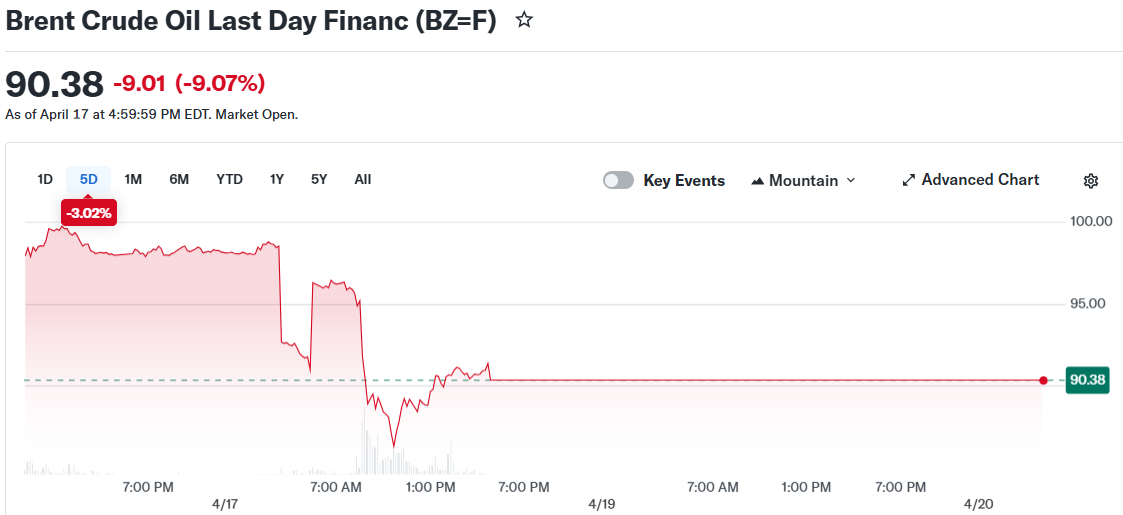 Brent Crude Oil Last Day Financ (BZ=F)
President Donald Trump confirmed the US Navy fired on and seized the Iranian-flagged vessel in the Gulf of Oman. He said the ship had ignored warnings to stop as it sailed toward Hormuz.
Iran condemned the seizure and threatened retaliation. State media reported Tehran had fired on several other vessels trying to cross the channel over the weekend before closing it again on Saturday.
BREAKING: Iran says it has attacked US military ships with drones in retaliation for the US striking and seizing an Iranian cargo vessel in the Strait of Hormuz, per Tasnim.
— The Kobeissi Letter (@KobeissiLetter) April 19, 2026
Iran said the US blockade of Iranian-linked ships violated the terms of a ceasefire agreement, which is set to expire on Tuesday, April 21.
The Strait of Hormuz carries around a fifth of the world’s oil and liquefied natural gas supply. It has been heavily disrupted since the US-Israeli war on Iran began in late February.
Peace Talks in Doubt
It remained unclear whether fresh peace talks would take place before the ceasefire deadline. Trump said US envoys, including Vice President JD Vance, special envoy Steve Witkoff, and Jared Kushner, were heading to Islamabad on Monday night for talks on Tuesday.
However, Iranian state media said Tehran had rejected further negotiations. The Tasnim news agency reported Iran would not send a delegation to Islamabad and would not talk while a US naval blockade remained in place.
Commercial traffic through Hormuz was nearly at a standstill on Monday. Only one oil products tanker was attempting to exit the waterway, with just two other vessels moving in the opposite direction.
Oil had previously surged to nearly $120 a barrel when the conflict began, before pulling back over the past two weeks as Trump raised the possibility of a deal.
What Analysts Are Saying
Analysts at OCBC said markets may have priced in a too-quick return of energy flows. “The standoff looks set to drag on as both sides test pain thresholds,” they wrote.
Haris Khurshid of Karobaar Capital said the market was still carrying a risk premium but not fully committing. He said prices could gradually push toward $105–$115 if tensions continue as they are.
Robert Rennie of Westpac Banking said physical fuel costs would stay under upward pressure as long as Hormuz flows remain constrained.
The two-week ceasefire between the US and Iran expires on April 21, with no confirmed talks scheduled as of Monday.
The post Oil Prices Surge After US Seizes Iranian Ship and Hormuz Closes Again appeared first on CoinCentral.





 Bengali (Bangladesh) ·
  English (United States) ·