
 1 hour ago
4
1 hour ago
4 
The post Newborn Essentials Checklist for First 3 Months appeared first on Penny Pinchin' Mom.
Walk into any baby store and you’ll face 47 different swaddles, 12 types of bottles, and impossible choices. Creating a newborn essentials checklist that actually works is harder than it should be because every product claims to be a “must-have.”
I spent $2,000 on baby gear before my first was born. Half of it stayed in the box. The $80 wipe warmer? Used it twice. The fancy diaper genie that required special refills? Returned it after three weeks when I realized a regular trash can with a lid works fine.
What I wish someone had told me: newborn essentials for the first 3 months fit into five categories: feeding, sleep, diapering, soothing, and going out. That’s it. You don’t need drawer organizers for onesies or a $200 baby monitor that tracks oxygen levels. You need the basics that work, in quantities that make sense, without the registry guilt.
This checklist covers exactly what you’ll use daily from birth through month three. No “nice to haves” disguised as must-haves. No items that only work for two weeks. Just the 15 things that earn their spot in your home because they solve real problems during those exhausting, beautiful first twelve weeks.
Feeding Essentials for the First 3 Months
These items handle feeding whether you’re nursing or using formula. You’ll use every single one multiple times daily, which means quality matters more than quantity.
4-6 bottles (even if you plan to breastfeed exclusively): The 4 oz size works for the entire 0-3 month window. Get the basic versions—skip the anti-colic claims that add $15 per bottle. Most babies adapt to whatever bottle you use consistently. Burp cloths (12 minimum): Not receiving blankets, not fancy bibs—actual burp cloths. You’ll go through 4-6 daily between spit-up and dribbles. Get the three-layer cotton ones that actually absorb. Nursing pillow OR bottle-propping pillow: The Boppy-style C-shape supports your arm whether you’re nursing or bottle-feeding. Eliminates the 2 AM arm cramp from holding a newborn at the right angle for 30 minutes. Bottle brush and drying rack: If you’re using bottles at all, get the brush with the nipple cleaner built into the handle. The countertop drying rack (not the fancy standing one) holds 8-10 bottles and fits next to your sink.Newborn Sleep Essentials That Get Daily Use
Your baby sleeps 14-17 hours in 24-hour periods during these months. These four items get constant use and directly affect whether you get any sleep yourself.
Bassinet or bedside sleeper: The $50 basic bassinet works as well as the $300 one—what matters is that it’s within arm’s reach of your bed and meets current safety standards (firm, flat surface, nothing loose inside). Sleep sacks (3-4): The wearable blanket kind with armholes and a zipper. Blankets aren’t safe for newborn sleep, but sleep sacks keep them warm without the suffocation risk. Get one 0-3 month size in lightweight cotton, one in fleece if your house runs cold. You need multiples because midnight blowouts happen. Fitted crib sheets (4-6): Even if baby sleeps in a bassinet, you’ll use a crib or pack-n-play for supervised daytime naps. Six sheets means you can strip the bed at 3 AM, toss it in the wash, and still have clean backups. Get the stretch-jersey kind—they’re more forgiving when you’re fumbling with them while holding a crying baby. White noise machine: The portable kind that clips to the bassinet or sits on your nightstand. Drowns out household noise and mimics the womb environment. You’ll run it every single sleep period. The $20 basic version with one fan-sound setting works just as well as the $60 app-connected one.Diapering Supplies: Quantities That Actually Make Sense
Most babies use 8-12 diapers daily in month one, dropping to 6-8 by month three. Stock what you’ll actually burn through, not what looks impressive on your nursery shelf.
Diapers (newborn and size 1): Stock one pack of newborn size (your baby might outgrow it in 2-3 weeks) and at least three packs of size 1. Store brand works fine—you’re changing them every 2-3 hours anyway. Wipes (12-15 packs): You’ll use 5-8 wipes per change in the early weeks (newborn poop is sticky). Get the fragrance-free kind in bulk. Don’t buy a wipe warmer—cold wipes wake baby up, which helps them stay alert during middle-of-the-night changes so they go back to sleep faster after feeding. Changing pad with 3-4 washable covers: The contoured foam kind that sits on top of a dresser or changing table. Get covers that go in the washing machine—you’ll wash them weekly. Keep a stack of prefold cloth diapers next to the pad as emergency liners when you don’t feel like doing midnight laundry. Diaper cream (zinc oxide-based): The thick white paste kind prevents diaper rash before it starts. Apply at every change for the first month when their skin is most sensitive. One 4 oz tube lasts 6-8 weeks.The Sanity-Savers: What Keeps You and Baby Functional
These solve specific problems that hit hardest in the first three months: crying you can’t stop, leaving the house without forgetting half your supplies, and keeping baby safely contained when you need both hands.
Soothing
2 pacifiers: About 60% of newborns take to pacifiers, 40% reject them completely. Buy two of the same style to start—if your baby likes them, you’ll want backups for when one falls behind the couch at midnight. The one-piece silicone kind (no parts that can detach) works for the full 0-3 month window. If baby refuses them by week two, donate them and move on. Baby carrier (soft-structured or wrap style): Your arms will give out before your baby stops wanting to be held. A carrier lets you hold them hands-free while you eat, do laundry, or just walk around the house. The wrap-style (long piece of fabric you tie) works well for newborns under 12 pounds. The soft-structured kind with buckles and straps takes 30 seconds to put on but typically starts at 8 pounds minimum. Pick based on your patience level and baby’s birth weight—both work, they just have different learning curves.Going Out
Car seat: The only non-negotiable item on this list because it’s legally required and you can’t leave the hospital without one. Get the infant carrier type (the bucket seat that clicks in and out of a base). It rear-faces, handles 4-35 pounds depending on model, and lets you move a sleeping baby from car to house without waking them. Don’t buy used—you can’t verify accident history. Install it before your due date and have a certified tech check it (most fire stations offer free checks). A diaper bag with a longer shelf life – Most diaper bags get retired around the time solids start. The GillyGro has a built-in booster seat and a wipeable mat, so it stays useful through the restaurant-highchair years.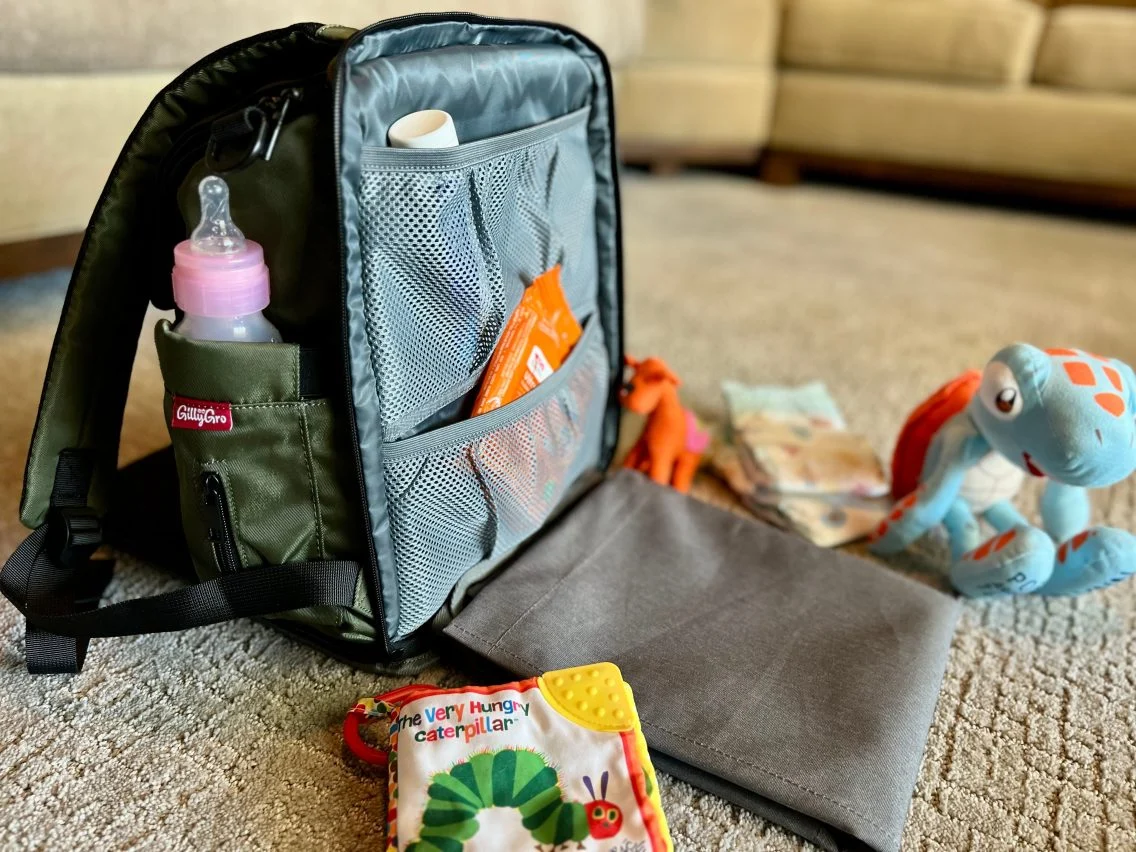 Stroller (optional but helpful): Some parents live in their carrier and skip the stroller entirely for the first three months. Others need the stroller for longer walks or as a place to contain baby while running errands. If you’re buying one, get a stroller that accepts your infant car seat (the “travel system” setup). This lets you click the car seat directly into the stroller frame instead of waking a sleeping newborn to transfer them. You’ll use it this way for the full 0-3 month window and beyond.
Download My Free Newborn Essentials Checklist
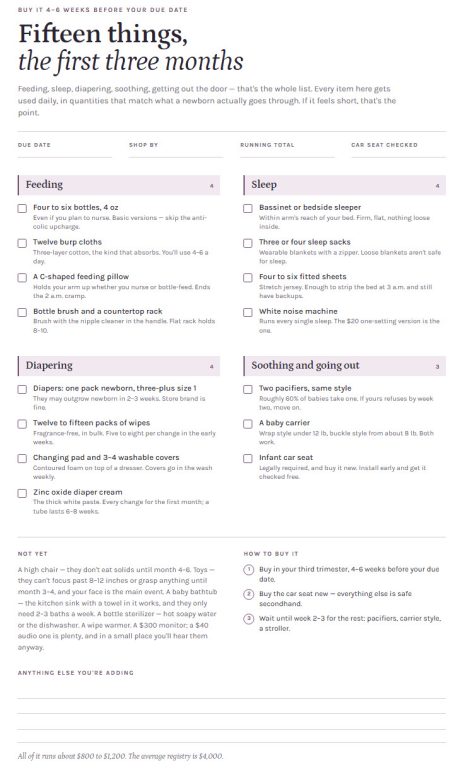
Newborn Essentials Checklist Download
What’s Actually Missing from This List (And Why You Don’t Need It Yet)
If you’re panicking because this list feels short, that’s the point. The baby industry makes money by convincing you that more stuff equals more prepared. It doesn’t.
You don’t need:
High chair or feeding seat: Babies don’t sit up or eat solids until month 4-6. Save the $150 and your floor space. Toys: Newborns can’t see clearly beyond 8-12 inches for the first 6-8 weeks. They can’t grasp objects intentionally until month 3-4. Your face is the most interesting thing in their world right now. Baby bathtub: A sink insert or even just the kitchen sink with a towel on the bottom works for months. Newborns only need 2-3 baths weekly—you’re doing mostly sponge baths until the umbilical cord falls off anyway (usually by week 2-3). Bottle sterilizer: Wash with hot soapy water or run through the dishwasher. Unless you’re on well water with contamination issues, regular washing is fine after the first use. The CDC says sterilizing daily is only necessary for babies under 3 months AND immunocompromised or premature—even then, once daily is enough. Fancy baby monitor: The $300 ones with video, movement tracking, and phone alerts sound reassuring until you’re watching your baby breathe on a screen instead of sleeping yourself. The basic $40 audio monitor works if your house is large. If you’re in a small space, you’ll hear them cry without any monitor.Your actual first-3-months kit costs $800-$1,200 depending on car seat choice and whether you buy new or accept hand-me-downs (everything except the car seat is safe to get used). That’s beds, bottles, 500 diapers, a way to leave the house, and tools to soothe a crying newborn—the real daily survival gear. The $4,000 registry average includes hundreds of dollars of items you’ll never open.
Buy these 15 newborn essentials in your third trimester, 4-6 weeks before your due date: early enough to install the car seat and wash the sleep sacks, but late enough that you’re not storing unused gear for months. Skip everything else until week 2-3 when you know whether your baby takes pacifiers, prefers the wrap or structured carrier, and actually needs that stroller.
Print this list. Share it with whoever’s throwing your shower. Your baby doesn’t care about matching nursery sets or coordinated burp cloths. They care that you can feed them efficiently, change them quickly, and hold them when they’re upset. These 15 items handle all three—everything else can wait until you know your specific baby and your specific life.
The post Newborn Essentials Checklist for First 3 Months appeared first on Penny Pinchin' Mom.



 Bengali (Bangladesh) ·
  English (United States) ·