

This evening, I will be speaking to students with The Fund for American Studies. As is my usual custom with June trips to DC, I went to the Court for opinion hand downs. And, as per my usual custom, I rolled up to First Street around 9:20 a.m. Usually, the bar section is completely empty in June, but today was different. The officer at the front gate said there were more than 200 people seeking bar admissions today, and that I might not even get a seat. That was something I hadn't experienced before.
I was asked to wait in the cafeteria to see how many empty seats there would be in the bar section. Also waiting was John Coghlan of Torridon Law, who was there to see his sister get sworn in. (Fun fact: John was the first lawyer to argue in person at the Court after the COVID shutdown on October 4, 2021.) Thankfully, we were let upstairs shortly before 10:00. Only three bar members would be allowed in.
I was seated just as Justice Gorsuch began announcing the majority opinion in Hemani. That meant no opinions from Justices Jackson, Barrett, or Kavanaugh. As Gorsuch read the summary of the facts, it became clear he wasn't buying the government's "habitual" drunkard argument. He dropped a few laugh lines about how much John Adams and James Madison drank. The Fifth Circuit would be affirmed here. But not in the next case.
Justice Kagan had the opinion of the Court for Hunter v. United States. This case concerned when a defendant was not bound by an appeal waiver. Kagan said that the government proposed an unforgiving standard, the Fifth Circuit adopted a middle standard, and other circuits adopted a forgiving standard. It was obvious who was going to win here. The Fifth Circuit was reversed.
Justice Sotomayor was next with T.M. v. University of Maryland. I had written about this case before. Elizabeth Prelogar was a last minute substitute for Kannon Shanmugam. Respondent was represented by Lisa Blatt. Justice Sotomayor made clear that the Court was not going to overrule the Rooker-Feldman doctrine, as Prelogar had asked for. She also rejected Prelogar's backup argument. But to my surprise, the opinion split 5-4 in an unusual fashion. The majority had Sotomayor, Thomas, Alito, Kavanaugh, and Jackson. Barrett dissented, joined by Roberts, Kagan, and Gorsuch. I will note that Justice Thomas cited the Heritage Guide to the Constitution (Third Edition).
In 1780, the Confederation Congress created a court under that authority whose jurisdiction allowed it to "hear new evidence without deference to state courts'" legal conclusions. W. Pryor, The Appellate Jurisdiction Clause, in The Heritage Guide to the Constitution 499 (3d ed. 2025) (Pryor)
I hope this is the first of many Supreme Court citations for this important book. Whatever baggage the Heritage brand may have should not override the amazing scholarship in the book from Judge Pryor and others.
I did notice the Justices seemed tense. They weren't talking to each other. I didn't see them laughing or joking around. Justice Alito was closely reading something. I thought he had an opinion to deliver, but it was apparently something else. Chief Justice Roberts was staring up at the ceiling for an extended period of time while Justice Sotomayor was reading. Justice Barrett was just looking forward intently. The only moment of levity came when Justice Gorsuch joked about our alcoholic founders. These vibes do not augur for a pleasant end-of-term.
After Sotomayor finished reading her opinion, the Chief Justice asked the clerk to begin the admissions process. Most of the members of the press box left at that point, somewhat disappointed at the lack of blockbusters. For a Thursday in June, this was a slow day. And given the federal holiday tomorrow, there are no more opinions for this week.
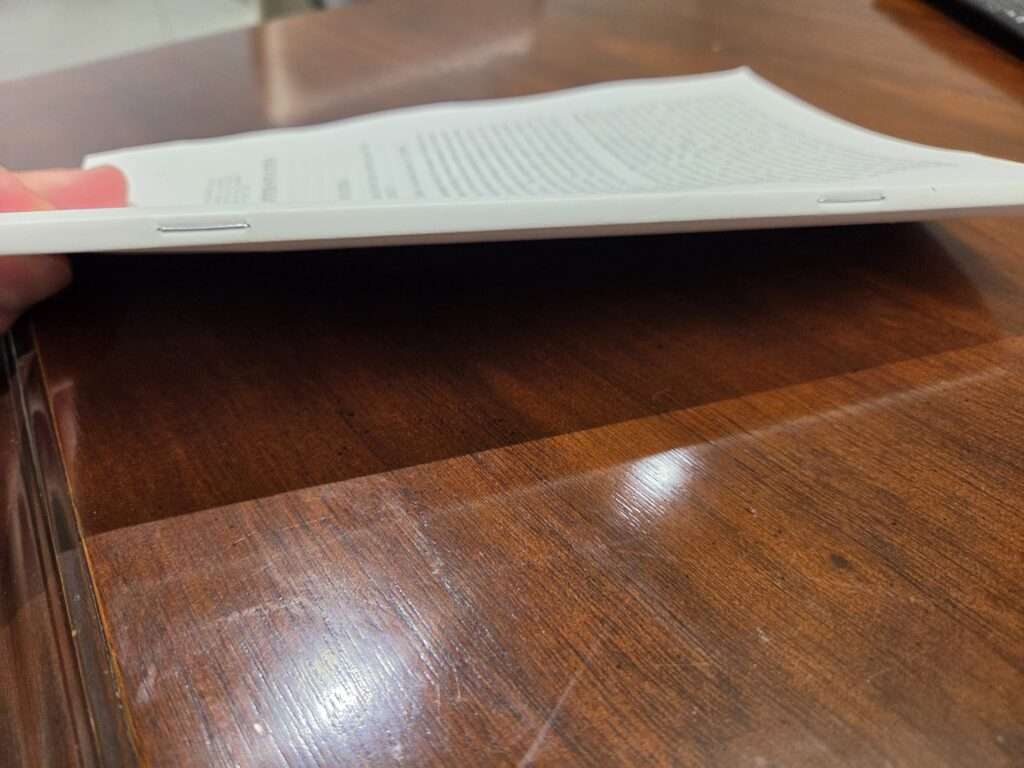
I stepped out of the Court to grab a copy of the bench opinions. It had been some time since I waited for a paper copy, and didn't realize the binding had changed. Two staples are visible on the spine. Mark Walsh, whose father was in the printing business, told me it is called a "Perfect Binding."
Mark also told me that there would be no opinions on Monday, and the next batch is scheduled for Tuesday. There is also a scheduled hand down for Thursday. So next week will likely add a Wednesday or Friday session. The consensus from several reporters I spoke with is that the term will end on June 30 or July 1.
A few other miscellaneous notes as I traveled around town.
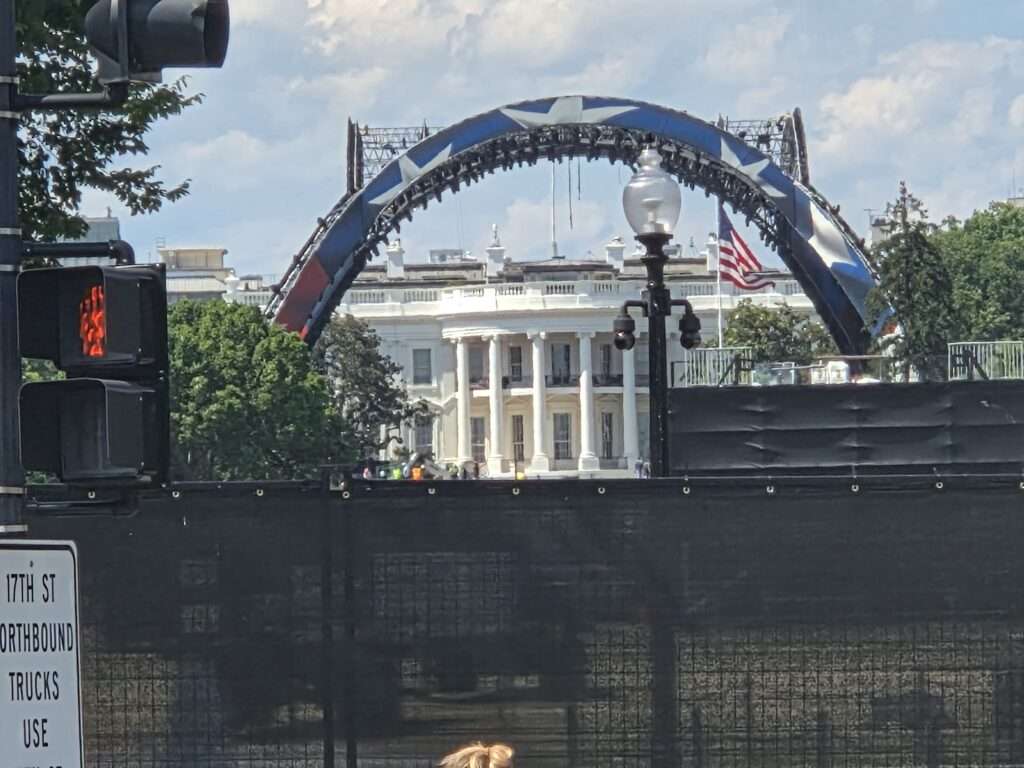
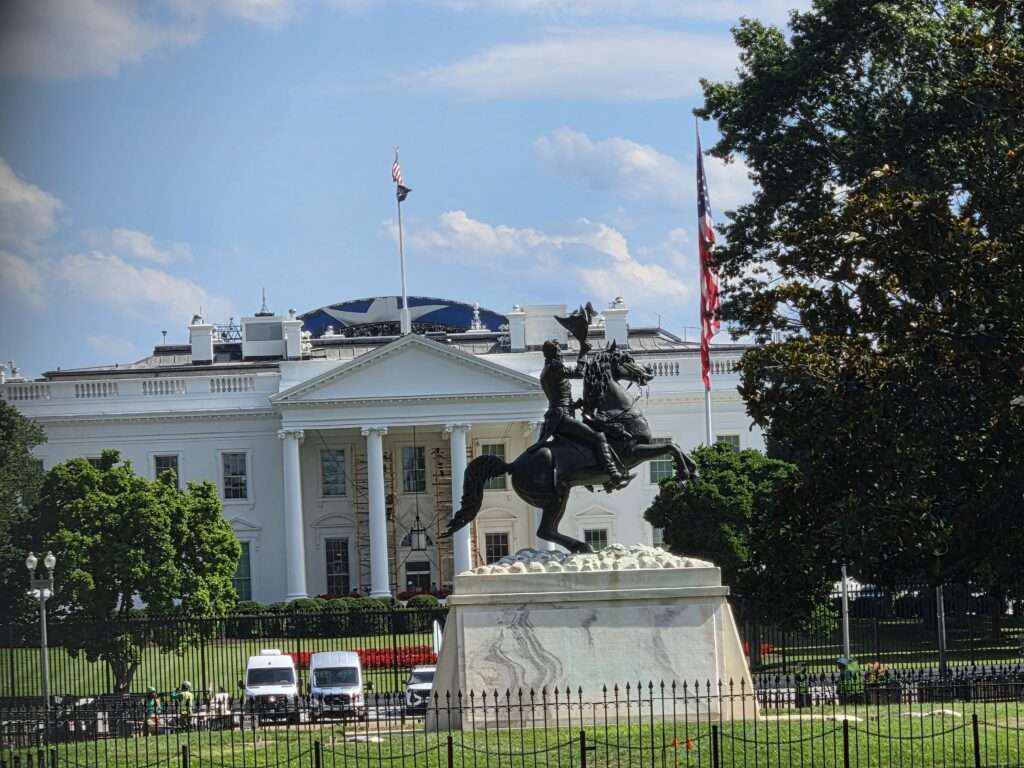
Yesterday, out of curiosity, I walked past the White House to see the renovated reflecting pool. It is difficult to convey how large the UFC Claw was. It towers over the White House. It can be seen from both Pennsylvania and Constitution Avenue.
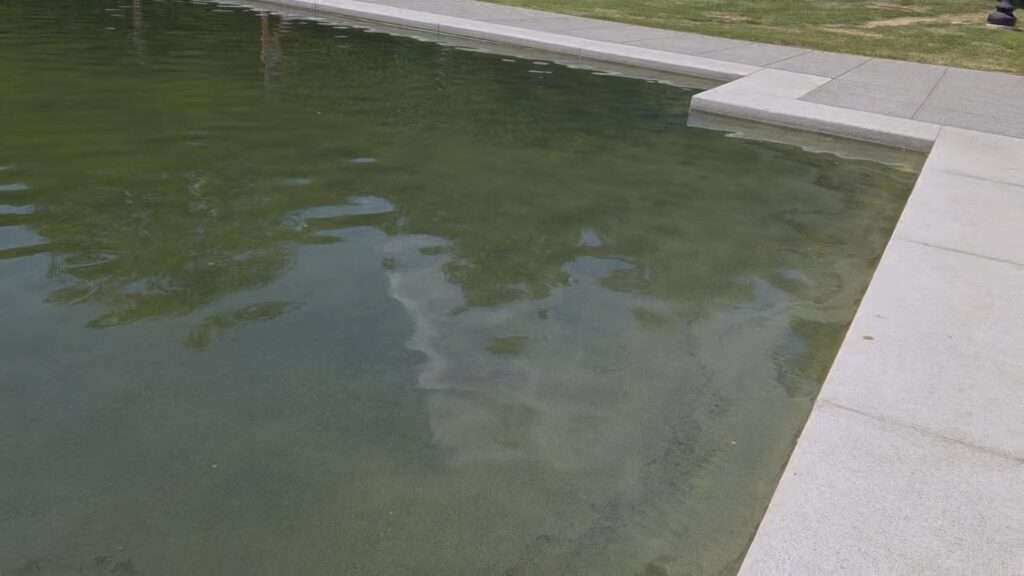
 The reflecting pool was green. It was filled with algae and other growth. I did not see American Flag Blue.

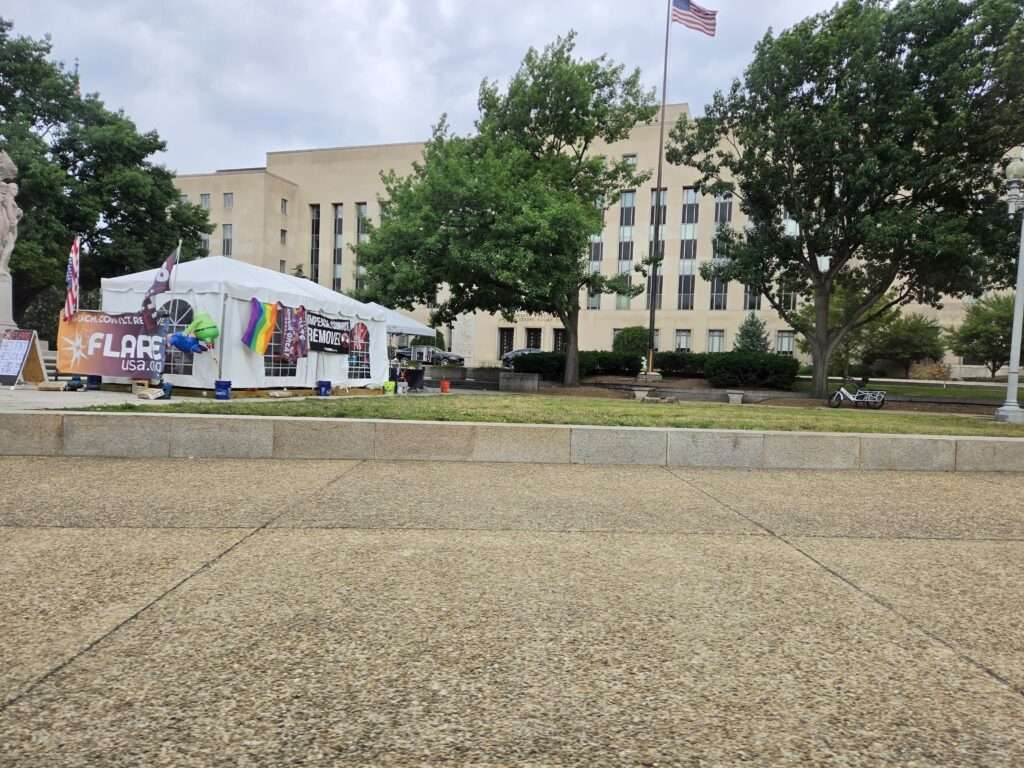
On the way back from the Court, I passed the "86-47" tent outside the D.C. Circuit Court House. Free Speech in action.
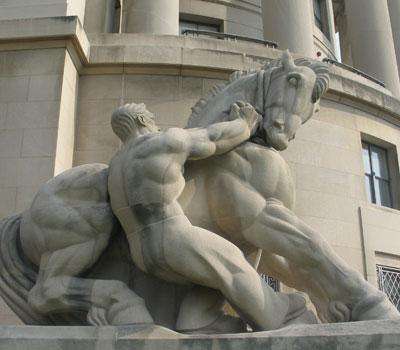
One last point. I have always been bothered by the "Man Controlling Trade" statue outside of the FTC building. This sculpture was made in 1942 to symbolize how the federal government controls the unbridled energy of the market. That certainly would have been how the Roosevelt administration viewed the power of the federal government. But it makes little sense for the present moment. Shouldn't the man let the horse run free? Maybe this is another item of D.C. architecture that warrants a change.
The post A Slow Thursday At The Court appeared first on Reason.com.





 Bengali (Bangladesh) ·
  English (United States) ·