

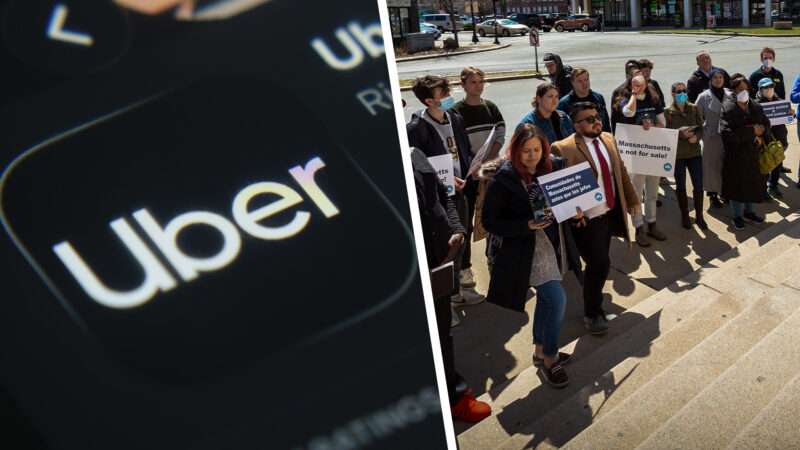
Gig worker unionization could be coming to an Uber ride near you. On June 1, the Illinois legislature passed a bill allowing rideshare drivers in the Land of Lincoln to unionize. The legislation, which would apply to the state's nearly 100,000 Uber and Lyft drivers, marks the third such state law to pass in just the past three years.
The state isn't the first. Gig work unionization is spreading, and it's likely to hurt both drivers and riders in the years ahead.
The history of rideshare unionization starts in Massachusetts, which became the inaugural state to allow rideshare drivers to unionize in 2024. The Massachusetts law is notable for providing a fairly easy path to unionization, with any union that gains support from 5 percent of drivers becoming eligible to obtain a list of all potential rideshare drivers in the state in order to increase its membership rolls. If the union eventually goes on to sign up a mere 25 percent of eligible drivers, it becomes the certified bargaining representative for all drivers statewide.
This model is known as sectoral bargaining, in which sector-wide bargaining replaces the firm-level bargaining that is usually seen across America. Sectoral bargaining has gained ascendancy in Europe and Australia and is preferred by unions as a particularly cost-effective way to avoid the arduous work of company-by-company organizing efforts.
The stakes are potentially enormous. In Massachusetts, the newly-recognized App Drivers Union cleared the needed representation threshold of 25 percent a few weeks ago to officially become the bargaining representative of 70,000 drivers across the state. This makes it the largest private-sector union organizing victory since United Auto Workers unionized at Ford in 1941.
The other two states to pass gig unionization legislation—California and now Illinois—have structured their laws in a similar way to the Massachusetts model, again utilizing a sectoral bargaining approach.
The Illinois bill currently sits on the desk of Democratic Gov. J.B. Pritzker, who is expected to sign it; California, which greenlit gig unionization in 2025, allows 800,000 gig workers in the Golden State to potentially become unionized. Minnesota has also considered similar legislation that could apply to its 10,000 rideshare drivers.
While union membership rates nationwide have barely budged in recent years—and remain at historic lows—this trend could reverse itself if hundreds of thousands of gig workers suddenly become new union members in the decade ahead.
These gig unionization laws also allow for what's known as binding interest arbitration, which provides that, if the relevant businesses and unions are unable to agree to a contract within a certain period of time—usually after several months—then a government-backed arbitration panel can be appointed to impose contract terms on the parties.
Binding interest arbitration is a longtime policy priority for organized labor since it provides a way to dictate contract terms to private businesses that are resistant to union demands. The concept is enjoying renewed—and bipartisan—popularity among policymakers.
In Congress, a bill known as the Faster Labor Contracts Act (FLCA), which is backed by a handful of pro-union Republicans (along with enjoying unanimous Democratic support), recently passed the House of Representatives and likewise utilizes binding arbitration for contract impasses. As with the FLCA, the Illinois rideshare unionization bill received modest Republican support, underscoring the rise of a burgeoning pro-labor strand within the GOP at both the state and federal level.
But the rideshare unionization push is at least in part a backdoor attempt to treat gig workers as full-scale employees rather than independent contractors. Debates over how to classify gig workers came to a head during the debate over California's notorious A.B. 5 law, which passed in 2019 and sought to turn contractors in the state into employees—a move that was partially rejected by state voters in a later ballot proposition.
But while direct reclassification efforts for gig workers have failed to gain the traction that progressives desired, gig unionization still moves gig workers one step closer to traditional employee status. By its nature, negotiating sector-wide rules for rideshare drivers across an entire state imposes one-size-fits-all standards on workers and platforms.
As a result, more platforms will likely resort to arranged scheduling models that limit how many workers can be active on a platform at any given time. This runs counter to what gig workers actually want—which is flexibility and the log-in-anytime access of gig roles.
In fact, this result has already been seen in locales that have pushed aggressive minimum wage laws for gig workers—another one-size-fits-all progressive labor policy that left-leaning cities have begun importing to gig work in recent years. For instance, the waitlist to become an UberEats driver in New York City grew to 27,000 after the Big Apple passed a minimum wage ordinance for app-based food delivery in 2023; the minimum wage rules forced Uber to limit drivers in an effort to control spiking labor costs.
Unfortunately, draconian sector-wide labor rules will also raise labor costs for these platforms, with the costs inevitably being passed along to riders in the form of more expensive Uber rides. (Such a passed-along price increase has also already been seen with the minimum wage mandates for food delivery.)
The gig worker unionization drive that is spreading across America is a potential sleeping giant. It could lead to increased union membership rolls, the proliferation of sectoral bargaining inside the country, and the adaption of binding arbitration procedures that will overturn America's long tradition of voluntary labor agreements and negotiations.
The costs of continuing down this path are clear—for both riders and drivers.
The post Your Uber Driver May Soon Be Unionized. At What Cost? appeared first on Reason.com.





 Bengali (Bangladesh) ·
  English (United States) ·