

Dogs typically love belly rubs and will roll on their backs to get more. With cats, it's a different story: Most are visibly uncomfortable when someone touches their belly, and the same applies to their feet and tail.
When a cat is petted in these areas, its body language often changes. "They might do a quick head turn, looking at your hand, or they might start moving away from you or wiggling around a lot, basically trying to get away from the petting," Mikel Delgado, a cat behaviorist and senior research scientist at Purdue University, told Live Science in an email. "If these early warning signs are ignored, they might escalate to biting, hissing or scratching."
But why do cats dislike it so much when humans touch these specific areas?
Although there has been little formal research into this question, animal behavior experts proposed a few ideas for why cats don't like to be touched in certain areas.
Off-limits petting zones
"Cats are prey animals as well as predators and so they can be very protective of areas that are particularly vulnerable to injury during attack, such as the belly area," Sarah Ellis, head of cat mental well-being and behavior at the cat welfare charity International Cat Care, told Live Science in an email.
A cat's belly houses vital organs — such as the liver, stomach and intestines — without the protective bony cage that the ribs provide for the heart and lungs. Although cats have evolved a special feature called the "primordial pouch" — basically a flap of loose skin and fat on their belly — which provides a little extra padding to protect vital organs during fights, most cats still feel threatened when humans touch or rub their belly.
Cats have extra padding on their stomachs to protect their organs. (Image credit: Cyndi Monaghan via Getty Images)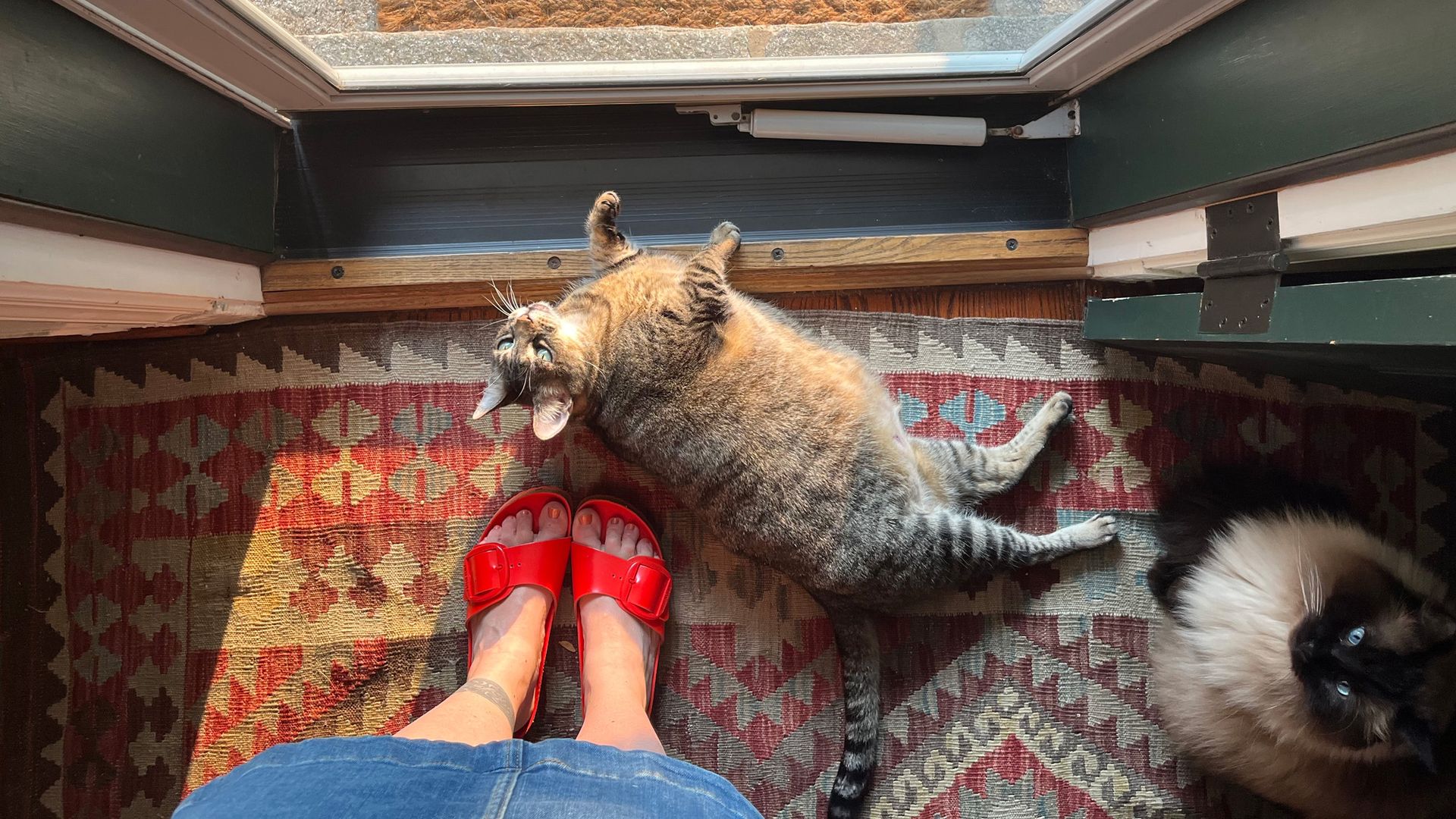
Dogs have a similar anatomy to cats, but they have to worry less about falling prey to larger animals. Cats, meanwhile, can be hunted by dogs, urban coyotes, and even birds such as hawks and owls, making it natural for them to be protective of their bellies.
The tail is also a vulnerable area for cats. "When a cat is chased by another animal, including other cats, the tail is often the part of the cat's body that is closest to touch," Ellis said, "and the risk of being bitten at the base of the tail is high." Therefore, cats may be skittish about having their tail stroked.
When it comes to foot rubs, there are two possible explanations for why most cats hate them. First, a cat's paws are essential in threatening situations. Running away from danger is a cat's preferred survival strategy, and they rely on their paws as a means of escape, Ellis explained. If they can't run away, "a cat may resort to repelling any threats through swiping and scratching and it needs its paws free to do so," she said. "It is therefore predisposed to not enjoy having its paws restricted in any way."
Another reason could be that cats' paws are very sensitive. They have wrist whiskers (also known as "carpal vibrissae") and toe pads that are sensitive to various types of stimuli, like pressure and heat, Delgado said, "so it's not surprising that many cats are sensitive about having their feet touched."
Petting rules and exceptions
If you're interacting with a cat, it's generally a good idea to stick to the areas where most cats like to be petted: the base of their ears, around their cheeks and under their chin. These areas are rich in scent glands, and cats tend to rub them against other cats they are friends with, Delgado explained. So essentially, cats like being petted in those areas because "they treat us as they do other cats," Delgado said.
But some cats go against the grain. "I've had a few who enjoyed belly rubs," Delgado said. Others enjoy having their tail stroked briefly and show their pleasure "by pushing their rump into the hand of the petter and holding their tail up in the air," Ellis said. (This behavior is sometimes called "elevator butt.")
As puzzling as it may be to humans, these varied preferences are a reminder that "each cat is an individual," Delgado said. Positive responses to petting of the belly, feet or tail can also signal close bonding to a human, Ellis said.
She advises people to "always take the cat's lead, learn what each individual cat likes and dislikes and respect these preferences."
How much of a cat fan are you? Find out by taking our cat quiz!





 Bengali (Bangladesh) ·
 English (United States) ·