

Every experience we have and every moment we live unfold naturally across space and time — so naturally that we rarely stop to question their existence.
Physics takes this just as much for granted as we do. For more than 100 years, the field has been built upon the foundational idea that space-time — the four-dimensional fabric of the universe — is fundamental.
But new insights drawn from the hearts of black holes, quantum computers and ultraprecise lasers, are now poised to challenge this assumption, leading a growing number of physicists to ask the same question: What if space and time aren't the bedrock of the universe, but emerge from something even deeper?
"You can build space from a theory without space," Jeff Forshaw, a professor of particle physics at the University of Manchester in the U.K., told Live Science.
Two theories that do not fit
For decades, we have known that two extraordinarily successful descriptions of nature are incompatible.
In Einstein's general theory of relativity, matter and energy bend space-time and we experience that curvature as gravity. Quantum mechanics, meanwhile, describes nature on the smallest scales of atoms and subatomic particles.
But quantum mechanics still has no adequate description of the force of gravity. The conflict between these theories of big and small becomes unavoidable in extreme environments, such as the centers of black holes or the smallest fractions of a second after the Big Bang, where gravity grows to be intense on the minute scales ruled by quantum mechanics.
An artist's illustration of the Big Bang with time running from the image's bottom to the top. During the first brief fraction of a second after the Big Bang the universe was so dense that quantum effects and gravity were equally strong. (Image credit: VICTOR de SCHWANBERG/SCIENCE PHOTO LIBRARY via Getty Images)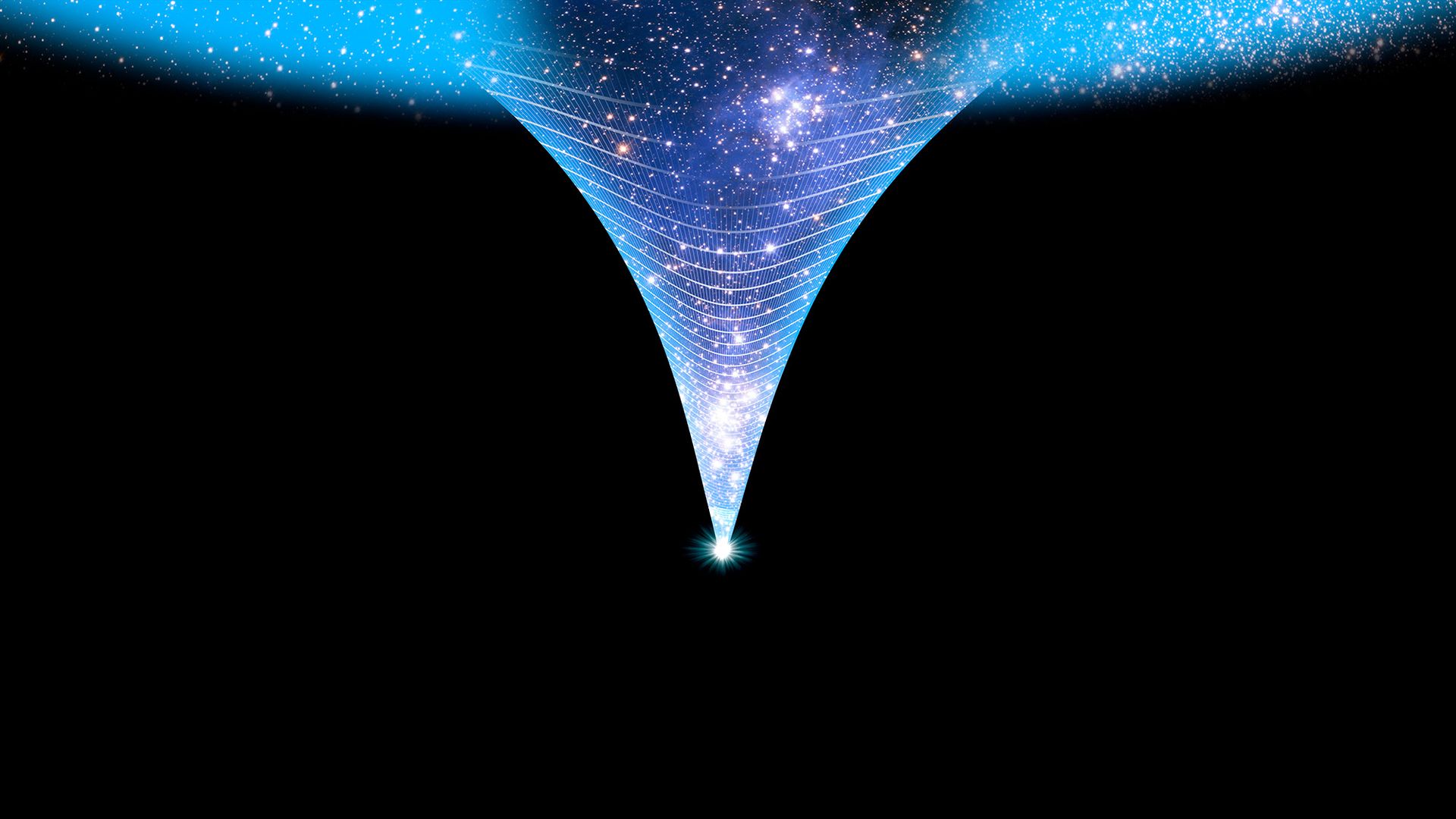
So far, efforts to combine them mathematically and theoretically have led to nonsensical results.
"They seem not to fit together into a single, consistent framework that we know to be correct," Latham Boyle, a theoretical physicist at the University of Edinburgh in the U.K, told Live Science.
It's possible that one or both of these theories is incomplete, but an increasingly popular belief among physicists is that both theories are perched upon an untested assumption: space-time itself.
Both general relativity and quantum mechanics assume that space-time exists. Yet neither explains why our universe seems to have three dimensions of space and one of time, or where space-time comes from. If this assumption is wrong, the apparent foundation of reality could be a large-scale approximation of something even more mysterious.
Is space-time like water?
In Einstein's model, space-time is a little like how people once viewed water: smooth and continuous, capable of bending and rippling. But water only appears continuous on large scales because we can't see its composite "bits," or individual molecules, said Boyle, whose research explores quantum gravity, the early universe and whether space-time is fundamental or emergent. One proposal is that space-time is similar.
"It seems smooth but only because we can't view it under a fine enough microscope," Boyle told Live Science. Yet no one has found direct evidence for space-time's microscopic "bits." That leaves physicists searching for indirect clues in places where existing theories are pushed to their breaking point: black holes.
At the hearts of black holes, general relativity breaks down by predicting space-time curving infinitely, while quantum physics gives their boundaries baffling properties.
Around black holes gravity (the curvature of space-time) is warped to an infinite degree. (Image credit: adventtr via Getty Images)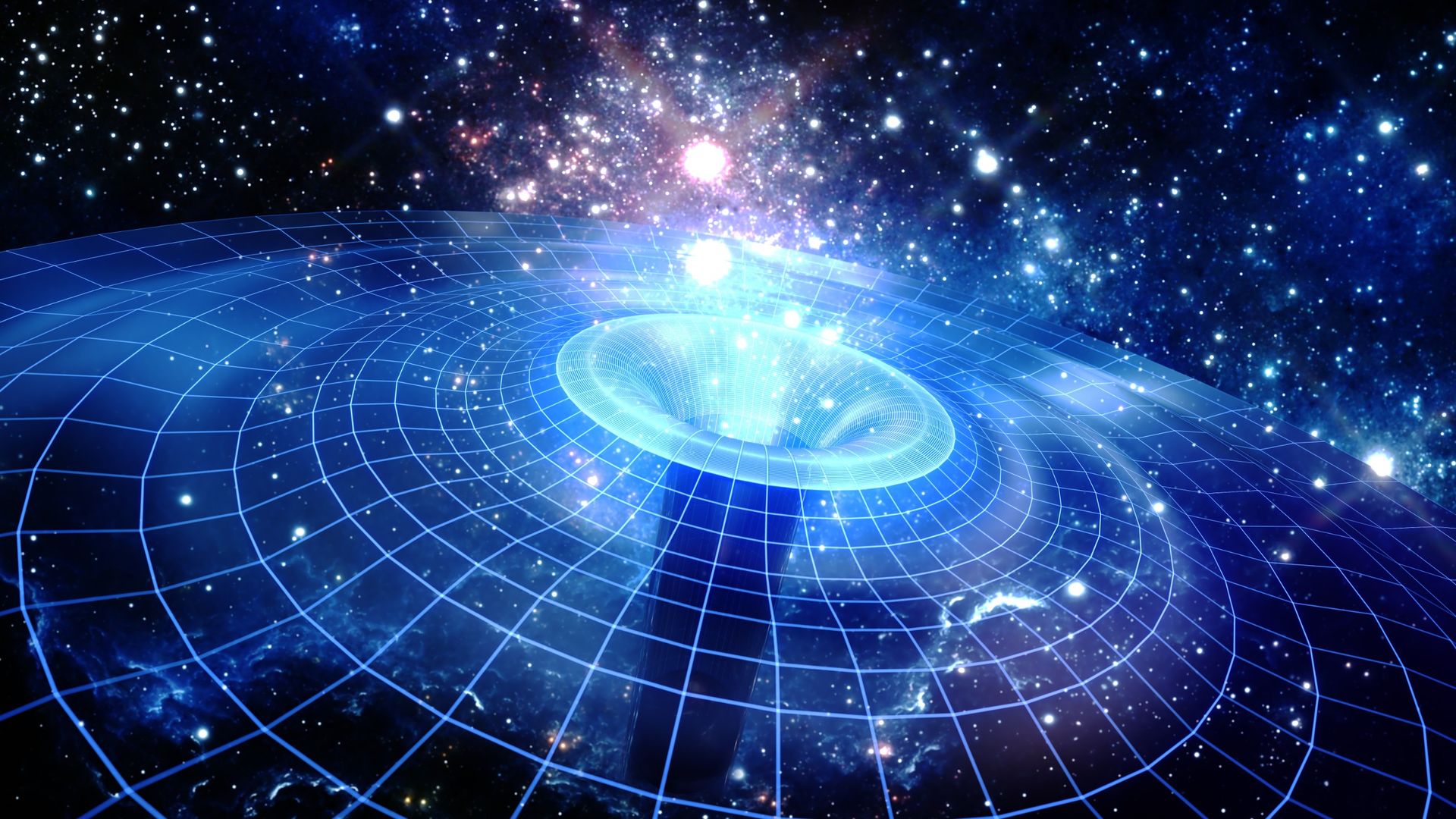
Black holes also offer intriguing clues that space-time, like water, may have microscopic ingredients. One clue comes from thermodynamics — the laws governing heat, temperature and entropy.
Entropy is often described as measuring the disorder in a system, but physicists use it to describe how many hidden microscopic arrangements can produce the same large-scale behavior. A glass of water, for example, may have one temperature and pressure even though its molecules could be moving and arranged in an enormous number of different ways. The more possible microscopic arrangements there are, the greater its entropy.
This matters because thermodynamics usually describes the large-scale behavior of microscopic ingredients. If Einstein’s equations are thermodynamic in nature, their entropy may be due to hidden microscopic states of space-time that physicists cannot yet see.
"General relativity is thermodynamics," Forshaw said. "Einstein's equations are a statement of thermodynamics. They're a statistically emergent feature of an underlying theory."
In the 1970s, Jacob Bekenstein and Stephen Hawking showed that black holes, too, have entropy and a physical temperature. This raised striking questions: Are there microscopic ingredients that account for those thermodynamic properties, and if so, what are they?
If those constituents exist, then space-time's smooth geometry, like the continuous appearance of water, emerges only on larger scales.
Another clue is that Einstein's equations appear to contain traces of this hidden structure, somehow reproducing the relationships needed for black holes to have a temperature, even though the theory directly connects the shape of space-time only to the matter it contains.
"Einstein's equation, which we thought was just a classical equation, nothing to do with quantum mechanics, seems to secretly know — or at some level to have known — about this finite entropy associated with the black hole," Boyle said.
The holographic universe
The entropy of black holes also gives rise to a second sign that space-time emerges from something deeper: a puzzle known as the black hole information paradox.
Quantum mechanics says that physical information can never be destroyed. Yet if black holes emit radiation — an idea famously proposed by Stephen Hawking in 1974 — they should slowly evaporate. This is a profound contradiction: A black hole's Hawking radiation is thermal, depending solely on its mass, electric charge and angular momentum. It contains no obvious record of what originally fell inside. That means that if the black hole eventually disappears, the information of what it once gobbled up seems to vanish with it.
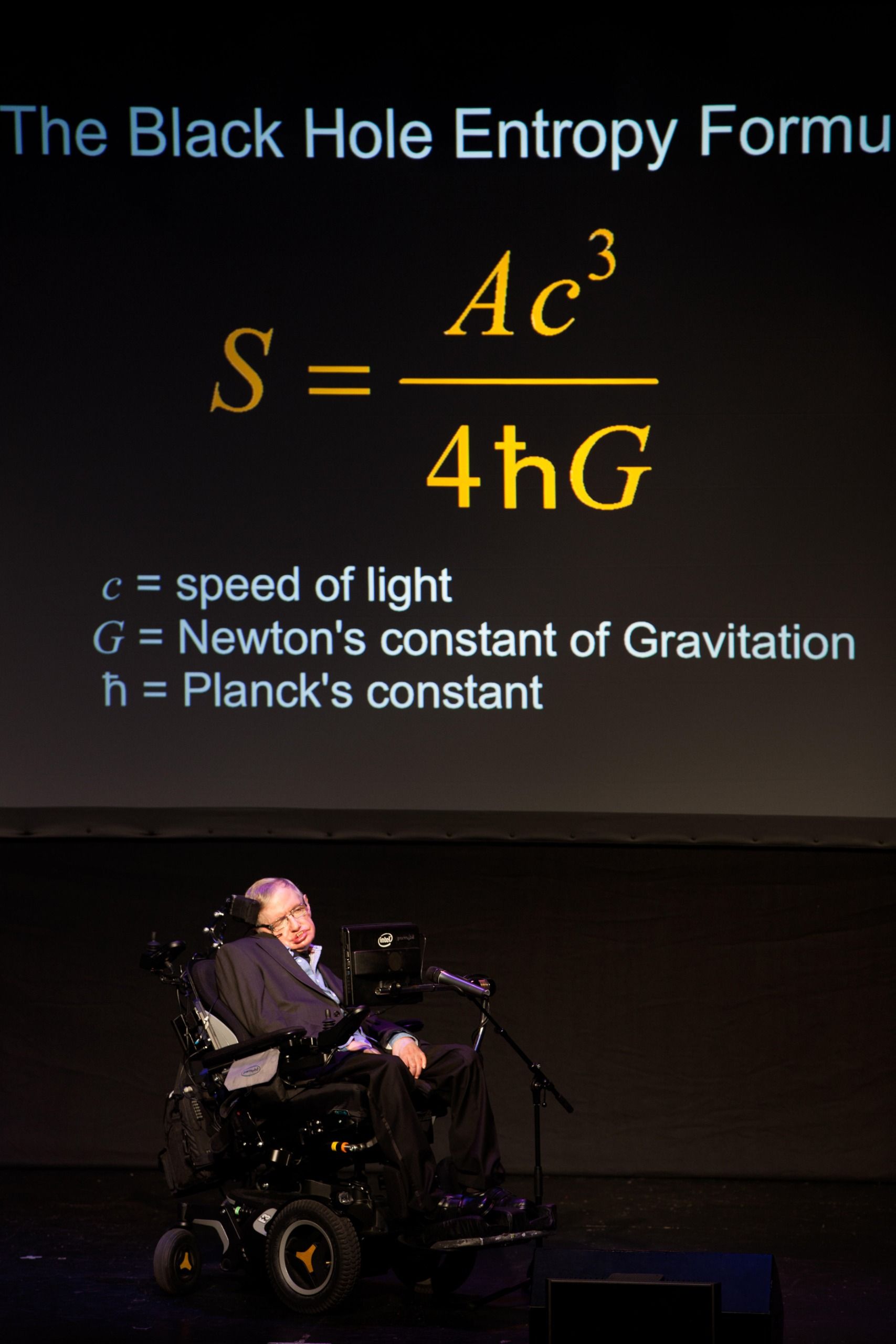
But a black hole's entropy scales not with the three-dimensional volume enclosed by it but with the two-dimensional area of its event horizon, the point beyond which nothing, not even light, can escape. Therefore, it's possible that all the information within any region might somehow be stored on its boundary. This became known as the holographic principle, named after a hologram, in which a 3D image is encoded on a 2D surface.
In 1997, theoretical physicist Juan Maldacena made the idea mathematically precise. He showed that a higher-dimensional theory containing gravity could be mapped onto a lower-dimensional quantum theory without it.
The two descriptions appeared to be interchangeable, equally valid views of reality. But some researchers now go further: They think the lower-dimensional quantum theory may be the fundamental description, while the higher-dimensional space-time we seem to live in is what emerges when its information is decoded.
These ideas gave rise to holography. Its central principle is that a gravitational world in more dimensions may be completely encoded by a quantum theory without gravity in fewer dimensions. That lower-dimensional theory lives on the boundary of the higher-dimensional spacetime.
You should think of the lower-dimensional thing as being what's most real
Mark Van Raamsdonk, professor of physics at the University of British Columbia
Mark Van Raamsdonk, a professor of physics at the University of British Columbia, compares the concept to a computer's memory chip. At the fundamental level, a video game is encoded in physical bits switching between states. Yet on a screen, those bits produce a representation of a 3D world containing objects, movement and physical rules. The virtual world seems spatially real, even though its underlying information is stored very differently.
"You should think of the lower-dimensional thing as being what's most real," Van Raamsdonk told Live Science.
Quantum entanglement may play a central role in how this lower-dimensional information gives rise to higher-dimensional space-time. It describes how particles can share linked quantum properties, even when separated by vast distances.
"If I want to decode what space-time geometry is being stored by the quantum state of this lower-dimensional system, all I need to do is probe this entanglement structure," Van Raamsdonk said.
For decades, directly testing this theory appeared hopeless. Physicists thought they would need particle collisions approaching the Planck scale — the fantastically high energy at which quantum effects are expected to become as important as gravity, and far beyond anything existing colliders can produce.
But physicists realized they don't need to rely on brute force. They are now developing several ways around that energy barrier.
Quantum gravity in the laboratory
How could scientists discover whether space-time has a deeper structure? One way is to search for a subtle jitter, or static hum, in space-time itself. Experiments such as GQuEST, a collaboration involving Fermilab and Caltech, and QUEST at Cardiff University in the U.K. split laser light along different paths and recombine it. Extraordinarily small changes in the distance light travels may reveal fluctuations, arising from discrete building blocks of space-time, that are consistent with some of holography's models.
In some holographic models, physicists represent the underlying units of information as quantum bits (qubits) — mathematically identical to those used in quantum computers. Physically, a computer qubit may be encoded in an ion or electrical circuit, whereas a qubit in a holographic model represents a possible microscopic unit of the quantum theory from which space-time emerges. This equivalence allows quantum processors to simulate space-time models.
In such models, the patterns of entanglement between the qubits dictate the physical distances between regions of space. The stronger those entanglements are, the closer together two corresponding regions are; if the entanglements are severed, the space-time between them tears apart.
QUEST compares measurements from two neighboring laser beam splitters, or interferometers. Some theoretical models predict quantum fluctuations of space-time that would affect both instruments in a related way. Researchers therefore search for matching fluctuations in their measurements while working to rule out shared sources of laboratory noise. Finding the predicted pattern could support those models; finding nothing would constrain how strong such fluctuations could be, killing off flawed models and refining how microscopic components (or chunks of information) translate into space-time's geometry.
Atom interferometers such as AION and MAGIS-100 extend the search for quantum jitters by using atoms as sensitive probes. When a laser pulse hits an atom, the atom enters superposition, in which it is simultaneously in two different locations at once. It then travels along two separate paths before being recombined by a final pulse. If space-time fluctuates slightly differently along one path than the other, a measurable shift is detected in the atom's interference pattern.
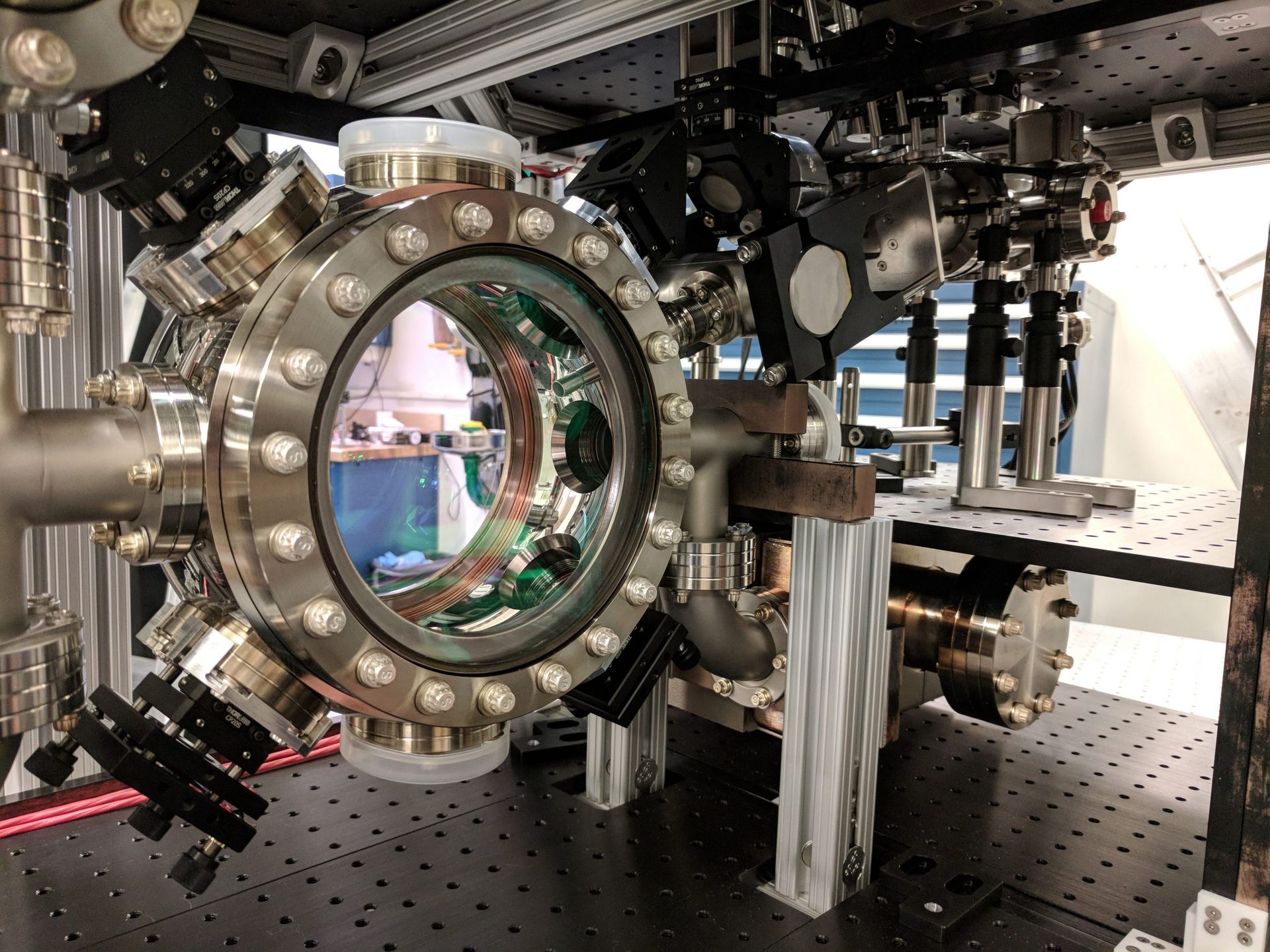
Another approach called BMV experiments (after the surnames of their independent developers Sougato Bose and his collaborators, Chiara Marletto and Vlatko Vedral) take diamond nanocrystals weighing around a hundred-billonth of a kilogram and place them into a state of quantum superposition.
Painstakingly shielded from every possible electromagnetic and nuclear interaction, and placed at different distances from one another, the diamonds are put through a key test. If they emerge from the experiment with the electron states entangled, then gravity alone produced the entanglement.
That would be evidence that gravity can transmit quantum effects — something a classical gravitational field could not produce. And if gravity (the curvature of space-time) can exist in superposition, it could be a strong clue that space-time's geometry is woven out of quantum information. The challenge, so far, is in excluding all the other effects that may obscure the signal.
On cosmic scales, future gravitational wave observatories — including the Laser Interferometer Space Antenna, the Einstein Telescope and the Cosmic Explorer — could scrutinize gravity at the first clues' source: around black holes. After two black holes merge, the resulting object settles down by emitting gravitational waves with characteristic frequencies and decay times. Einstein's theory makes precise predictions for this "ringdown," allowing researchers to search for discrepancies.

Such discrepancies could potentially point to the quantum nature of space-time near black holes. Interpreting them would require distinguishing between competing explanations — an unexpected signal could cryptically hint at space-time's underlying nature, but it wouldn't reveal a direct picture of its microscopic ingredients.
To identify the bits that make up the reality beneath space-time, scientists are also turning to quantum computers. By entangling many qubits in specific ways to mimic different models of emergent space-time, scientists could determine which mathematical models of the constituent bits are more likely.
"The study of many-body, highly entangled systems is where the future of this whole enterprise is," Forshaw said.
Precursor tests are already underway. In 2022, for example, Google's Sycamore quantum processor was used to reproduce the behavior of a simple theoretical wormhole — not by creating a real hole in space-time but by arranging nine qubits so that their behavior could also be described using gravity.
Earlier this year, researchers went further, using the trapped-ion quantum computer IonQ Forte to test how something resembling gravitational geometry could emerge from patterns of quantum information. The qubits in Forte were arranged into a model that could be interpreted in two connected ways: both as a network of quantum information and as a simple holographic geometry. The researchers then altered the entanglement between the qubits. In the model’s gravitational interpretation, this was akin to adding mass. Just as adding mass bends Einstein's space-time, the researchers expected changing the entanglement to alter the corresponding geometry — and it did.
The findings demonstrate that researchers can study a mathematical relationship between entanglement and geometry using quantum hardware. However, they do not establish that our space-time emerges from lower-dimensional quantum information.
"The experiment that we did is a baby step in that direction," Crystal Noel, an experimental physicist at Duke University who led the experimental side of the project, told Live Science. One limitation of this result is that it reproduces features of a simplified, static theoretical universe, rather than the expanding universe in which we live. Testing a more realistic model of the universe might require entangling 100 or 200 qubits, which may be possible in the near future.
Each of these experiments will probe different aspects of the relationship between gravity and quantum physics, although none would by itself prove that space-time emerges from information. Taken together, however, their results could begin to reveal what theories of quantum gravity match the real world — and whether emergent space-time is among them.
Such a discovery would raise profound questions not only about the universe’s foundations, but about what it means for anything — including ourselves — to exist within it.
"If I tell you that space doesn't exist, it really questions what it means to be," Forshaw said. "How can you actually talk about things when there's no space to put things in?"
Help us improve Live Science Pro: We're always trying to make our content better. Leave us feedback about Pro here.


 Bengali (Bangladesh) ·
 English (United States) ·