
 28 minutes ago
4


Wall Street’s AI sell-off has produced a familiar confrontation: investors worried that an extraordinary spending boom is running into political and financial limits, and major brokerages arguing the market has become too pessimistic.
Morgan Stanley and UBS called last week’s rout overdone, Reuters reported on November 9. Their argument is that tougher scrutiny of data centres need not derail demand for artificial intelligence infrastructure. The next earnings releases will test whether that distinction holds up.
For investors, the disagreement is consequential. A slower construction schedule could reduce immediate spending pressure. It could also delay revenue while borrowing costs keep accumulating. The same delay can look manageable from a long-term demand forecast and painful from a company’s cash-flow statement.
Why Wall Street says the AI sell-off went too far
Morgan Stanley’s interpretation, according to Reuters, is that some projects could move from 2028 into 2029 rather than disappear. Its analysts argued that a longer investment cycle could ease supply-demand imbalances and improve the credit outlook.
The bank recommended “buying the drop.” HSBC also said it was increasing equity exposure following the correction, while UBS argued investors had become too negative on political risk, credit risk and AI spending.
That is a case for reassessing expectations, rather than evidence that every company caught in the decline is inexpensive. Demand for computing, the price paid for a stock and the cost of financing a data centre are separate questions.
The argument also puts more weight on delivery. Investors will need companies to turn spending commitments into usable capacity, customer payments and a credible path through their financing obligations.
The political backlash is real
There is a substantive policy dispute behind the market anxiety. Reuters reported on November 6 that Democrats plan legislation addressing data-centre electricity costs, independent testing of advanced AI systems and corporate liability when products cause harm.
Senator Chuck Schumer identified protection from higher energy bills as a priority. Representative Lori Trahan’s plans include independent evaluations of leading models and clearer liability rules, according to the report.
President Donald Trump’s opposition creates a significant obstacle to passing restrictions. Yet dismissing the entire political risk would also go too far. Committee control can increase pressure through hearings and demands for information, even when legislation stalls.
“The probability of legislation is much higher than people anticipate,” Raymond James policy researcher Ed Mills told Reuters.
The distinction for shareholders is between a campaign promise, a proposed bill and a binding rule. They have different implications for project schedules and costs. A market repricing based on the most restrictive possible outcome may overstate the danger; one that assumes no change may understate it.
CoreWeave provides a near-term test
CoreWeave has scheduled its third-quarter earnings call for November 10 at 5 p.m. US Eastern. The AI cloud provider offers a more immediate test of infrastructure economics than a distant estimate of total AI demand.
Its second-quarter results show both sides of the debate. Revenue rose to $2.575 billion from $1.212 billion a year earlier, while adjusted net loss widened to $567 million from $130 million. Adjusted net loss is a non-GAAP measure.
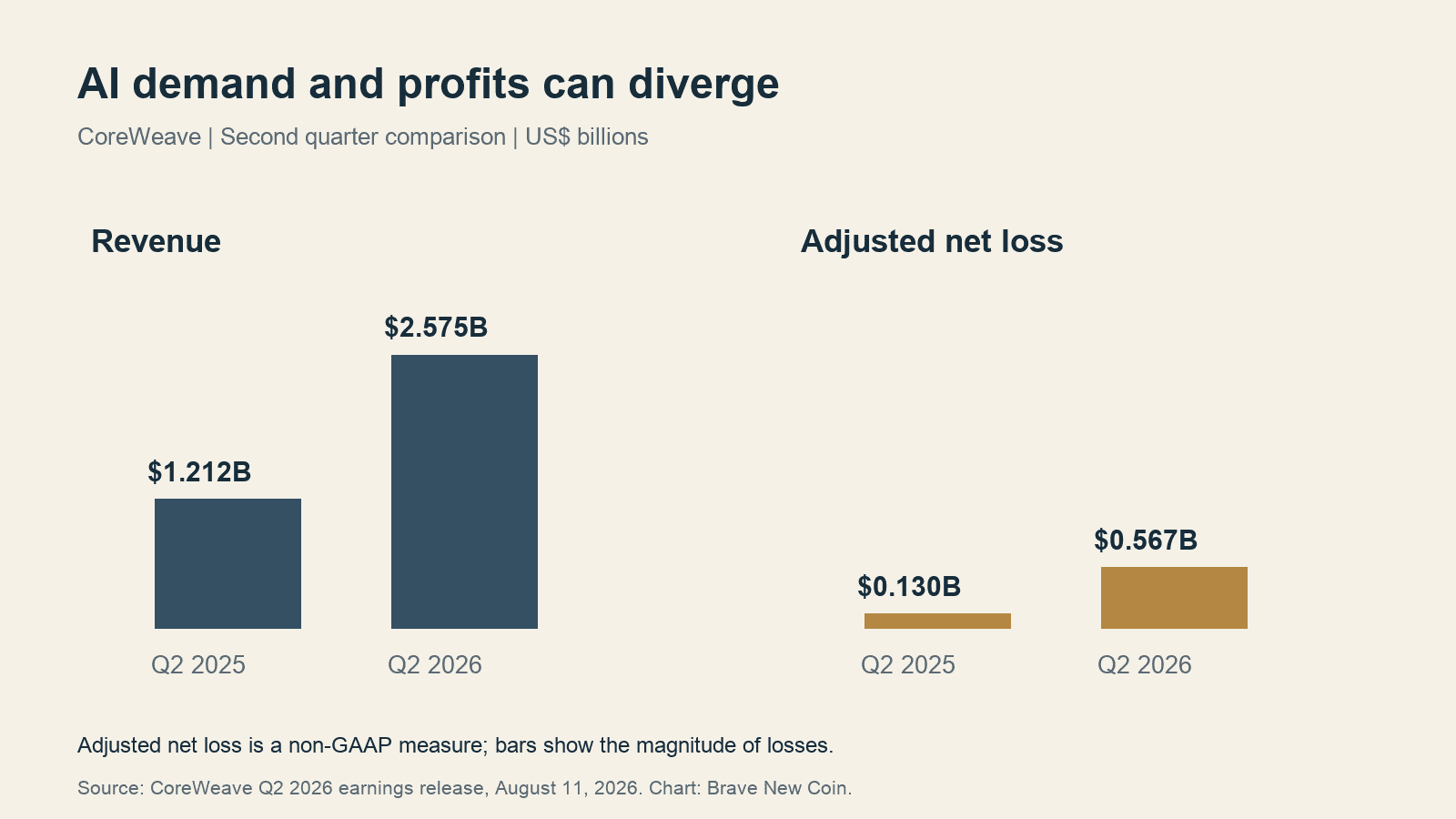
Chart: Brave New Coin, using CoreWeave’s Q2 2026 release. Adjusted net loss is a non-GAAP measure; loss bars show magnitude.
CoreWeave also reported approximately $104 billion of revenue backlog at June 30. The company says that measure includes committed customer contracts whose recognition depends on delivery and service availability. A large backlog therefore offers visibility into potential revenue, without being cash already collected.
Investors will be looking for the pace at which that demand becomes revenue, the cost of bringing capacity online and the terms on which expansion is financed. Strong growth can coexist with substantial losses; an earnings beat does not automatically settle the funding question.
Power and financing can change the story
The infrastructure boom is also becoming a power-supply story. BNC’s coverage of Anthropic’s energy commitments and IPO valuation pressures illustrates how electricity access and the price investors will pay for AI growth are increasingly connected.
Companies can have willing customers and still encounter limits on available power, equipment or construction. Each obstacle matters because expensive infrastructure must be funded before it produces its full return.
Investors should also distinguish a delay that allows suppliers to catch up from one caused by customers withdrawing demand. The first may spread spending over a longer period; the second can undermine the revenue assumptions used to justify the investment. Management explanations, changes in delivery schedules and the terms of new contracts will matter more than treating every postponement as either healthy or disastrous.
The interest-rate backdrop offers limited comfort. The Federal Reserve held rates at 3.75%–4% in October, but two policymakers preferred an increase. That leaves financing conditions as a live part of the AI investment debate.
What would justify the optimism?
The bullish case becomes stronger if companies sustain demand, bring projects into service and demonstrate that financing remains manageable. Evidence of cancellations, repeated delays or worsening funding terms would support a more cautious interpretation.
The brokerages have made their call. The useful question now is whether the next company disclosures support it. A recovery in share prices can arrive quickly; proof that the underlying economics are improving takes numbers, execution and time.




 Bengali (Bangladesh) ·
 English (United States) ·