
 3 hours ago
2
3 hours ago
2 
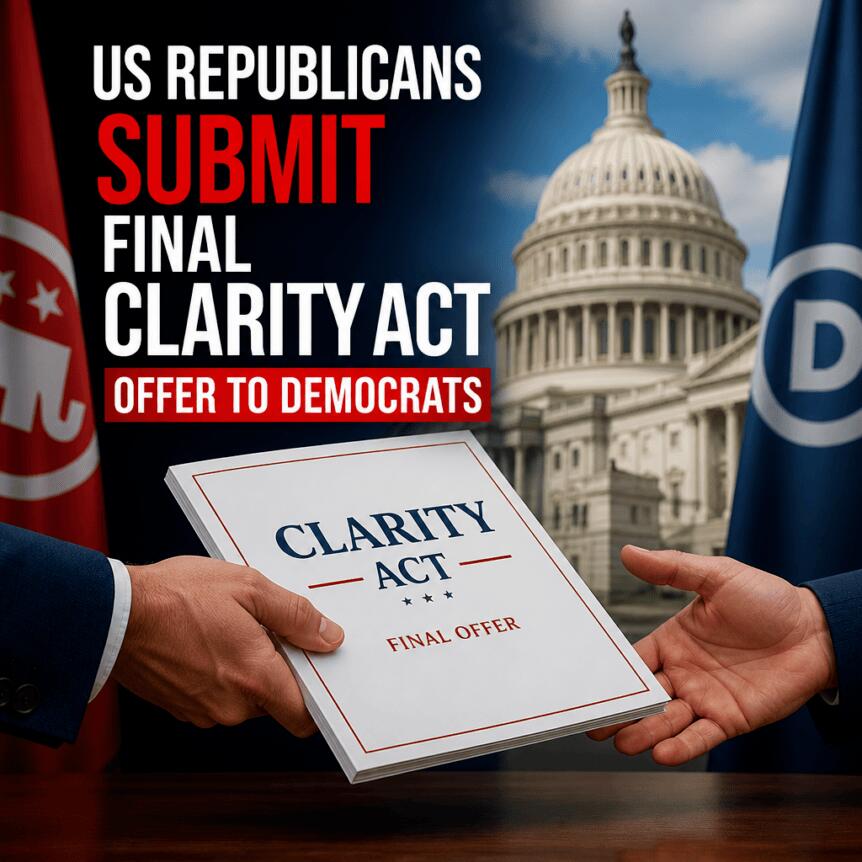
US Senate Republicans have released revised text of the CLARITY Act, aiming to win Democratic support ahead of a procedural vote scheduled for Tuesday at 2:15pm ET. The updated 635-page proposal, led by Senate Banking Digital Assets Subcommittee Chair Cynthia Lummis along with Chairs John Boozman and Tim Scott, makes notable changes to ethics rules for federal officials and expands related provisions touching stablecoin rules and the Blockchain Regulatory Certainty Act (BRCA).
The bill’s timing is close: the procedural vote is intended to determine whether the Senate can move the measure toward floor consideration. Republican aides have characterized Sunday’s release as a “final offer” to Democrats, signaling a last round of adjustments before lawmakers decide whether the text can advance.
Key takeaways
The revised CLARITY Act includes new ethics provisions that would restrict federal officials and their spouses from holding or engaging in certain significant digital-asset financial interests. State attorneys general would gain enforcement authority for those ethics-related restrictions, including rules against exchanges listing assets that violate the bans. Civil penalties in the ethics framework could reach $500,000 or 20% of the amount received in a prohibited transaction, whichever is greater. The updated BRCA would extend “safe harbor” style protections beyond prior exclusions to cover miners and validators, while removing references tied to unlicensed money-transmitting offenses. Stablecoin-related provisions would require Treasury to introduce restrictions on certain rewards if community banks are losing deposits at a substantial scale, with that authority set to expire 18 months after enactment.Ethics provisions become the centerpiece of the final text
In explaining the revised draft, Lummis said the current language reflects a year of bipartisan negotiations and includes 126 changes made at the request of Democrats. Her statement also asserted that the ethics changes had been agreed to by President Donald Trump.
According to Lummis, the revised ethics rules are designed to address government participation in the digital-asset sector. Under the new framework, state attorneys general would be able to enforce prohibitions on covered federal officials—along with their spouses—issuing, sponsoring, or holding significant financial interests in digital assets, along with related restrictions connected to exchanges listing assets that would be in conflict with those bans.
The text also requires covered individuals to either divest significant financial interests or place them into a “qualified blind trust.” Penalties for violations are set at either $500,000 or 20% of the amount received in the prohibited transaction, whichever is greater. The ethics provisions are scheduled to take effect 360 days after enactment, though they could begin earlier if implementing regulations are finalized.
The procedural vote timing suggests the ethics overhaul is intended to reduce political friction around the bill’s advancement. If the Senate permits the measure to move forward, this would mark a shift from earlier drafts toward a tighter government-conflict approach that may be central to how Democrats evaluate the bill on the merits and on governance concerns.
Stablecoin yield rules: Treasury gets conditional authority
The revised proposal also revisits stablecoin oversight. Lummis said the Treasury Secretary would be required to develop rules limiting rewards, if Treasury determines that community banks are losing deposits on a substantial scale.
Importantly for industry participants, this authority would not be permanent. The power to impose those restrictions would expire 18 months after the bill becomes law, meaning any yield-related stablecoin restrictions would be time-bound unless Congress acts again or the rulemaking process produces continuing effects under other legal authorities.
For stablecoin issuers, exchanges, and other intermediaries, the key practical question will be how Treasury defines “substantial” deposit loss and what enforcement mechanism accompanies any reward limits. The bill text’s narrow trigger suggests targeted intervention rather than a broad, immediate crackdown, but the short expiration window may still concentrate risk and uncertainty into a relatively limited regulatory period.
BRCA revisions broaden protections for infrastructure actors
Beyond ethics and stablecoin provisions, the Senate’s updated CLARITY Act text modifies the BRCA. Lummis indicated the revised BRCA would keep protections intended to prevent developers from being treated as money transmitters or financial institutions under the Bank Secrecy Act.
In a change from earlier versions, the revised BRCA would extend those protections to miners and validators—groups previously excluded. That expansion matters because it shifts how certain participants in blockchain infrastructure might be evaluated under US anti-money-laundering and related compliance frameworks. While the precise boundaries of any safe harbor will depend on the final statutory language and follow-on rulemaking, the explicit inclusion of miners and validators is a significant narrowing of the government’s ability to characterize them as regulated financial intermediaries.
The updated BRCA would also remove references to Section 1960 of Title 18 of the US Code, which addresses prohibitions on unlicensed money transmitting businesses. Removing those references could affect how existing criminal and compliance interpretations are applied alongside the new regulatory structure described by the bill.
In addition, the revised proposal is described as including other changes aimed at conflict-of-interest and trading safeguards at digital commodity exchanges, brokers, and dealers, along with clarifying how consumer protection laws apply in the digital-asset context.
What happens next for the Senate
With Tuesday’s procedural vote approaching, the revised CLARITY Act text becomes the immediate focus for lawmakers assessing whether the Senate can move toward broader consideration. The most closely watched elements likely remain the ethics enforcement model—particularly the role of state attorneys general and the scope of the divestiture or blind trust requirement—as well as the BRCA’s expanded coverage for miners and validators and the time-limited stablecoin reward restrictions tied to Treasury’s community bank deposit findings.
This article was originally published as US Republicans Submit Final CLARITY Act Offer to Democrats on Crypto Breaking News – your trusted source for crypto news, Bitcoin news, and blockchain updates.




 Bengali (Bangladesh) ·
  English (United States) ·