

The price of Uniswap (UNI) rose to $9.05 on September 18, 2026, a gain of 18.67 percent within 24 hours and of 48.8 percent over a week. Two things lie behind the jump that have nothing to do with each other and yet coincide on the same day: a rebuild of the protocol's fee logic that has been running for months and burns UNI by design, and an exemption granted by the US securities regulator the day before that lets tokenised stocks into automated trading pools for the first time. Which of that matters to you depends less on the price than on three practical questions: where you can buy UNI in Germany in a compliant way at all, how the tax office treats a swap on a decentralised exchange, and what you actually hold as a holder.
The UNI price at a glance: these are the figures currently on the screen
All the values that follow come from our own query of the CoinGecko API on September 18, 2026 at 20:51 UTC. UNI is quoted at $9.05, or 7.87 euros. Over the past 24 hours the high was $9.39 and the low $7.52. That is a range of around 25 percent within a single day, and it says more about the state of the market than the closing level does.
Over seven days there is a gain of 48.8 percent, over 30 days one of 155.59 percent. Market capitalisation stands at $5.62 billion, which puts UNI in 21st place among the largest crypto-assets. Trading volume over the past 24 hours was $2.13 billion. There are 621.0 million UNI in circulation out of a total of 888.2 million.
One figure is missing from most reports of the day, and it puts the rest in perspective: UNI's all-time high is $44.92 and dates from May 2, 2021. At the current level that is 79.9 percent away. This week's jump is therefore a strong recovery out of a very deep valley, not a return to old record levels.
Why the daily range matters more than the daily gain
Anyone who bought today at the high of $9.39 and sells tomorrow at the low of a similar day loses around a fifth without anything having changed in the news. With moves of this magnitude, the moment of entry within a single trading day decides more money than the entire fundamental story. That is no argument against buying, but it is an argument against a market order at the peak of a move.
What the fee switch at Uniswap actually does
The term fee switch describes a switch in the Uniswap protocol with which holders of the UNI token can decide by vote that part of the trading fees flows to the protocol itself instead of remaining entirely with the liquidity providers. The switch has existed since the launch of Uniswap v2 but was turned off for years.
The specific split is described in the proposal named UNIfication, which Uniswap Labs and the Uniswap Foundation published on November 10, 2025. For v2 pools the fee for liquidity providers falls from 0.30 to 0.25 percent, with the remaining 0.05 percent going to the protocol as a protocol fee. Anyone providing liquidity therefore earns slightly less per trade after the change than before.
On top of that comes a one-off item: a retroactive burn of 100 million UNI from the protocol's treasury. The amount is an estimate of what would have been burned had the fee switch been in force since the token launched. A burn is the permanent disabling of tokens by sending them to an address from which nobody can ever move them again.
Uniswap governance voted on the proposal. According to CoinDesk reporting of December 26, 2025, the result was practically unanimous, with more than 125 million votes in favour and 742 against. The changeover has been proceeding step by step since then: according to the UNIfication document, the feeds for v2, v3 and Unichain are in operation, while the connections for v4, aggregator hooks and the bridges to further networks are still open and have to pass governance individually.
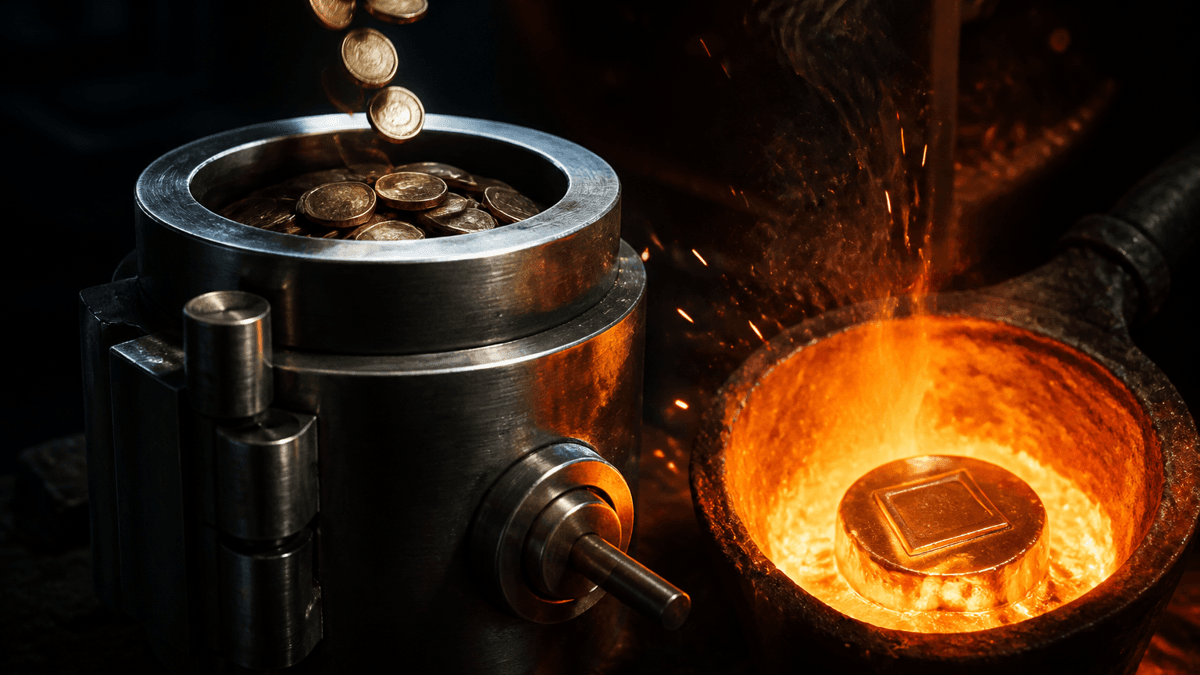 Fees accumulate in a contract, and they are only taken out in exchange for burned tokens.
TokenJar and Firepit: why fees only come out against burned UNI
The mechanism behind it is unusual enough to be worth knowing before you credit the token with a valuation. The fees collected do not land directly in a till that somebody could draw on. They flow into an immutable contract named TokenJar and accumulate there.
They can only be taken out through a second contract named Firepit, and exclusively in exchange for the destruction of UNI. Anyone who wants the accumulated fees has to burn tokens for them. The circulating supply therefore falls to the extent that the protocol earns fees and somebody collects them.
For the valuation of the token this is the real difference from before. A pure governance token entitles the holder only to vote, and voting has no calculable value. A token whose circulating supply shrinks with the use of the protocol, by contrast, can be modelled like a security with a buyback programme. That is precisely why the market has valued it 155 percent higher over the past 30 days.
What this model does not deliver
A burn is not a distribution. No money flows to you, and you have no claim to anything. The value arises purely arithmetically from the fact that fewer tokens represent the same protocol value. If usage falls, the effect disappears immediately, without any notice period. Ethena operates a comparably built model for its ENA buyback; there, too, the entire effect hangs on the protocol's ongoing revenue.
The SEC exemption for tokenised stocks and what it has to do with Uniswap
The second trigger dates from September 17, 2026. The US Securities and Exchange Commission issued an exemption which its own announcement calls an innovation exemption. The core of it: trading venues for tokenised securities may trade tokenised US stocks through automated market makers and liquidity pools for five years without counting as an exchange within the meaning of the Securities Exchange Act of 1934.
An automated market maker, AMM for short, is a program that forms prices from the inventory of a liquidity pool according to a fixed formula and manages without an order book. Uniswap is the best-known representative of this design, which is why the market reads the decision as a tailwind for precisely this business model.
The exemption comes with conditions. It includes caps on the number of tradable symbols and on volume, requires auditable smart contracts, synchronised trading halts, public announcements, record-keeping duties and technical safeguards. Holders of tokenised stocks are to have the same rights as holders of the original share. Liquidity providers who put their own capital into such pools are at the same time exempted from the duty to register as dealers. The SEC combined the arrangement with a request for comment.
For you as an investor in Germany little follows from this for now. The exemption applies to US trading venues and US stocks under US law. It opens no access for you and changes nothing about your tax position. How a tokenised security is treated for tax here depends on its specific structure and should be clarified in advance if in doubt. What the SEC decision actually moves is the expectation of future trading volume on AMM infrastructure. Expectation is the right word for it: volume that does not yet exist generates no fees yet either, and without fees nothing burns.
Our own count: this is how large Uniswap's share of DEX trading really is
On days like this, market share figures circulate that hardly anyone recalculates. We therefore counted for ourselves. cryptoticker.io compiled this analysis itself on September 18, 2026.
Method: query of the public DefiLlama interface for the overview data set of decentralised exchanges on September 18, 2026 at around 20:55 UTC, HTTP status 200, followed by summing the 24-hour volumes per protocol. All 1,365 protocols listed in that data set were checked.
Result: the total 24-hour volume of all recorded decentralised exchanges was $10.06 billion. Of that, $3.06 billion fell to Uniswap across all versions, split into 1.64 billion on v3, 1.36 billion on v4, 56.2 million on v2 and $103,641 on v1. That gives a share of 30.44 percent. The next largest single competitor in the data set came to 5.42 percent.
Uniswap is therefore by a clear margin the largest decentralised exchange, but it does not hold a majority of total volume. Almost 70 percent of trading runs elsewhere, spread across a great many small venues. Anyone basing a valuation on the assumption that Uniswap captures the lion's share of DEX trading is calculating with too large a slice of the cake.
What this count cannot deliver: it rests on the figures of a single data provider, it does not capture centralised exchanges, and it cannot strip out artificially inflated trading volume. An independent check against a second source is outstanding.
 The US regulator is opening tokenised stocks to automated trading pools, but only under conditions and only in the United States.
Buying UNI from Germany: regulated exchange or directly onchain
There are two routes, and they differ in almost every respect. The first runs through a centralised exchange with an authorisation under the EU Markets in Crypto-Assets Regulation, MiCA for short. That authorisation obliges the provider, among other things, to separate client assets from its own assets, to operate complaints procedures and to publish an information sheet for the crypto-asset concerned. Which providers hold this authorisation for the German market can be found in our continuously maintained overview of the best crypto exchanges.
The second route leads straight to the protocol, that is, into the wallet and into a pool. There is no provider there who is liable for anything. There is no deposit protection, no support, no reversal in the event of a mistake. If you send to a wrong address or hit a cloned contract, the money is gone. In exchange you get direct access with no intermediary, and your tokens sit in your own custody.
How to recognise a cloned interface
The most common damage on the protocol route arises not from price losses but from fake trading interfaces that rank high in search engines. Check the address of the contract your wallet is to work with before you sign an approval, and never grant an unlimited spending allowance for a token when you only intend a single swap. The same applies by analogy to trading venues without EU authorisation: where no regulator has jurisdiction, there is also no body you could turn to in a dispute.
Tax on UNI: why every swap is a sale in Germany
This is the point at which a rally of 155 percent in 30 days can become expensive. Crypto-assets count as other assets in Germany. Gains from their sale fall under private disposal transactions within the meaning of Section 23 of the Income Tax Act. If more than a year lies between acquisition and disposal, the gain is tax free. If it is less, it is taxable at your personal income tax rate as soon as the sum of all private disposal gains in a year reaches the exemption threshold of 1,000 euros.
The decisive term is disposal. Swapping one crypto-asset for another is, for tax purposes, a sale of the first and an acquisition of the second. Anyone swapping Ether for UNI on a decentralised exchange has thereby sold the Ether, even though no euro ever moved. Swapping back later is another sale. With several switches inside a week, twenty tax-relevant events quickly arise, none of which appears on a bank statement.
Unlike at a German broker, nobody withholds tax. There is no capital gains tax at source and no annual statement. Working out the figures and declaring them in the Anlage SO is entirely down to you, as is the duty to provide evidence. Anyone not recording the transactions as they happen reconstructs them laboriously from transaction hashes later. Tools that automate exactly that and track holding periods for each individual lot are compared in our comparison of crypto tax tools.
The special case of providing liquidity
Anyone putting UNI or other tokens into a pool does more than hold. They generally swap them for proof of a share in the pool and receive a running share of the fees. The tax treatment of these events has not been conclusively settled on points of detail to this day, and the classification of the income depends on the specific structure. If you are considering this step, that is the point at which tax advice pays for itself, and before you act rather than after.
Governance and custody: what you actually hold as a UNI holder
UNI is a governance token. It carries a voting right in the protocol's votes and nothing else. No claim to profit, no pool of liability, no share in a company. Even after the switch to the fee switch, no income flows to you as a holder; the mechanism works through the reduction of the circulating supply.
In practice, a say means little for small holders. The vote on UNIfication passed with more than 125 million votes. Against a large address holding millions of tokens, a holding of a few hundred carries no weight. Anyone buying UNI is in practice buying a bet on the use of the protocol and on the effect of the burn mechanism, hardly on their voting right.
For custody the same applies as for any token based on a smart contract. If it sits on an exchange, it belongs to you in an insolvency only as the legal system of the provider concerned allows. If it sits in your own wallet, everything hangs on securing your recovery words. For longer holding periods, and the one-year holding period suggests a longer holding period, self-custody is the obvious choice.
What argues against the rally: three points that can be documented
First, the basis of the valuation. The burn mechanism only works as long as fees accrue. Our own count above shows a Uniswap volume of $3.06 billion in 24 hours. A decline in overall crypto trading drags that figure down immediately, and with it the arithmetical effect on the circulating supply.
Second, the scope of the changeover. According to the UNIfication document, the feeds for v2, v3 and Unichain are in operation, while v4, aggregator hooks and the bridges to further networks are still outstanding. v4 in particular contributed $1.36 billion of daily volume in our measurement. A considerable part of the trading therefore does not yet feed the mechanism, and every further step needs a governance vote of its own.
Third, the reach of the SEC decision. It applies for five years, under conditions, with caps on symbols and volume, and it is combined with a request for comment. Whether appreciable trading volume on AMM infrastructure arises from it is an open question. The price has priced in an expectation whose fulfilment will only be readable from figures in the coming quarters.
On top of that comes the obvious: an asset that has risen 155.59 percent in 30 days and whose daily range today was 25 percent can give a considerable part of that back in an equally short time.
Fee switch and the UNI rally: what you should take away
Separate the trigger from the mechanism. The SEC exemption of September 17 is an expectation of future volume, whereas the fee switch is a running mechanism with documented figures. Only the latter can be recalculated today. If you want to buy on that basis, do it through a provider with EU authorisation; which ones those are is in our comparison of regulated crypto exchanges. Settle the holding period before you swap. Every swap on a decentralised exchange is a sale with a period of its own. Set up your record-keeping before you trigger the first transaction, not next spring. The tools for it are in the comparison of crypto tax tools. Do not buy into the daily peak. There were 25 percent between today's low and high. An order split into partial amounts over several days costs a few fees more and takes precisely this risk out. Where those fees are lowest is shown by the comparison of the best crypto exchanges.(As of September 18, 2026. This article is not investment advice. Prices and fee structures change; check the terms with the provider before you buy.)
Primary sources: the UNIfication proposal by Uniswap Labs and the Uniswap Foundation and the SEC announcement on the innovation exemption of September 17, 2026.



 Bengali (Bangladesh) ·
  English (United States) ·