

What is rarer than discovering a "super-puff" planet with densities much (much) lower than those of the solar system gas giants? Discovering two orbiting the same star.
That is exactly what astronomers have done, finding two extrasolar planets, or exoplanets, that are super-puff siblings orbiting the same star. Both planets, designated TOI-791 b and TOI-791 c, have densities lower than that of cotton candy, making them the lightest exoplanets ever seen.
"Only a handful of these super-puffy planets are known, and it is even rarer to find two in the same system," team leader George Dransfield of Oxford University said in a statement. "Their extremely low densities make them fascinating targets for understanding how planetary systems form and evolve."
The two planets orbit a dwarf star called TOI-791, which is located around 1,110 light-years from Earth. Both planets are around the same size as Jupiter, but the solar system's most massive planet has a density 28 times greater than TOI-791 c and 35 times greater than TOI-791 b.
The low density of these exoplanets aren't their only remarkable quality, however. The super-puff siblings are also locked in a rare dance that sees the inner planet complete five orbits as the outer planet completes three orbits. This is known as a 5:3 mean-motion resonance.
As TOI-791 b and TOI-791 c complete this orbital tango, they gravitationally tug on each other, causing changes in their transits of their parent star, with transits representing the moments these planets cross the star's face from our vantage point. These transits are some of the longest ever seen, lasting 11 hours per planet, and were integral to discovering the worlds.
If you cross me....
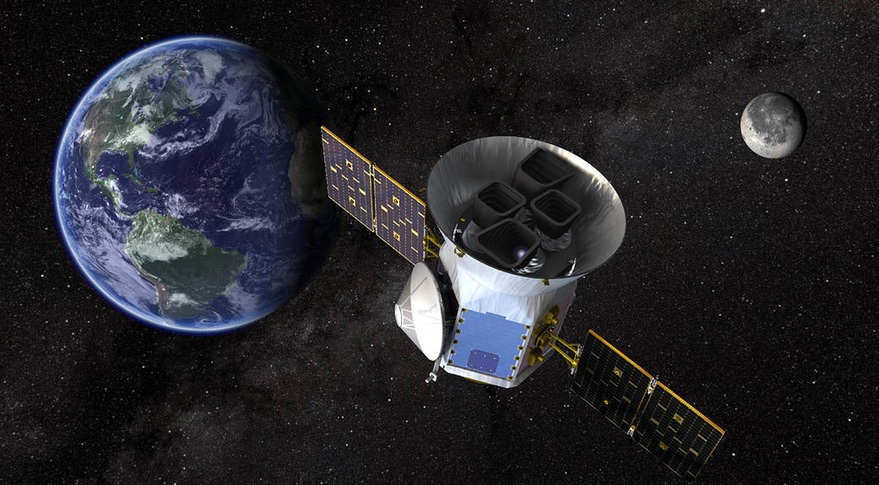
TOI-791 b and TOI-791 c were first identified as candidate planets in 2019 and 2023, respectively, when the Planet Hunters citizen scientist group assessed data from NASA's exoplanet-hunting spacecraft TESS (Transiting Exoplanet Survey Satellite).
TESS hunts planets using the transits they make of their host stars from its position around Earth. These planetary transits cause a tiny dip in light from the star that TESS can detect.
Dransfield and colleagues then measured the size and density of these planets using data from telescopes across the globe, including the ASTEP (Antarctic Search for Transiting ExoPlanets) telescope at Concordia Station in Antarctica, to discover the planets are rare super-puff gas giants.
The discovery could help solve the puzzle of how super-puff planets actually form. The prevailing theory suggests super-puff planets form in distant, cold regions in the disks of gas and dust that surround their parent stars. This allows gas to accumulate around small solid cores, leading super-puffs to gather vast atmospheres of hydrogen and helium.
Further investigation of TOI-791 b and TOI-791 c could help sort between this formation route and other birth mechanisms for super-puffs.
"This system offers a unique laboratory for understanding how super-puff planets form and evolve," team member Amaury Triaud of the University of Birmingham said in the statement. "We propose to carry out space-based observations using the James Webb Space Telescope to assess if the puffy atmosphere contains carbon, nitrogen, and oxygen-bearing species, revealing new insight into how these unusual planets formed."
The team's research was published on Thursday (June 25) in the journal Monthly Notices of the Royal Astronomical Society.





 Bengali (Bangladesh) ·
  English (United States) ·