

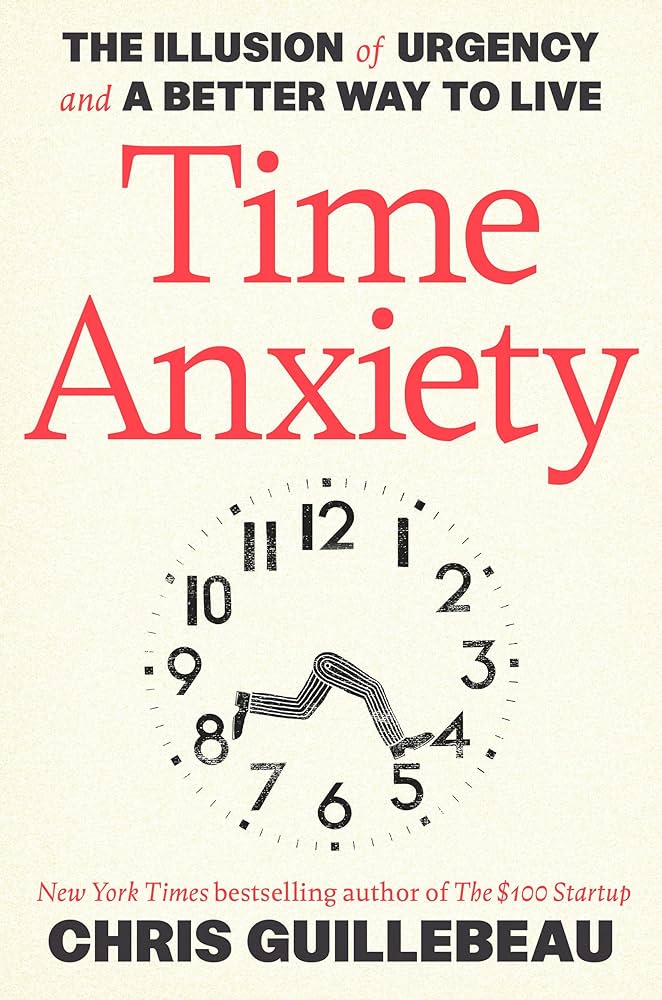
You know that feeling, like you’re forever running behind in work and life? That you’ll never finally be “there,” or be able to relax and enjoy things. Like the days are just collapsing into each other? Welcome to the wacky world of time anxiety. You are not alone.
Chris Guillebeau has spent fifteen years writing about the questions that keep smart, capable people stuck. He is back on the show to talk about his new book, Time Anxiety, the clearest thing he has written yet on why “get up an hour earlier” backfires and what actually helps.
In this conversation, you’ll explore:
Why your brain is chronically wrong about how much time anything takes, and the fifteen-minute fix for chronic lateness The eighth day exercise, a way to find out what you actually want to do with your time by imagining a day with zero obligation to anyone else The traffic light method for working with your real energy instead of fighting it Why swapping the word “productive” for “valuable” changes how a day feels The shame so many caretakers feel about carving out time for themselves, and the answer Gretchen Rubin gave Chris that changed how he thinks about itIf you’ve ever felt like your calendar is lying to you about how much time you have, this is the conversation for it.
You can find Chris at: Website | A Year of Mental Health Substack | Instagram | Episode Transcript
Next week, we’re sitting down with Dr. Fred Cohen to talk about why almost everything you’ve been told about migraines is outdated, and what the science actually says about treating them. Be sure to follow Good Life Project wherever you get your podcasts so you don’t miss any upcoming episodes!
Check out our sponsors and resources: Visit Our Sponsor Page
_____________________________________________________________________________________________________
Episode Transcript:
Jonathan Fields: [00:00:00] Ever feel like you never have enough time in your day? Tell me it’s not just me. Most advice about time comes down to one idea. Get more of it by getting up earlier, working faster, or squeezing your calendar tighter. What if that was a lie? What if doing those things actually stopped you from seeing what’s really going on and doing the things that truly gave you back time? Our guide today, New York Times best-selling author of Time Anxiety, Chris Guillebeau, says the anxiety you feel about time has almost nothing to do with how much of it you actually have. In this episode, you’ll discover why your brain is chronically wrong about how long anything takes, and the 15-minute fix for chronic lateness. The eight-day exercise that reveals what you actually want to do with your time. You’ll learn a simple traffic light method for working with your energy instead of fighting it. And the real reason get up an hour earlier backfires for so many people. And finally, why doing some things poorly on purpose might be the smartest decision you make all week. So excited to share this conversation with you. I’m Jonathan Fields and this is Good Life Project. And we’ll jump in right after this short break.
Jonathan Fields: [00:01:14] I feel like every couple of years you latch on to a topic. Oftentimes this is a topic which is deeply present in your own life. Um, something that you’ve struggled with, something that you’ve seen so many other people struggle with and you dive deep into it. You take generally a really contrarian view on a lot of these things too, and then ask the big question, how can I help? How can we actually approach this differently? The focus that you’ve been really digging into over the last chunk of years, and the focus of your new book, Time Anxiety, is what you term time anxiety? Take me into this. What are we actually talking about when we’re talking about time anxiety?
Chris Guillebeau: [00:01:53] I think we’re talking about a couple of things. One is the the fear of running out of time. So kind of the existential, there’s not enough time in my life for the things that I want to do. Uh, or there’s something I should be doing right now, but I’m not sure quite what it is. Or maybe I have some regret over something that I did or shouldn’t have done or should have done, you know, years ago. And now I feel like it’s too late. Um, and so I have this, this, you know, ever present anxiety and I don’t quite know what to do about it. And the other part is what do I do right now? Like, what do I do next? Um, you know, of all the things that I could be doing, how do I actually not just structure my day, but just make some decisions and, you know, I feel overwhelmed. Um, and it’s not so much a productivity problem. That’s how a lot of people try to approach or solve it. Um, and then if you go down that road, you end up getting really good at doing the wrong things perhaps. I’ve done that certainly in my life. Um, but it’s much more of how do we make choices, you know? How do we know what actually matters? How does how does what we do now connect to something that ultimately matters to us? And so you’ve got the existential kind.
Chris Guillebeau: [00:03:05] You’ve got the day to day kind. And I feel like this is just very, very common. And when I first came up with the phrase and, and started like just playing with it a little bit and just talking with people, I noticed that, uh, like it wasn’t just me, like almost everybody that I talked to, probably more than any other book that I’ve worked on, you know, in 15 years, just about everybody I talked to was like, I have that, you know, and maybe I have more of the first kind or more of the second kind, but like one way or another, I have that. And they started using some phrases that just were very common also. And, uh, I just talked to so many people and they would all say the same thing about like, this is, this is me all the time, or my friends and I talk about this, but we never had a name for it. Um, this is the defining problem of my life. Sometimes people would say. And so that’s why I was so interested in it, um, just from the perspective of studying it. But I also don’t come to it like intellectually, I come to it just from my own struggle in life. And, you know, how do I resolve this for myself?
Jonathan Fields: [00:04:03] Yeah. I mean, and I do think it’s so pervasive, certainly in my life. Um, you know, I remember, um, it was actually last year having conversations with Liz Gilbert who had asked me to write a piece for her, a wonderful Substack, letters from love. And you know, when you write a letter from love to yourself and the thing that just popped into my mind when I thought about what would I write about is this feeling of feeling like I’ve fallen behind in my own life. You know, like I had expectations when I was a kid, when I was in my 20s or 30s, like, this is where I would be, right? And, and now I’m, I’m in that season of time where like, I’m measuring like, have I, am I there? And I feel like, you know, I’ve just been perpetually behind and that the window of time that I have to quote, catch up. It’s closing. You know, like there’s less road ahead of me than there is behind me at this point in my life. Pretty. It’s pretty safe. Bet. So, um, is, is that sort of an experience that commonly would be folded under time anxiety?
Chris Guillebeau: [00:05:07] It is. And you know, the interesting thing is it, it doesn’t necessarily connect to a certain age. So that’s, that’s what’s interesting about it. There are 17 year olds who might say almost the same thing. They wouldn’t say the part about, you know, the number of years ahead of me versus behind me and such. But they would also say, I feel like I have missed something. Um, or I feel like it is too late for something. And so they have that sense of, uh, I just have this pressure in my life and like, how can I adjust and how can I move forward? And so for those of us who are who are not 17, you know, who are on the other side of it, it’s easy to say like, oh, that’s silly because, you know, the the world is their oyster. They can do so much and such, but it’s a very real feeling, you know, to have this, this sense of, what do what what do I do, you know, and, and how you know how what have I achieved or accomplished? And how does that measure up to what I hoped for? And, you know, if I’m to make some sort of adjustment, what what is that? Um, so I think it’s actually common among people of, of all ages.
Jonathan Fields: [00:06:07] Yeah. Is there a world in which time anxiety is good? And here’s what here’s why I’m asking, you know, um, there are a lot of folks who are experts in just generalized anxiety. And what they’ll often tell you is that anxiety is a natural phenomenon. Um, and that there’s value in anxiety, there’s fuel in anxiety, there’s a motivating or activating energy and anxiety. But then there’s a tipping point, you know, where it becomes dysfunctional actually stops you from being who you want to be and living the life that you want to live. Is there a corollary here with time anxiety?
Chris Guillebeau: [00:06:43] You know, a few years ago, I wrote this other book called The Happiness of Pursuit, which was about like my quest to go to every country, and then other people who had pursued all these different kinds of quests and such. And I kind of wanted to look at the commonalities, you know, between them, like all these different people. What do they have in common besides the fact that they pursued this quest? And one of those things was they tended to have what I called an emotional awareness of mortality. Mhm. Uh, which is not just, oh, I understand that everyone dies. Like that’s an intellectual awareness, but the emotional awareness is like, someday I will die. And that sense, you know, seemed to kind of urge them along, right. And nudge them towards action and get them thinking about what is this thing I want to do. And so I do think that there is a corollary to that in the sense of, okay, why do we ultimately feel anxious about anything? Um, well, you know, the one sentence distillation of it is because we are going to die. Right.
Chris Guillebeau: [00:07:42] Do we ultimately feel like, you know, time is running out? We worry that time is running out because time is running out. Like that’s the bad news, right? Um, but the, the good news is I think it’s actually very healthy to live with that emotional awareness of mortality. And it can urge you towards action and urge you towards maybe a realignment and thinking like, okay, what, what does matter? You know, if very few things matter, ultimately, in the end, what is on that short list and how can I spend more time doing those things and less time doing other things, but also just less time worrying about the other things, because it’s not always the doing of the things that causes the most anxiety. It’s the thinking about them. You know, I stress out a lot about my email and other communication, and I don’t actually spend a lot of time on it. I spend more time, you know, feeling regretful or feeling mad at myself for not responding to things. And I actually do responding to things. So I think learning to, to let go is helpful.
Jonathan Fields: [00:08:42] Yeah. Um, if somebody is experiencing somebody listening to this and like, I think I’m feeling this, but I’m not entirely sure. What are some of the things that people have said to you, like the scripts that they have in their head or the things that they’re saying to themselves when they’re experiencing this? So somebody might be able to say, oh yeah, that’s actually me. I’m going through this right now.
Chris Guillebeau: [00:09:02] It’s often a lot of physical symptoms. So it’s not just a feeling. It’s like, I actually feel like this tightness in my chest. You know, I feel like discomfort in my stomach. Maybe I have headaches. Um, maybe I’m dizzy. Um, and then, you know, just some like symptoms or characteristics of feeling depressed or anxious in general. Um, I just, I have panic attacks or I have symptoms of panic attacks. Maybe it’s not a full blown panic attack, but I just feel very disconcerted and I’m constantly trying to reset myself or regulate my nervous system. And I can fix it sometimes, you know, for, for a period or for a time, but then it’s always kind of looming, like it’s this thing that’s just always, always there. And so maybe I’m distracting myself, you know, maybe I, maybe I do find some purpose for a while, but then I kind of go back to this point of like, am I using my time? Well, am I doing this thing that I feel like I should be doing, but I don’t quite know what it is.
Jonathan Fields: [00:10:03] You mentioned earlier that there’s there are a whole lot of things that people try and do to, quote, fix this problem that tend to not be super effective. And I guess some of them probably even deepen the problem. What are some of the things that you see people turn to? Um, and then end up giving up on because they’re, they’re either not working or actually making it worse.
Chris Guillebeau: [00:10:25] I think there’s always this advice about just get up earlier, you know, just get up one hour earlier. And I think that’s problematic because it works for one day. Right? But you can’t like what if you’re already getting up early? First of all, you know what? If you already are not getting enough sleep, uh, you know, sleep deprivation is not a great, you know, long term strategy for pretty much anything. And so it’s not just that I feel like there’s a whole there’s a whole wave of these kinds of like tips and hacks and such, and even a good productivity system because I was like super into productivity for so long and like, you know, read all the books. And like, I was always trying different apps and lists and things. And I think those, those tools have a place, you know, but also, as I said, if you’re not careful, you get really good at doing the wrong things. Um, and ultimately these, all these tools and systems, they just, they just kind of create the, the potential for more and is more really what you need in your life. And also like there’s, there’s going to be more after that. It’s not like you’re going to reach a point where you’re like, okay, now I am more productive. Now everything is all buttoned up. No, you’ll just continue to, to make more and more. So I think the whole like productivity industrial complex is something that I was, I very much embraced for a long time and then kind of just have become more and more skeptical of, um, because I think like productivity without purpose, uh, is ultimately meaningless.
Jonathan Fields: [00:11:48] Yeah. I so agree with you. And I think, you know, we think that if we, if we dial in the system and then we get all the things checked on our list, then, oh, we have all this extra time in our day and we finally, we can do the things we want to do, and we can breathe and be spacious and meditate and hang out with our friends. And it’s been my experience. And like, I’m raising my hand because I do this all the time. I just fill that space with more stuff to do and not stuff that I’m like, excited to do or want to do or just like that gives me peace. I just like, okay, so now I’ve opened up two hours. How can I use that time productively now to and there’s a never ending, you know, like torrent of stuff that will flood into whatever time I open up with whatever system I’m using that the end of the day doesn’t make my experience of life better.
Chris Guillebeau: [00:12:34] Mhm. I think if you can, something I’ve tried to do is, is replace productivity with with value or just thinking of the word valuable as opposed to productive. And just asking myself not how can I use my time more productively, but how can I use my time in like, in a valuable way? How can I like one little trick I have is like from time to time, maybe like once or twice a day, I’ll like look back on the last 40 minutes and be like, what did I do the last 40 minutes? How valuable were my last 40 minutes? And so the valuable is the key word because it’s not just how productive, you know, like value can be found in a conversation with a friend. Value could be found in rest. Value could be found in going for a walk, anything that you choose to be valuable. But I think there’s also times where you could look back on your last 40 minutes and say, actually, it probably wasn’t that valuable. I’m not really even sure what I did. Maybe I was here at my desk and I presumably I spent that time somehow, but I couldn’t really tell you what it was. And so that’s just a little moment to be like, okay, well, what can I do for the next 40 minutes to find value? So not so much filling the space, always with productivity, although that’s okay too. But as you said, maybe just not making it the default all the time.
Jonathan Fields: [00:13:52] Yeah. It sounds like what you’re describing here though, is that understanding what we value, like what we hold dear, what we hold important actually is incredibly important when we’re making these decisions.
Chris Guillebeau: [00:14:04] I think it’s very important to know what that looks like for you. And the answer could be different for lots of people. I mean, I think you’ve done a lot of work, you know, on this question and come at it from different approaches and such. I think in general, a lot of people don’t really spend a great deal of time thinking about what they want. You know, what they want to get out of life, what they do value, you know, not just the buzzwords or the, you know, the five values from the list, but ultimately what is important to them given the fact that life is short, time is limited. You know, every every yes means we’re saying no to lots of things. And again, this is it’s an interesting thing because it can feel pressuring and it’s not I think there’s a way to make it not feel pressuring. I think that’s really key, you know, and like when I wrote this book, I was like, I have to find a way to write this book in a way that doesn’t actually make people anxious, you know? Right. This is the thing.
Jonathan Fields: [00:14:55] It’s like, I need to get through it so I can just find the facts and the information, then go do it. Right.
Chris Guillebeau: [00:14:59] Exactly. Like I’m even thinking like I’m doing a book tour and I’m like preparing for the, you know, I’m like writing. I’m like, how do I write the talk in a way that is actually going to provide some relief? You know, that’s the whole goal. The whole goal is to provide some relief, not just make people feel stressed out because they’re already stressed out. So yeah, I think, but I do think there’s a way to come at these questions in a way that, um, that provides relief.
Jonathan Fields: [00:15:22] And we’ll be right back after a word from our sponsors. Let’s dip into some of the ideas, like the big ideas that you tee up around time anxiety and also strategies sort of like, like how do we actually. Okay, so we’ve kind of spent some time on the problem and how it shows up in different people’s lives in my life and some of the things that come up. But let’s talk about what do we do about this? Um, one of the things, a concept that you float fairly early on in the book and the conversation is this notion of cognitive distortions. Um, take me into this.
Chris Guillebeau: [00:15:54] Yeah. Um, so I think first things first, for someone who is feeling overwhelmed, who has the, the sense of, you know, I’ve got this, this restlessness, this time anxiety, the first thing I think we need to do is, is like, give yourself time. However, you can give yourself the gift of time. I like to think of it like this, like wherever you can just kind of make some even short term decisions to kind of triage and, and notice what it feels like to actually give yourself time. So if there, if there are things on your calendar, like, can you look at your calendar for the next couple of weeks? Um, you know, can you take 1 or 2 items off and notice before you fill that space with something else, just kind of pay attention to how it feels to, to do that. Um, can you learn to maybe not do everything with excellence? And this is, this is hard for some people. You know, if you got straight A’s all the time, like, um, but I think it’s actually important to do some things poorly. You know, if you’re, if your laundry is not perfect, if the dishes are not perfect, uh, okay. You know, life goes on, right?
Jonathan Fields: [00:16:57] Well, I think I’ve mastered those things. Not, I mean, I’ve mastered not doing them in a masterful way.
Chris Guillebeau: [00:17:03] So you’ve got it. Um, so so when so, and then we can kind of dive into like, okay, what are the like cognitive distortions like these, this kind of thought processes or neurological patterns that we get into where it’s like, uh, you know, I am, I am not going to be okay. I’m not going to be able to fix this problem. Um, I was, I experienced like a small amount of rejection or like some minor rejection. And now this kind of takes over my life and personalizing it. I’m catastrophizing it. I’m like, this is the worst thing ever. I can’t go into the woods because there are bears in the woods. Like, it can prevent all kinds of, of, you know, of decisions. Um, and so when it comes to time anxiety, it’s like, I will, I will never solve this problem. Um, I, I am kind of condemned, you know, to like go through this all the time. And so maybe just thinking through like, where does this, where does this come from? And might there be a different story, you know, that we could tell ourselves? Maybe your story is like, yeah, you’ve had some struggles. Like this is the human condition, but are there not times in which you have one as well? Like, are there not times in which you have been able to figure things out? Um, and just kind of beginning to tell yourself a little bit of a different, um, a different story.
Chris Guillebeau: [00:18:12] Like I, I have, um, I have always had this very like negative internal monologue. Um, that’s very self-critical. And I guess for a while I thought like, I wasn’t sure if it was like everybody else has this or nobody else has this, you know, I don’t know what you think about this. But I always had this, like I was always being very critical of myself. And I learned something to do about that was I can’t always silence it. Like, it’s just, it’s just there. It’s been there for a long time. Um, but what I can do is kind of add to it and just add this counterpoint of, okay, well, you know, you have figured things out, so maybe you can figure this thing out too. And this, this thing did not go well, but that’s okay because here’s a few other things that have gone well. And you know, you’ve been here before.
Jonathan Fields: [00:18:58] Yeah. I mean, it sounds it sounds not too dissimilar to Byron. Katie’s the work, you know, just a few simple questions. One of them being, is it true? And like, what is the evidence that it’s true, you know, and is there a different story that we can tell about these exact same facts that we’re spinning about? Um, here’s my curiosity around this. I think we all deal with cognitive distortions. We kind of like, you know, there’s some objective circumstance out there. And then there’s the, the weirdness, the story that we spin about it, we distort it into, like you said, oftentimes these self-flagellating, um, stories, um, about the thing about our ability to do the thing about like, whatever it may be. And then the more we repeat it, the more it becomes like our reality. We think, oh, this is actually this is the circumstance itself. I love the sort of the interventions that you just offered up, like kind of like pulling back and saying, is there a different story we can tell about this? Here’s my curiosity around this, and it’s always been my curiosity around cognitive distortions, however you want to phrase them. Um, it’s about the moment before that because before we can actually do this, before we can do the intervention, we need to actually be able to notice that we’re in this cycle, that we’re telling this story that is distorting reality. Have how, how do you do that? Like, how do you catch yourself? Yeah. So that you can actually realize, oh, wait wait wait wait wait. Now let me actually do this thing, right?
Chris Guillebeau: [00:20:28] No. That’s good. Uh, I don’t know a way to catch myself before hand. Uh, it’s more like when. It’s when it’s happening, you know? Um, and the thing about when it happens is it doesn’t just happen once, you know, like, it doesn’t just come and go. Like it is a loop, right? So, um, I think the more you do it, the more you begin to add to the story or otherwise counter, uh, you know, the distortion in some way, perhaps the sooner you begin to notice it. Um, so, you know, you, you wallow in it less or you fixate less or you obsess less. I mean, this is something I used to just do this for weeks, like over a single issue, you know? Um, whereas now it’s like, at least when I do it, I can recognize, you know, a little bit of what’s what’s happening. Mhm.
Jonathan Fields: [00:21:13] Yeah. That makes sense to me. I do want to bounce back to, to what you said, um, to t this topic of cognitive distortions up because you certainly gave us a preamble, which is actually one of the opening points and strategies in the book, which is this notion of giving yourself more time in the conversations that you’ve had or in your own experience. Do you ever see or have you come up with people feeling a sense of shame when they think about actually carving out more of that time for themselves? Because I sometimes question it myself, I’m like, I’ve got so much other stuff to do, important stuff, stuff that I say that I really care about and like my schedule is massively overburdened. Like I can’t be doing this. And if I do it, I’m like, ah, I’m not doing a good thing here.
Chris Guillebeau: [00:22:02] I, you know, our mutual friend Gretchen Rubin, I feel like she has a great answer to this. And to your question about shame, I think definitely, I think people feel shame about all the things that they haven’t done or that they feel like they haven’t done, you know, to a certain degree of completion or quality. And I think that can be an overriding force or factor in our lives. And, uh, I was on this, uh, like conversation with Gretchen and some other people once and someone asked some question about this. And I think I gave an answer that was like, okay. And then she gave a much better answer, which is something to the effect of like, when you, you know, when you carve out time for yourself, um, ultimately you’re going to be a better person. Like this is going to be good for you. And this will also enable you to care for others more effectively. You know, so if it’s someone asking this question who’s a caretaker or someone who’s like, but I really don’t have time. Um, well, you know, I don’t want to suggest that it’s easy or that, you know, anyone can do this to, to the same degree, but it is ultimately important to care for yourself. And, uh, so if you care for yourself, then you’re going to be able to not only be better off for yourself, but also be a better caretaker or just a better person, uh, for other people or for all those responsibilities that you have.
Jonathan Fields: [00:23:21] Yeah. It’s almost like the shame. The shame story itself is a cognitive distortion that you start to spin. Um, and it’s like sort of like debriefing that and saying like, what’s the other story about this too? Yeah. And I think if.
Chris Guillebeau: [00:23:36] You, you have to think about like, just play out the tape a little bit with the shame because, uh, like, okay, if you feel so much shame, you feel so overburdened with these things that you have to keep doing the things. Um, and then it’s going to cause some, either it’s going to cause some negative effect in your health, or you’re going to just be frustrated with you. You might just give up at a certain point, like I’ve known people who just kind of completely walk away from all their responsibilities. And, you know, that’s, I mean, if you have to do that, you have to do that. But wouldn’t it be better, uh, you know, to find a way to address the problem before it got to that point.
Jonathan Fields: [00:24:12] Yeah. So agree. I find myself, if I ever drop into that place where it’s like I’m doing something because I feel like if I stop doing it, I’m getting to feel a sense of shame. I’m like, oh, this is actually a moment I need to question. Like, I don’t understand truly what’s going on here, but there’s something that’s actually not functional for me. So I need to really like dig into this and figure out what’s going on. And it’s sometimes like you have to dig pretty deep to really figure it out for sure. Um, you bring up this concept of time blindness, this notion that we’re horrible at really understanding how, like how we use our time and how fast or slow time moves. Take me a little bit deeper into this and how it affects us also. And, and also maybe like, how can we get better at it?
Chris Guillebeau: [00:24:53] Yeah. I mean, so there’s some really simple things that we can do. Um, so time blindness is a condition that’s initially associated with ADHD, which, you know, I’m ADHD diagnosed. And the more that I’ve learned about that, um, the more helpful it’s been in my own life, but it’s not exclusive to those who ADHD or identify as neurodivergent or any other mental health condition. Uh, it’s this, this thing where we. We have a poor perception of time and I, like I said, I think almost everyone has a poor perception of time. Some have it worse than others. Um, but one of the reasons is we, we have this tendency of, of like trying to add something like we want to just do one more thing. And so we chronically underestimate how much time it takes for transitions in particular, like to go from one thing to another. Or if I have to run an errand or go to a meeting in person or something, then I think it, I think it’s going to take ten minutes, but it’s really going to take 25 minutes if I factor in like the traffic and the door to door thing and all that. Um, and so this inevitably ends up causing a lot of stress because you’re always running behind, right? And you’re constantly running behind and your friends are kind of used to it at this point. They’re like, oh, so and so is always late, but it doesn’t feel good, right? It doesn’t feel good to you because, you know, you’re letting people down, you’re letting yourself down.
Chris Guillebeau: [00:26:10] Um, a really simple thing and this is going to sound so dumb, but a really simple thing is, is just to allow yourself more time. Like give yourself 10 to 15 minutes more than you think you need for every transition, and it will make your life so much better if you’re not doing this already. Um, because as I said, you’re often 5 or 10 or 15 minutes late for things or things are scheduled too tightly. And now you have this little window and people sometimes worry about that, like, but what am I going to do with that five extra minutes? You know, like as if they have to fill it with something and like, this is a good problem to have, right? Didn’t you want more? You wanted more time. Okay, now you have given yourself more time. So I don’t know, bring a book or something, you know, but just allowing yourself, you know, 15 to 20 more minutes than you think you need will make a really big difference. Um, another thing I like to do is, is make time visible. Like I’m a big fan of clocks and I have like multiple clocks around my space. And, um, you know, if you think about casinos have no clocks because they don’t want people to think about time. They want people to forget entirely about time.
Chris Guillebeau: [00:27:12] So maybe there’s a place in your home, like your bedroom or somewhere else where you want to be free of time. Like if you don’t keep your phone in your bedroom, like I respect that, but I would say for pretty much everywhere else, the more you can make time visible, it’s actually helpful. It doesn’t mean you’re going to be watching the clock, it just means you’re aware of if this is this needs to happen, then I’m aware generally of what time it what time it is. So it’s a thing. The time blindness concept can be this overwhelming, like negative force in our lives. And it’s pretty easy to fix it or at least counteract it to a certain degree. Laura Vanderkam. I’m sure you know her as well. She writes on time a lot, and I have a little bit different take than her for some things, but I also learn a lot from her as well. And she has a, I think she calls it her Friday list, which is like all these like small things that kind of come up during the week. And rather than just trying to like fit them in through the day, she like saves them for Friday and she has either the morning or afternoon kind of blocked off to like, let me just do all these little things. Um, and then she ends up feeling better kind of going into the weekend.
Jonathan Fields: [00:28:13] Yeah. No, that makes a lot of sense to me. I’m thinking also of things that you’re working on, where there are deadlines attached to them that aren’t just your own personal deadlines, where there are dependencies that are based on you actually delivering a certain outcome on a certain time and date. You know, we were both authors, like we have in theory, we have deadlines to deliver flexible deadlines. But yes. Yeah, yeah. It’s publishing and she’s a little bit weird with that. But, you know, for so many people in work, you know, it’s like they’re working on a team, they’re working, they have a boss or leader or manager and, and they’ve got to do all these different things. And so I like the idea of, okay, if you really want to feel like you’re able to deliver on the promise of not just your own expectations, but other people’s expectations, um, which are important, especially in the context of work where like you’re making promises, right? You know, basically taking everything that you think. And even if you think you’re really good at estimating, saying like, what if I pad this 15 or 20%? Um, and then just make the process so much more breathable for me.
Chris Guillebeau: [00:29:18] Mhm. Yeah. And then maybe also like those, those deadlines, some, some deadlines are real, as you said, but I think, uh, we tend to kind of operate or a lot of people operate on only one speed, which is like, everything is urgent. Like everything must be done now. And so I think it’s helpful as well to, to question like, what really is urgent, you know, and a lot of things that, you know, seem to be urgent, maybe could actually be done at any time, right? A time that’s more convenient to you. Um, and so if you get more specific on what are the real deadlines, I think that’s helpful. And then also another thing that that has been helpful for me because I just keep adding stuff, you know, it’s like if I only have, if I have things to do for like half the day, it’s not like I’m going to finish half the day and then just not do anything right. I keep adding Um, and so for, even for people who are not self-employed, if you’re doing any kind of knowledge work, you know, in a company like the list, the list is endless. Like there’s always something to be done. So it’s really helpful to decide for yourself what is enough. Like what is enough for today? What is enough for this project? You know, for this week, for this thing and decide that at the outset, like, what does done look like? Is it really helpful question. Um, and then once you reach done, you can just kind of take a moment to like, recognize and celebrate that and maybe take a break and do something else. And, you know, if you so choose to go on to the next thing, that’s great. But if you have decided this is what done looks like for me today, and I, I was, you know, really effective at doing it. And if you have the ability to like step away, then why not do that?
Jonathan Fields: [00:30:56] Yeah. I mean, I guess the struggle with that for a lot of people, and I’m raising my hand here again, is that there’s no such thing as done. So what you’re inviting people to do is say, okay, so let’s acknowledge the fact that for a lot of us, it’s kind of true. Mhm. Right. Um, so then it’s up to us to be the arbiters of intermediate dumb or.
Chris Guillebeau: [00:31:14] Well, yeah.
Jonathan Fields: [00:31:15] So just so dumb. That was a Freudian slip. It’s like.
Chris Guillebeau: [00:31:17] Well, there’s no external done. I think that’s.
Jonathan Fields: [00:31:20] Right.
Chris Guillebeau: [00:31:20] Right. So therefore therefore, you know, the task at hand is to create like is to decide because the because the external done doesn’t exist. Therefore, I must step in and impose some structure on this, which is really imposing structure on myself. Um, you know, so that I don’t just, you know, continue to spin the wheels and then maybe I work all day and I actually end up feeling really tired. And I got a whole lot done in the beginning, but because I just kept going and didn’t necessarily use the time. Well, you know, in the second half of the day, just for example, I end up feeling not proud. I end up feeling bad when I could be celebrating.
Jonathan Fields: [00:32:00] And we’ll be right back after a word from our sponsors. You introduce this concept um of, of time rules also, um, take me into this.
Chris Guillebeau: [00:32:12] Yeah. I think um a lot of us have kind of unspoken or undocumented rules for ourselves of how we spend our time. And sometimes these are rooted in, uh, responsiveness or like availability. Uh, if we, if we want to be, you know, a good employee or employer, um, then, you know, it’s really important for us to return emails or other communication, uh, within a certain amount of time. Um, and that’s an example of a time rule. I always do this, I always do this. This is like I have my, my communication cleared by the end of the day and so on. So time rules can be helpful. Um, or they can actually end up holding you back. And so I want to encourage people to kind of examine like, what are the time rules that you, that you currently live by? What might be some better time rules for yourself? How can you set some boundaries? Because again, if you don’t do this, no one will. I think that’s maybe a common theme of, you know, some of the last couple of things we’ve been touching on is no one’s going to come along and help you have a better like nighttime routine. You know, no one’s going to come along and help you achieve whatever balance or alignment, you know, you need to have between the things you work on for other people, the things you work on for yourself, your responsibilities at home and in your relationships, your hobbies.
Chris Guillebeau: [00:33:31] Like these are things like you have to kind of do this or no one else. No one’s going to do it for you. So when it comes to time rules, um, just asking yourself what might be helpful, you know, in, in that way, what are some rules I could make for, for myself? I mean, something I’ve learned from you, you know, is you, you often I don’t know if it’s like perpetual, but you often have like an auto responder on your email that’s just like, hey, I’m kind of in maker mode, as you call it, which is a great phrase. Um, and you know, I might not be able to get back to you. And I mean, I understand not everybody can do the same thing, but it’s it I think it’s probably relieving to have that right. Because then the other person is like, oh, he’s, you know, he might be able to get back to me or he might not be able to because, you know, because of this. So you have kind of written a time rule there that I imagine is, is has been helpful to you. I imagine that there was a reason why you did that in the first place, right? Because you were feeling kind of stressed 100%.
Jonathan Fields: [00:34:24] And that’s been, um, it’s been a persistent vacation message on my email. I don’t even remember when I said it. It’s probably close to a decade at this point.
Chris Guillebeau: [00:34:33] That’s great.
Jonathan Fields: [00:34:34] Yeah. Um, and you’re right, it says like, you know, like, hey, I’m working on some deep projects now in maker mode. Thank you so much. You know, um, and then I give a bullet list of like eight different contexts. If you’re reaching out about this, here’s the person to talk to you. If you’re reaching about this, here’s the person to talk to you. So I don’t want to leave people hanging, but I also want to set expectations that like for 90, like a lot of the reasons that people might reach out to me, it’s actually not a me thing. They just don’t know that yet. And also, even if it is, I’m constantly weighing and going back to that values part of the conversation. You know, like what’s important to me here is important for me to respond to this person oftentimes who I don’t know, or to go deep into this project, you know, that I’m working on. And I think sometimes we’re afraid to set those rules because we’re afraid of the response. We don’t think that people will understand why we’re doing it. But I think sometimes we should give people the benefit of the doubt for sure.
Chris Guillebeau: [00:35:27] For sure. I mean, so you’ve enacted another strategy that I recommend about putting a brick in your mailbox. Yeah, because we all have so many inboxes these days. I think that’s part of the problem. And we can all get direct messages on every platform and such. And so you, you can choose your availability and you can choose, you know, which means and platforms and so on that you want to be able to be reached at and which ones you’re going to engage with and not. And then you can actually, with a lot of the platforms, you can actually just turn that feature off. You know, like with Substack, like you were new coming on Substack, but maybe now you can go and actually just turn that off. So, so people won’t be able to message in the future and, you know, prevent any, any misunderstanding. So it’s kind of like clearing stuff off your calendar. It feels really relieving when you do it, when you kind of like, oh, okay, I’m not going to have 17 different ways of, of being contacted this way. I can actually do a better job at the three ways that I’m prioritizing.
Jonathan Fields: [00:36:20] You mentioned earlier in our conversation, also something I want to dip back into. Um, and we kind of joked about it a little bit like in the context of mastery, but this idea of doing things poorly. Mhm. Um, as a, as a, a strategy to, um, help with time anxiety, I think is interesting. I want to know a little bit more about this.
Chris Guillebeau: [00:36:40] Yeah. Um, I mean, I should give some credit to Casey Davis. Um, she’s a therapist and influencer. Um, she wrote a book like How to Keep House while drowning. Um, and so I borrowed some of this concept from her about how, Uh, you know, we have this ingrained idea about excellence because that’s what we’re often taught. It’s like, you must always do your best. And, uh, the reality is, uh, you know, for all the things that we do in life, we’re not always going to be able to do our best. Um, and so kind of like making choices with everything else. Uh, sometimes it’s okay to do less than your best. And, um, and, you know, it’s okay. The world does not, does not end. Uh, so we talked about laundry and dishes and things. Um, but she also says, you know, if you’re overwhelmed by the pile of laundry, you know, if you have like a large household and it’s going to take like eight loads of laundry, don’t try to do eight loads of laundry, do one load of laundry, right? Just, just get one load of laundry going and that’s going to help you feel better. It’s going to help you start the process. Maybe later you’ll go and do the rest of them most likely, but it just kind of gets you into the action. But without, you know, necessarily having it being done to completion, uh, for, for students, you know, like not every term paper is going to be perfect. You know, sometimes it’s okay to just turn in less than your best work. Overall, you want to be doing your best work, but you’re also feeling a lot of pressure about that. Um, you know, if you’re taking your kid to eat at McDonald’s, you’re not a terrible person, right? Like you probably don’t want to take them to McDonald’s every day.
Chris Guillebeau: [00:38:13] Like that’s not good. But, you know, eating something is better than not eating at all. Right? So just this idea of like, how can we, how can we move through the world with a certain amount of ease and acceptance? Um, that we’re not going to make perfect choices all the time. And it doesn’t really matter. Like when we get the laundry to done, it needs to be done. But you know, there is time for that. Uh, so do things poorly. And also it kind of connects like also, don’t be afraid to walk away from things that are that you are not enjoying or are not working. Right. Not everything you start needs to be finished. Um, which is another value, you know, that’s kind of ingrained from a young age for a lot of us is like, you must finish everything, right? And so even if you think about things like books or movies or like content media that you consume, you know, I start a lot of movies and watch like 15 to 20 minutes and I just stop. And people always think this is weird. Uh, but I’m like, if I don’t like it, there’s just so much, there’s so many, there’s so much on, on TV. And these days there’s something else, right? Um, so I think it’s, it’s, it’s just really powerful and it actually feels really good to like walk away from, especially if you go to like a movie theater even. And like that’s even bigger because you’re not just like changing the Netflix channel, you’re actually like, oh, I thought I was gonna like this movie, but I’m not really feeling it. I’m going to walk away. Um, I think that actually feels really, really good.
Jonathan Fields: [00:39:32] Yeah. So I agree with that. Um, traffic light model. Um, as we sort of like wrap around to some of the later ideas, um, in time anxiety, um, take me into this.
Chris Guillebeau: [00:39:45] Yeah. So another thing I, um, kind of had to learn about myself over the years is partly because of the ADHD, but I have this tendency to hyper focus on tasks and projects. When I’m really excited about something, then I will, like give everything to it, and then I’ll also get kind of burned out, right? Um, and so I always knew I had the hyper focus, but I didn’t quite understand why over time I would develop this like great resistance, uh, towards doing things that I actually liked doing. Like it was really hard for me to write several of my books, uh, because I kind of went a little bit too hard in the beginning. So understanding that hyper focus really needs to be balanced with appropriate periods of rest. Um, kind of made all the difference for me. So it’s not so much about trying to like even out, I think it’s actually really fun to, to go all in for stuff that you’re excited about, but you need this kind of traffic light model. So it’s like you think about your own, you know, fatigue and your ability to work. Most of us can only work about 2 to 3, maybe four hours a day of, of actively focused cognitive work.
Chris Guillebeau: [00:40:48] Like we can do other stuff, but that’s different. So if you once you understand, oh, I’ve only got like 2 to 3 hours a day of this focused energy, how do I best direct it? Um, and so the traffic light is like, okay, I’ve got a green light. I’m feeling good. I am focused. That’s good. You know, and then the red light is like, I really need to take a break, like a long break. Um, and the yellow lights a little bit kind of tricky, right? Because you’re like, ah, what, what do I do? And I think, um, the best thing during that time is like, you can, you can do some other kinds of work. Maybe you can do some creative work, but that’s not as like cognitively focused. Um, and so just kind of understanding and like it takes some practice, but like noticing your own, like circadian and ultradian rhythms. Um, and when you can do the best kind of work, um, it’s made a big difference in my life. So hyper focus combined with rest.
Jonathan Fields: [00:41:36] Yeah, I love that. And it’s a lesson that I’ve had to learn the really hard way also. And as you said, like it helps you in part, you know, with an ADHD diagnosis or any form of neurodivergence, But also, um, this is almost everybody experiences some version of this. So this is, this is the way the brain functions. Um, I’ve, it’s interesting. I somehow stumbled upon this Paris review article of, um, interview of Ernest Hemingway and, and he said, and he shared this thing that completely changed the way I focus on writing. It ended up becoming one of my time roles in the context of writing, using sort of like your structure, which is that he said, stop writing at the end of each day. Um, not when you’re done writing, but like when you actually know what the next sentence is and you’re excited to write it, you know, and that way. Yeah. And it was great because I wouldn’t, I wouldn’t push to the point where like, I just forced myself to keep going until I was done. And then I was exhausted. And also by ending kind of like in the middle where I knew it was coming, it made me really excited to wake up the next day. And, and I knew that there was no resistance. I would just hit the ground running. I couldn’t wait to go and write the next sentence because I, like I was already in it when my eyes opened, and it just completely changed the nature of the experience. So it’s kind of like combines, like these two different ideas of the traffic light model and, and creating these roles that are really effective for you.
Chris Guillebeau: [00:43:05] Yeah. You didn’t leave yourself with a problem, you know, and so much writing is like problems to be solved and such. Um, and you left yourself with like, here’s the next path and you know, you’ll encounter problems later on, but to get on that on ramp early, I think is very effective. Yeah. I think if people understand not all hours are created equal, I think that also makes a big difference, right? There are some hours in which, you know, you can probably be 2 to 3 times as effective as other hours. And so if you can figure out what those are for you and, and, you know, try to be intentional about how you spend your time in those hours. Um, then that’s much better than just like I’m going to work for 12 hours a day or whatever, as you said.
Jonathan Fields: [00:43:44] Yeah. And you. I mean, you brought that up just a little bit earlier in conversation, this notion of circadian and ultradian rhythms. And there are sort of like general assumptions and general science that says most people like do this type of thing best at this time of day. But I would imagine you would agree if when I say like results may vary, you’ve just got to run the experiments yourself because I know I actually don’t fit into those.
Chris Guillebeau: [00:44:07] Yeah, I would imagine you would be an exception actually. Like, I don’t know this actually about you, about what your your ideal hours are, but I would bet that you are kind of different than the norm.
Jonathan Fields: [00:44:16] Yeah. Weirdly, when you’re supposed to be like struggle the most to go into like deep creative mode and jags like I’m, I tend to like do best there. And then those super early morning hours when supposedly like the best time you’re in that kind of twilight weird, you know, like stuff just comes to you. I’m completely non-functional.
Chris Guillebeau: [00:44:34] Yeah. So you gotta learn. You gotta figure it out. Dan, Dan, Dan Pink has done a bunch of work in this area, too. It’s great.
Jonathan Fields: [00:44:39] Yeah. And I think maybe that’s one of the big things to take from this also is really just run the experiments. Um, so as, as we zoom out a little bit here, um, and we really just sort of like reexamine the concept of time anxiety. Um. What’s like an easy first because people are probably listening to this say, yes, I have this thing, I experience it on a regular basis. You’ve just shared a whole bunch of different ideas to think about and potential things to try. Have you seen in your own experiment or talking to other people that they’re sort of like a logical or easy first step into what can I do.
Chris Guillebeau: [00:45:17] First is noticing and just noticing how you spend your time and not just letting it pass by, but I mean, you could take it, you could have a journal, you could, you could be scientific about this, but I think you could just just notice, like, how do I spend my time? You know, what am I doing today? How are like the different sections of the day broken up. What do I do during transition times? If I have a commute or if I go from one thing to another, what does that feel like? And maybe as a as a second step, you could ask, what do I want more of? And what do I want less of? Mhm. And you could answer that, you know, however you see fit, right? It could be really big picture or it could be very, you know, minute. What do I want more of in my life? What do I want less of? I think if you if you do these things, you really don’t have to do anything else. Like you could, you know, turn these into a bunch of active steps. But if you do these things, I think you will start living differently. I think if you’re noticing how you spend your time asking what you want more of and less of, then you will just naturally and intuitively, without even putting more active attention on it. Start living differently and start feeling better.
Jonathan Fields: [00:46:35] Mhm. Love that and feels a good place for us to come full circle as well. So I have asked you this question a number of times over the years, but it’s been a chunk of years since I’ve asked you so. And this container of Good Life Project. If I offer up the phrase to live a good life, what comes up?
Chris Guillebeau: [00:46:50] I don’t remember how I answered before, but what I think of now is paying attention.
Jonathan Fields: [00:46:57] Mhm. Thank you. So let’s talk about some of the big Aha’s and actionable takeaways from this conversation. One thing that I’m really sort of sitting with is how much of my own time anxiety, and yes, I have it comes from letting the wrong things run too long. And how rarely I stop to ask what done actually looks like before I start. And Chris gave us a few things worth carrying into this week. In addition to that and the traffic light method, knowing that you’ve only got 2 or 3 hours of real focused energy in a day and protecting it instead of spreading it thin, and also permission to do some things poorly on purpose. So you have room left for the things that really deserve your best. Pick one of those. That’s my invitation this week. Notice what shifts for you. And hey, before you leave next week, we’re sitting down with Doctor Fred Cohen to talk about why almost everything that you may have been told about migraines is outdated and what the science actually says about treating them. So be sure to follow Good Life Project wherever you get your podcasts so you don’t miss that or any upcoming episode. And do me a quick personal favor. Share this episode with just one person, maybe someone who you know has been feeling crunched by time lately. This episode of Good Life Project was produced by executive producers Lindsey Fox and me, Jonathan Fields. Editing help by Troy Young. Kris Carter crafted our theme music. And of course, if you haven’t already, follow us wherever you get your podcasts so you never miss a conversation. Until next time, I’m Jonathan Fields, signing off for Good Life Project.
The post Time Anxiety: Beating the Dread That You’ll Never Get Ahead | Chris Guillebeau [Best of] appeared first on Good Life Project.



 Bengali (Bangladesh) ·
  English (United States) ·