

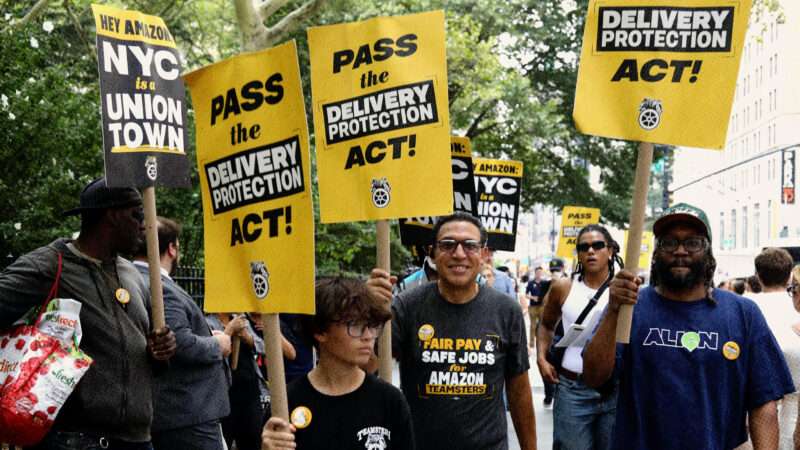
As if New York City weren't already an expensive enough place to live, legislation introduced to the City Council could soon make delivering packages in the five boroughs far costlier. Cloaked in the language of improving safety, the bill—recently endorsed by Mayor Zohran Mamdani—is little more than a thinly veiled attempt to strengthen the power of unions.
Introduced by NYC Council Member Tiffany Cabán in February, the misleadingly named "Delivery Protection Act" would require companies like Amazon and FedEx to directly hire employees for last-mile delivery, rather than contracting this service out to subcontractors. Last-mile delivery, which constitutes the final steps a package takes before hitting a consumer's doorstep, is the most expensive part of the delivery process, since it requires drivers to stop at many homes, often amid dense urban environments. The proposed legislation will only make this type of package delivery more expensive.
One of the main rationales behind the bill is safety. Proponents like Mamdani argue that Amazon's last-mile delivery service—which relies on subcontractor companies that hire their own workers—exacerbates traffic safety incidents in the Big Apple. Under this theory, ending the use of subcontractors would result in lower staff turnover and shift liability directly onto Amazon, which in turn could lower safety incidents and better protect the drivers themselves from injury.
But in recent years, Amazon has invested over $12 billion in technology and safety features for its delivery contractors, which it reports has led to a 48 percent decline in accident rates since 2020. This includes the creation of "DNY7"—a state-of-the-art Amazon training facility in Brooklyn where worker onboarding goes beyond federally mandated safety training—and through the acquisition of camera-equipped vans and modern electric bikes.
While proponents of the bill have pointed to statistics showing that the worker injury rates of Amazon's last-mile subcontractors is 8.3 per 100 workers versus 2.4 for all private employers, this comparison is essentially meaningless. The relevant comparison would be the national injury rate average for couriers—which is 8.0, suggesting that the Amazon's last-mile subcontractors are in line with industry norms.
The International Brotherhood of Teamsters and the New York City Central Labor Council, AFL-CIO are backing the bill. Under federal labor law, Amazon's subcontracted last-mile delivery partners can be individually unionized, but the labor contract wouldn't be signed with Amazon itself. Banning subcontracting for last-mile delivery would force Amazon to hire these deliverers as direct employees, making them easier to organize.
As attorney Alex MacDonald has noted, this is part of a larger strategy being employed by unions in recent years: If they are unable to organize through "organic, boots-on-the-ground campaigns," they now lobby for laws like this one that "read like a shortcut to organizing." In other words, what can't be accomplished by collective bargaining is pursued through direct regulation.
But these types of laws generally—and NYC's proposed ban on last-mile delivery services specifically—are arguably preempted by the National Labor Relations Act (NLRA). As MacDonald argues, the NLRA was designed to be a "scheme of overlapping rights, obligations, and zones of self-help" that create a cohesive national labor code—one which emphasizes "private negotiation and the free play of market forces." The more that progressive locales and labor unions undercut this carefully calibrated scaffolding, the wobblier it gets, until it is eventually undermined completely.
Ironically, NYC's last-mile delivery bill is also being opposed by those it purports to help: The City Council hearing stretched to seven hours long as several hundred last-mile delivery workers unexpectedly showed up to testify against it. These workers make around $24 per hour on average and have employer-funded healthcare through the subcontracted companies.
Amazon's last-mile subcontractors are also something else: small businesses. These 40 or so businesses represent a cross-section of New York City itself, with 25 percent operated by black or Hispanic owners, while another 10 percent are veteran-owned, according to testimony from Amazon. If the legislation passes, these businesses would be destroyed.
Amazon has also testified that the bill's passage could eliminate an estimated 5,000 jobs within the five boroughs, as the company warns it may need to relocate delivery operations outside of New York. At the very least, the effect will be to disincentivize the creation of further last-mile facilities in the city—in favor of neighboring counties or states—and further increase automation.
Another possibility is that New Yorkers will see yet more "regulatory response fees" tacked onto deliveries (or to Amazon Prime memberships), similar to Instacart's $5.99 surcharge that was introduced in response to NYC's recent minimum wage law for grocery delivery.
The Mamdani-backed effort to end last-mile delivery subcontracting in New York City is supposedly about safety. In reality, it will mostly serve to boost unions, eliminate jobs, and raise the cost of package delivery. It's an idea that deserves to be sent back to the warehouse.
The post This Mamdani-Backed Bill Would Kill Jobs, Boost Unions, and Make Deliveries More Expensive appeared first on Reason.com.




 Bengali (Bangladesh) ·
  English (United States) ·