

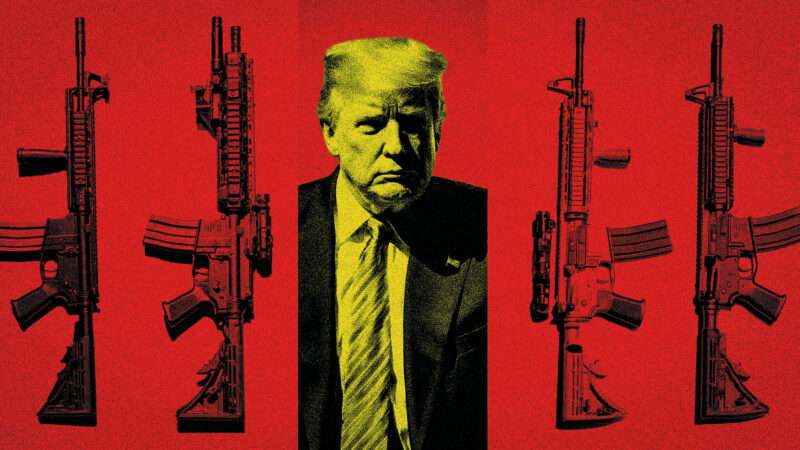
After the Supreme Court clarified the constitutional test for gun control laws in 2022, many longstanding restrictions on the right to arms looked newly vulnerable. Second Amendment groups jumped at the opportunity, filing one lawsuit after another in cases that frequently pitted them against the Biden administration.
Those groups now have a powerful ally in the Trump administration, which has filed several lawsuits aimed at vindicating Americans' gun rights, including two filed last week in Colorado. But even as the Justice Department advertises its commitment to defending the Second Amendment, its position in other gun cases belies that stance.
The Colorado lawsuits involve the state's 15-round magazine limit and Denver's "assault weapon" ban. Harmeet Dhillon, the assistant attorney general in charge of the Justice Department's Civil Rights Division, argues that both laws are unconstitutional for the same reason: They ban arms "in common use" for "lawful purposes," which the Supreme Court has said are covered by the Second Amendment, and there is no "historical tradition" that would justify such a policy, as required by the test that the Court prescribed in 2022.
Last December, Dhillon deployed the same argument against the District of Columbia's "assault weapon" ban in another lawsuit filed by the Civil Rights Division's newly established Second Amendment Section. Although federal appeals courts so far have not been receptive to such challenges, at least four Supreme Court justices—Clarence Thomas, Samuel Alito, Brett Kavanaugh, and Neil Gorsuch—seem inclined to agree with Dhillon.
That suggests the Supreme Court may soon weigh in on the constitutionality of "assault weapon" bans, which typically target rifles based on arbitrarily disfavored features such as pistol grips, folding stocks, and flash suppressors. While the outcome of such a case is uncertain, Dhillon's argument seems like a straightforward application of principles the Court has already recognized.
Dhillon is on even firmer ground in her December 16 lawsuit against the government of the U.S. Virgin Islands, which imposes a vague, highly discretionary requirement for publicly carrying handguns that is strikingly similar to the New York law that the Supreme Court overturned in 2022. Her investigation of the Los Angeles County Sheriff's Department, which takes as long as 18 months to act on carry permit applications, likewise seems consistent with the Court's concerns about bureaucratic burdens on the right to bear arms.
The legal hook for the Justice Department's involvement in these cases is a federal law that authorizes the attorney general to seek civil remedies for a law enforcement "pattern or practice of conduct" that deprives people of their constitutional or statutory rights. "The Constitution is not a suggestion," Acting Attorney General Todd Blanche said last week, "and the Second Amendment is not a second-class right."
The Justice Department nevertheless maintains that the Second Amendment does not apply to broad categories of Americans who are barred from owning firearms based on criteria that have little or nothing to do with public safety. The Trump administration has defended the Gun Control Act's ban on firearm possession by "unlawful" drug users, which is at the center of a case that the Supreme Court will soon decide, and that law's disarmament of people with nonviolent felony records, which has generated many petitions that the justices so far have declined to accept.
Both of those controversies pit the Trump administration against the National Rifle Association and other leading gun rights groups. It is not hard to see why, since neither policy is supported by the sort of "historical tradition" that the Supreme Court has said is required to justify gun regulations.
The Justice Department insists that "the Second Amendment is not a second-class right." Yet it argues that cannabis consumers and people convicted of nonviolent felonies are, in effect, second-class citizens.
Unlike the civil liberties guaranteed by other constitutional amendments, the Trump administration says, the right to arms can be revoked for arbitrary reasons. Contrary to Blanche's rhetoric, that sure seems like a second-class right.
© Copyright 2026 by Creators Syndicate Inc.
The post The Trump Administration Is a Powerful but Unreliable Ally of Second Amendment Advocates appeared first on Reason.com.



 Bengali (Bangladesh) ·
  English (United States) ·