
 1 month ago
44
1 month ago
44 
The ball starts rolling before the real games even begin. The NFL regular season doesn’t start until September 9, but the league already mints money during the August 13–29 preseason. Money flows in via more ticket sales, TV and streaming content, concession sales, and merchandise opportunities while turning fans’ training-camp excitement into real spending.
NFL teams usually play three preseason games. These games help coaches prepare the team and see how rookies, draft picks, and backup players perform in real game situations. In 2026, first-round picks like Fernando Mendoza and Ty Simpson are making their NFL debuts, which gives fans an early look at what these players are capable of and might do in the season.
Beyond player evaluation, preseason games generate substantial revenue for teams and the league. The NFL said in 2001 that money made from ticket sales at both preseason and regular-season games was part of the league’s shared revenue.
Let’s see what those numbers look like.
The TV Business Is Bigger Than It Looks
Preseason is becoming another way for the NFL to create media content and attract viewers. In 2026, 32 preseason games will be shown live on NFL Network and ESPN, while all 48 games will be available as replays on NFL Network.
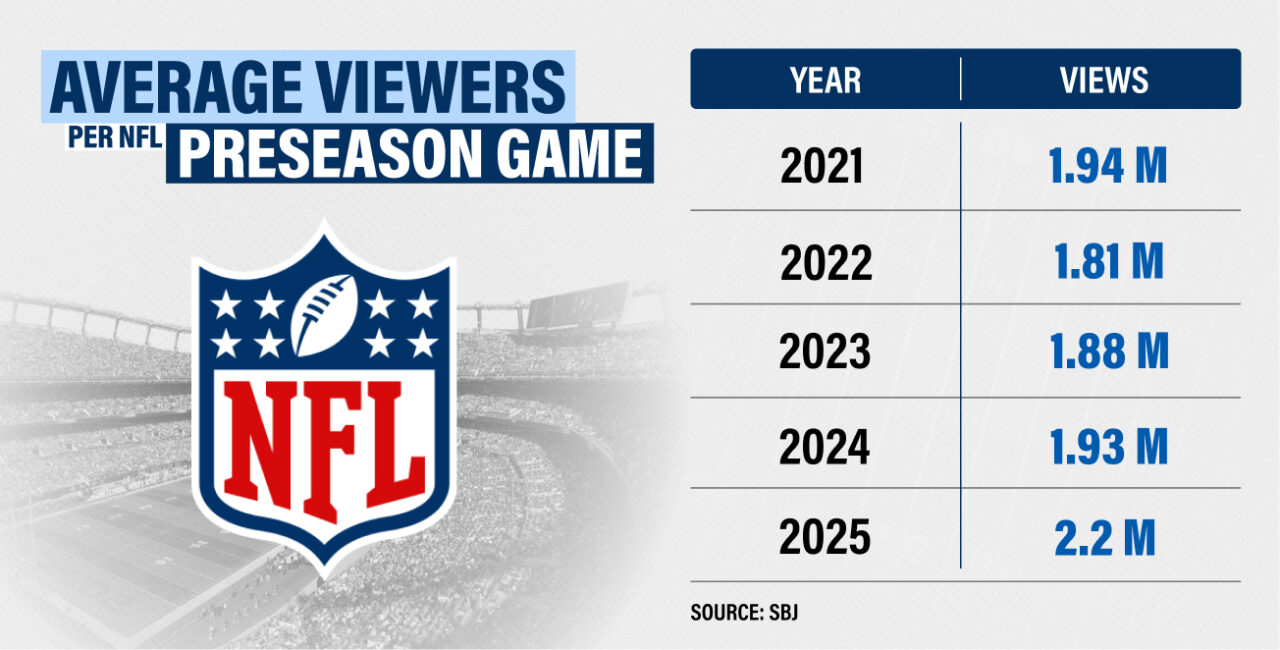
This is because the preseason games are also generating massive numbers. In the 2025 season, nationally televised preseason games averaged 2.2 million viewers per game, the NFL’s best preseason viewership since 2018.
During the first week of the 2022 preseason, NFL Network games averaged 1.77 million viewers, up from 1.5 million in 2021, according to The Athletic.
On top of it, the Jaguars-Raiders Hall of Fame Game that year also drew 5.7 million viewers and earned a 3.1 rating. These numbers help explain why preseason matters to the NFL’s huge media business. In 2021, NFL games took 75 of the 100 most-watched U.S. television broadcasts. Because so many people watch the NFL, even preseason games give broadcasters a large audience.
Why Teams Still Need It on the Football Side
Preseason is not only about making money. Coaches use these games to evaluate players before the regular season starts. They watch rookies, backups, and players competing for starting positions. The games give coaches a chance to see how players perform in real game situations.
The 2026 preseason has three weekends: August 13-15, August 20-23, and August 27-29. Each game gives coaches another opportunity to see who performs well and make their final roster decisions. On August 30, 2026, every team must cut its roster to a maximum of 53 players.
Coaches therefore use what they see in training camp and preseason games to decide which players stay and which players get cut. This matters most for rookies and backup players. They are often competing for a small number of roster spots. Plus, making sure these games run smoothly also demands a lot of investment.
The Cost of the Preseason Product
An NFL game needs hundreds of people to make it happen. Stadium workers, security staff, officials, NFL employees, technology teams, and other workers all have to be there. The stadium also needs equipment and other resources to operate the event, even when it is only a preseason game.
Security can be a big expense. A 2025 Santa Clara Stadium Authority report showed $2.4 million in public-safety costs for NFL events in the quarter ending on Septemeber 30, 2025, which worked out to about $612,000 per event during the period studied.
Preseason games also need massive TV and streaming production. In 2026, NFL Network scheduled 19 live preseason games, while ESPN added 12 more out-of-market games on its app.
Coaches and players still have to travel for preseason games, just like they do during the regular season. In Week 1, for example, the Packers traveled to Pittsburgh, the Colts went to New England, the Cardinals went to Las Vegas, and the Chargers went to Houston. Teams continued to travel in Weeks 2 and 3, with matchups such as the Raiders visiting Houston, the Packers visiting Denver, the Rams visiting the Chargers, and the Seahawks visiting the Chiefs.
Travel also adds time, work, and some risk of injury for players. The unusual part is that many established stars may play only a few snaps or may not play at all. Despite these costs and risks, the NFL continues to put out the preseason product. Why?
The Fan’s Perspective vs. The Owner’s Perspective
From the fan’s point of view, the question is simple: “Why am I paying to watch backup players?” Preseason games usually do not have the same importance as regular-season games, and many star players may play only a few minutes or sit out. Still, NFL teams can charge fans because people want to see their team live, watch rookies and new players, and get an early look at the team before the regular season.
A recent example is the Patriots vs. Colts preseason game on August 13, 2026. Ticket prices started at just $19, but some tickets on the secondary market were listed for as much as $2,691. The big difference comes down to demand and the type of ticket. A fan who simply wants to watch the game can find a cheaper seat, while someone who wants a premium seat may have to pay hundreds or even thousands of dollars.
However, from the team’s point of view, preseason games are still a way to make money. Even though the games do not count toward the regular-season record, teams can still earn money.
A 2006 report from the Los Angeles Times showed just how much money preseason could generate. The newspaper estimated that a typical NFL team could make about $7.8 million from ticket sales for four exhibition games. The estimate used an average crowd of 65,000 fans and an average ticket price of $60.
The team could make even more from other sources. The Los Angeles Times estimated about $1 million from parking and concessions at two home games and another $1.5 million from local TV and radio deals. That brought the estimated total to about $10.3 million from four preseason games in 2006. The figures are old, but they show why teams view preseason as a valuable extra revenue opportunity.
The Bigger Business Angle
The NFL uses the preseason to build excitement before the 18-week regular season. From training camp to preseason, it creates a lot of buzz.
It also boosts their streaming business. When the league launched NFL+, it offered fans direct access to NFL content, including live out-of-market preseason games.
Preseason also creates content outside the games. The NFL works with HBO and Warner Bros. Discovery on “Hard Knocks,” which follows teams during training camp. Shows like this give fans behind-the-scenes stories and help keep them interested in football before the regular season starts. All of this creates different ways for the NFL to make money.
The regular season is especially valuable because each team plays only once a week, so meaningful games are limited. The preseason keeps fans engaged until those games begin. Plus, the preseason wins or losses have zero impact on the regular-season record. Which means teams can earn with no risk other than evaluating players.
So, this way the NFL builds in a massive way to earn a good amount, grab fans’ attention, evaluate players, and already create massive hype ahead of the season.
The post The Preseason Business: Why the NFL Makes Money Before the Games Count appeared first on EssentiallySports.


 Bengali (Bangladesh) ·
  English (United States) ·