

Animals may have had a rich variety of complex body types far earlier than scientists had recently thought.
A crucial moment in the history of life on Earth was the Cambrian explosion. Starting some 539 million years ago, it marks when animals very quickly became much more diverse. How this “explosion” in diversity happened has been a mystery. But a trove of newfound fossils points to an answer.
Animals seem to have begun evolving an array of strange body types even before the famed explosion. Researchers described them April 2 in Science.
“This paper is absolutely fascinating,” says Emily Mitchell. “It provides vital insights into [pre-Cambrian] life.” Mitchell is a paleontologist who did not take part in the research. She works at the University of Cambridge in England.
Explainer: Understanding geologic time
The time just before the Cambrian explosion is known as the late Ediacaran (Ee-dee-OCK-ur-ən) Period. It lasted from about 575 million to 539 million years ago. The earliest fossils that were clearly animals date to this time. But until now, they haven’t offered many details about the bodies of critters who lived back then.
What’s more, many animals seen in the Cambrian Period haven’t been found in the Ediacaran Period. This led researchers to suspect the Cambrian explosion started with very few species.
Newfound fossils unearthed in southwestern China now challenge that idea. They show that more than 539 million years ago, Earth’s oceans teemed with a zoo of weird creatures.
Soft, clarinet-shaped animals anchored themselves to the seafloor. They swayed alongside creatures that looked like worms or baskets. Those were just a few of the complex species thriving in pre-Cambrian seas.
Strange sea creatures
Paleontologist Gaorong Li led the new research. It all started in 2022. He and others were collecting fossils near Yuxi, China. Their team was on the hunt for remnants of Ediacaran algae. But that hunt turned up something odd: fossil fragments of species they couldn’t identify.
In 2023, the team discovered another surprise. They turned up fossils of bizarre, cylindrical animals several centimeters (inches) long. At one end, the critters had flat pads that could have gripped the ocean floor. At the other end were flag-shaped tentacles that appeared to extend from their mouths.
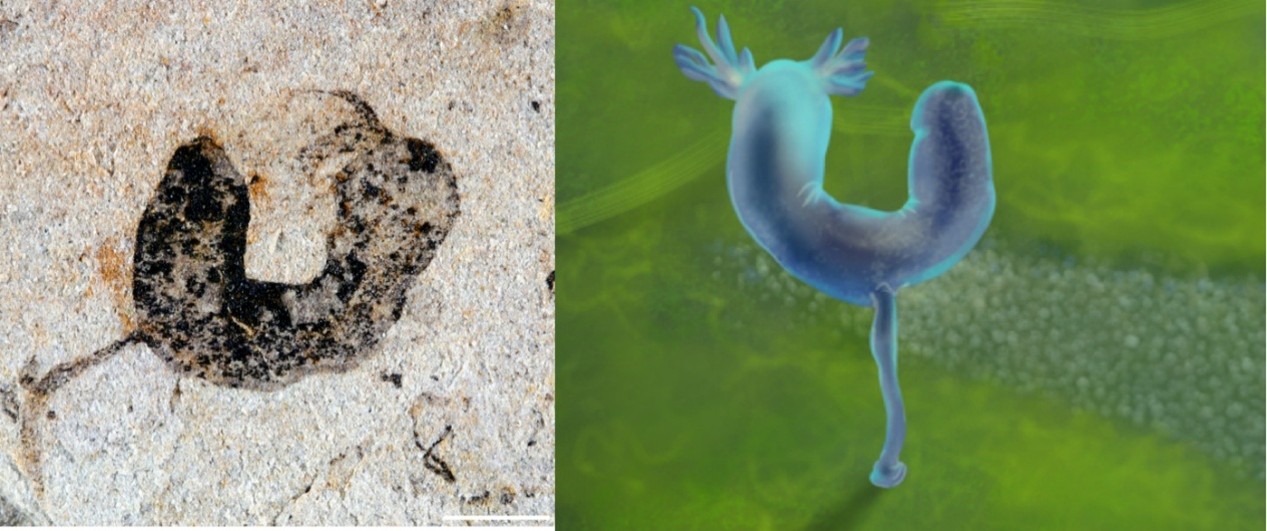 This early deuterostome (fossil at left, artist’s reconstruction at right) is related to animals like vertebrates and sea stars. It appears to have appendages on one end that may have been used in feeding. It’s also new, very early fossil evidence of animals with bilateral symmetry in the Ediacaran Period.Gaorong Li & Xiaodong Wang
Finding these “bugle worms” was a turning point, Li says. Back then, he worked at Yunnan University in Kunming, China. In 2024, his group joined forces with researchers at the University of Oxford in England. Together, they gathered roughly 700 late Ediacaran fossils.
They compared this haul to other Ediacaran fossils. They also compared the new fossils to those from the Cambrian Period.
Some of the new fossils looked like Haootia — an animal that lived some 560 million years ago. Haootia and these other fossils resembled martini glasses with tentacles on the rims. Like modern jellyfish, they had body parts that spread out from a central point. This is known as having radial symmetry.
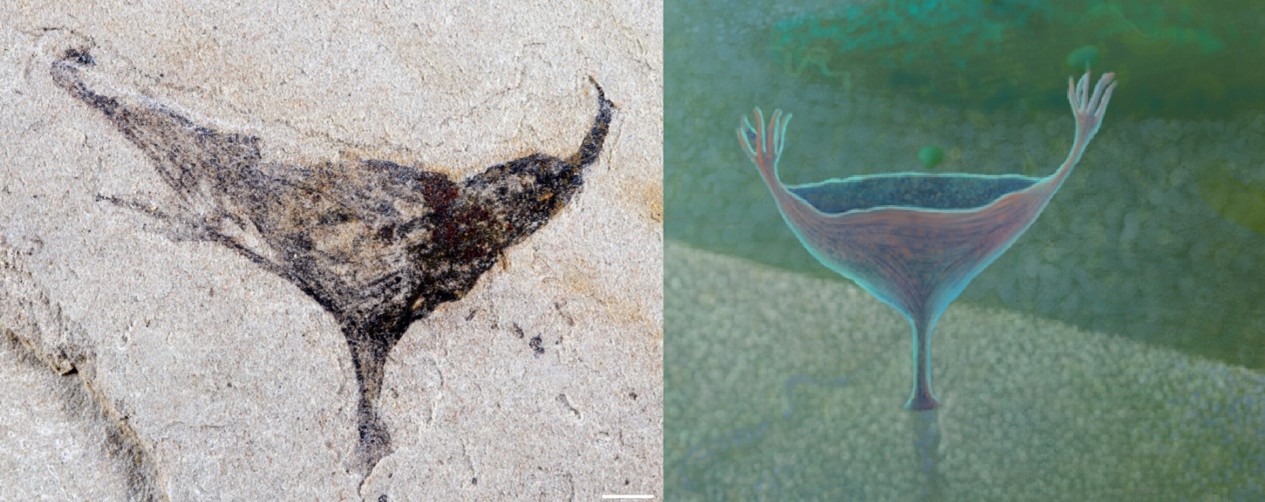 The Haootia-like animal (fossil at left, artist’s illustration at right) may have been a relative of animals such as corals, anemones and jellies.Gaorong Li & Xiaodong Wang
Bilateral bodies
The freshly collected fossils included more eyebrow-raising finds. Some had bilateral symmetry. That is, they had similar features on the right and left sides of their bodies — as humans do.
It’s rare to find such early fossils with left-right symmetry. Until now, only four species from the Ediacaran Period had shown this feature. Li and his team found more than 180 bugle worms and other fossils with this type of symmetry. Some looked like sausages on skewers with feathery bits around their mouth ends.
The sheer number of fossils with bilateral symmetry that Li’s group found is striking, says Emmy Smith. She’s a paleontologist at Johns Hopkins University in Baltimore, Md. The diversity among these fossils amazed her.
Many had special structures for feeding, Smith notes. Clearly, the animals were quite physically complex. “That strengthens the view that [animals] were already diversifying before the Cambrian,” she says.
The Cambrian explosion, it seems, didn’t come out of nowhere, Li says. Instead, animal life had been getting more complex for millions of years before that.
Do you have a science question? We can help!
Submit your question here, and we might answer it an upcoming issue of Science News Explores


 Bengali (Bangladesh) ·
  English (United States) ·