

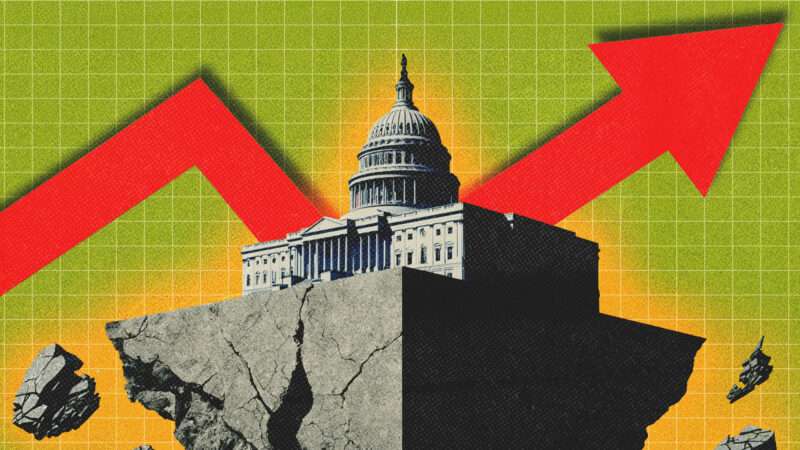
Ten-year interest rates have vaulted from around 4.5 percent in July to nearly 5.3 percent this week. That may not seem like a lot, but in the history of the bond market, such a rapid rise in rates is almost without precedent. The last time it happened was in 1994, when the "bond vigilantes" relentlessly sold bonds in response to Hillary Clinton's vision of "managed competition" in healthcare. The person on the street knows much more about the stock market than the government bond market, but it is the bond market that has the ability to impose fiscal discipline on the government.
The Clintons may have retreated from their healthcare plans in 1994, but there is no sign that Treasury Secretary Scott Bessent or President Donald Trump have learned their lesson yet. Instead of having meaningful discussions about reducing spending and entitlements, they are dreaming up ways to intervene in the bond market to get the desired result: lower interest rates.
First, some context is necessary. Most people operate under the assumption that the bond market is a mess because inflation is high. It really isn't—inflation, measured by the Consumer Price Index (CPI), is currently 3.4 percent and is on a downward trajectory—much lower than it was in 2022, when it reached 9.1 percent. The Fed's preferred measure of inflation, personal consumption expenditures, is also low and headed lower.
You might observe in the real world that oil and gas prices are high, especially diesel, and diesel is a big contributor to inflation because many goods in the U.S. are transported by truck. But the government strips out volatile food and energy prices and focuses instead on "core" CPI—an artifact of the Arthur Burns Fed in the 1970s. Even when including energy prices, inflation is headed marginally lower. So inflation is not the reason why interest rates are high.
People also believe that deficits are the main driver of higher interest rates, which is partially true. When the government is forced to issue more debt, the increased supply of bonds overwhelms demand, resulting in lower bond prices and higher interest rates. Although $2 trillion deficits sound scary, when normalized for the size of the economy, the terror abates somewhat. Deficits were twice as large post–financial crisis in the Barack Obama years, and interest rates went lower. A 6 percent deficit-to-GDP is high, but it is about where it was during Ronald Reagan's first term, and we easily grew out of those deficits and eventually reached a surplus in 2000. Not to say that the deficit isn't a problem or even an existential crisis, but if we made an honest attempt at cutting spending and getting the deficit down to about 3 percent of GDP or so, the story would have a happy ending, and interest rates would decline.
If it's not inflation, and it's not the deficit, what is it? Really, it is a crisis of credibility: Bessent's credibility, Federal Reserve Chairman Kevin Warsh's credibility, and Trump's credibility. The bond market expresses doubt that these officials will take positive action to do anything about inflation or spending. When the Warsh Fed raised interest rates last month, the bond market revolted anyway. Bessent, rather than trying to fix the structural problems, blames the "Bloomberg terminal bros" responsible for pushing interest rates up, which is not too far off from Hugo Chávez blaming Venezuelan bond traders for his interest rate problem.
About a month ago, Bessent intervened weakly in the bond market by announcing repurchases of long-term bonds of up to $4 billion per operation. In the scale of interventions, this is fairly junior varsity because the bond market trades hundreds of billions of bonds per day. Also, the Treasury Department routinely does bond buybacks here and there to improve the liquidity of off-the-run issues. Bessent later doubled down and increased the buybacks to $6 billion per operation, which resulted in interest rates going even higher—hence the credibility issue. If Bessent wants to get interest rates down, the intervention will have to be truly massive.
There are some other things the government could do to get interest rates down. Trump could direct Fannie Mae and Freddie Mac to increase purchases of mortgage-backed securities, and since the government-sponsored enterprises are still under government conservatorship, they would have no choice but to comply. This, of course, would greatly increase risk at Fannie Mae and Freddie Mac; when they failed in 2008, they required an almost $200 billion bailout.
Bessent could also discontinue the 20-year and/or 30-year bond. This would make logical sense if you were the treasury secretary—rather than locking in high interest rates for 30 years, you would discontinue their issuance and wait for interest rates to come down. However, the risk is that yields would continue to go even higher, and Bessent would have missed the chance to lock in rates at about 5.5 percent for the bond, which might look good in hindsight.
But the elephant in the room is yield curve control, or debt monetization. This is where the Federal Reserve would print money to buy unlimited quantities of Treasury bonds, pegging interest rates at certain levels. Most people know that monetizing the debt has been tried before—by Weimar Germany, Zimbabwe, and Argentina—and it has been responsible for practically every hyperinflationary episode in history. Yield curve control is less likely because it requires the Fed's participation, and the current composition of the Fed's board makes it unlikely that they would agree to it.
The 10-year interest rate is the most important price in the economy. If it rises, the market is sending signals—to borrow less and save more. It is the only thing that can possibly force discipline on the government, since voters and Congress seem not to want to do it. When you monkey with that price, you cause massive distortions in the economy because the price signal no longer works. The government will keep on borrowing, and in the case of yield curve control, it will be financed by printed money.
Democratic strategist James Carville once said: "I used to think that if there was reincarnation, I wanted to come back as the president or the pope or a .400 baseball hitter. But now I want to come back as the bond market. You can intimidate everybody." Bessent is not intimidated and is seeking to circumvent the free market. The average politically engaged person is focused on social issues and not the mechanics of government bond issuance, which is regrettable because what happens next at the Treasury could have far-reaching consequences that affect us all for decades to come.
The post The Bond Market Doesn't Trust the Treasury appeared first on Reason Magazine.





 Bengali (Bangladesh) ·
  English (United States) ·