

A pair of newly found planets are the puffiest worlds ever seen. They’re both about the size of Jupiter but with less than 6 percent of its mass.
In terms of density, these planets are “like candy floss or shaving foam,” says George Dransfield. She’s an astrophysicist at the University of Oxford in England. “They’re the lightest planets that are Jupiter-sized.”
Both orbit TOI 791. That’s a sunlike star about 1,113 light-years from Earth. The TESS space telescope spotted them as they passed — or transited — in front of their star and blocked some of its light. Comparing the star when it was blocked and unblocked let Dransfield and others measure the planets’ width.
One world is about 0.993 times as wide as Jupiter. The other has about 1.155 times Jupiter’s width.
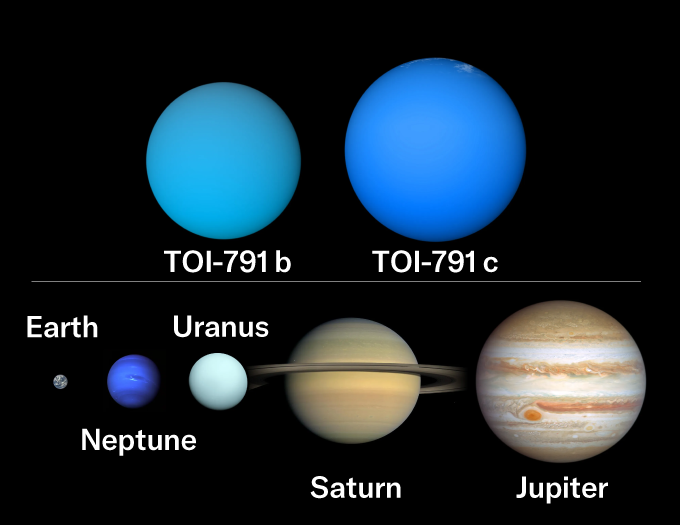 Two newfound planets that orbit the star TOI 791 (top row) are roughly as large as Jupiter and about as dense as shaving cream. Their large sizes could be due to heat “puffing” up their atmospheres.Daniel Rutter/NASA
For the team to find their density, it needed to know both the planets’ size and mass. Transits only give their size. That’s where their orbits come in. The two planets periodically pass by one another as they circle their star. As they do, the planets give each other a little gravitational tug.
“They’re in this fun little dance,” Dransfield says. “We were able to measure the masses of the planets by how much they kick each other’s orbits.”
Explainer: All about orbits
Dransfield and her teammates tracked the planetary dance over several years. They used the Antarctic Search for Transiting ExoPlanets telescope, or ASTEP. It was the only telescope on Earth that could observe the planets’ entire transits. Why? Because it takes about 12 hours for each planet to pass in front of its star. It’s hard to find a place on Earth that gets 12 straight hours of darkness at a time during which to view that. But Antarctica gets three straight months of darkness each year.
“Without this telescope, this discovery would not have happened,” Dransfield says.
Those measurements let her team deduce the planets’ masses. One was 9.5 times the mass of Earth. The other had the heft of 18.6 Earths. (Jupiter has 317 times Earth’s mass.) That means their densities are 0.038 and 0.047 grams per cubic centimeter. For comparison, cotton candy’s density is typically about 0.05 grams per cubic centimeter.
The researchers shared these findings in the July Monthly Notices of the Royal Astronomical Society.
Sizing up superpuffs
The new planets join the small group of large but lightweight worlds known as superpuffs. Astronomers aren’t sure how they form. One theory is that they’re born far from their star and move inward. Their atmospheres would heat and puff up as they neared their stars.
Some superpuffs might have giant ring systems, which could make them look bigger than they really are. Astrophysicists Anthony Piro and Shreyas Vissapragada proposed this idea in 2020. But that’s probably not the case for the two newfound planets, says Piro.
Having two ringed planets mistaken for superpuffs around the same star would be too much of a coincidence, he says. Piro works at the Carnegie Observatories in Pasadena, Calif. He did not take part in the new study.
The host star is spinning quickly, which could be a sign that it’s fairly young, Piro notes. If so, these superpuffs might still be cooling off. They might shrink as they age. “We might be catching these planets at an intermediate stage,” Piro says.
The next step is to use the James Webb Space Telescope to probe the planets’ chemical makeup. That could reveal more about their origins, Dransfield says.
“Finding things like superpuffs, which are incredibly rare, means we can learn more about how planets form,” Dransfield says. They also offer clues about how planets evolve and what they can end up looking like. “That also helps us [understand] Earth in the wider context of the cosmos.”
Do you have a science question? We can help!
Submit your question here, and we might answer it an upcoming issue of Science News Explores




 Bengali (Bangladesh) ·
  English (United States) ·