
 3 hours ago
2


Quick Summary
Pros
Cons
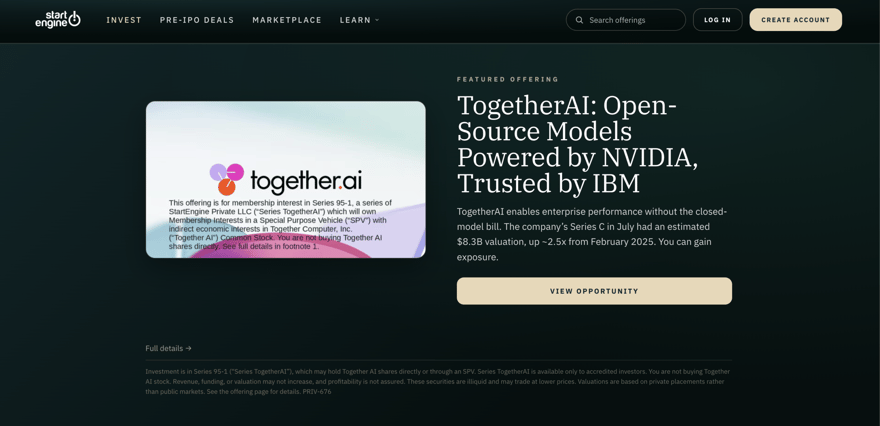
StartEngine is an investment platform that allows you to invest in early-stage startups and other private companies. Stories of getting in on the ground floor of Airbnb, Uber, and other household names can make even the most conservative investors curious about startup investing. Platforms like StartEngine let everyday investors participate without needing venture capital connections.
But access doesn't guarantee a successful investment. Startup shares can be difficult to sell, and you could lose everything you invest.
If you’re an extremely lucky investor, you may have held a ten-bagger publicly traded stock (one that increases by 10X the purchase price) a few times in your life. But publicly-traded stocks rarely see rapid price increases. You can certainly build passive income from stock market investing, but few get wealthy overnight by buying stocks.
In this article, we review StartEngine's offering for everyday investors interested in startup investing. If you want to raise money for your startup, StartEngine could be an amazing funding platform, but we’re not focusing on the founder experience here.
What Is StartEngine?
StartEngine is an online marketplace working to make startup investing accessible to more people. Today, most startup investing is done through Venture Capital funding or personal relationships. StartEngine is using crowdfunding rules to bring startup investing to more people.
StartEngine's published figures put its community at more than 2.1 million (this doesn't mean 2.1 million people have invested) and capital committed at $1.5 billion. Both totals include SeedInvest. StartEngine acquired SeedInvest's business assets in May 2023, expanding its reach among startup founders and prospective investors. The acquisition is now an established part of its business.
What Does It Offer?
StartEngine offers equity crowdfunding opportunities and a marketplace for reselling eligible private-company securities. It also provides separate investments opportunities for accredited investors.
Buy Shares of Early-Stage Startups
Investors interested in early-stage investing can browse StartEngine's current campaigns, review offering documents, and choose which businesses to fund. The selection changes as companies launch and close their fundraising rounds.
Before you invest, always review the company's finances, valuation, intended use of the money, and the rights attached to your investment. Both accredited and non-accredited investors can invest in startups on the site, but non-accredited investors have limits on how much they can invest.
StartEngine Tracks Your Investment Limits
StartEngine uses the financial information you provide to calculate applicable investment limits. However, non-accredited investors also need to account for crowdfunding investments made on other platforms.
Under the SEC's Regulation Crowdfunding guidelines, if either your annual income or net worth is below $124,000, your limit over a 12-month period is the greater of $2,500 or 5% of the greater of those two amounts. If both are at least $124,000, the limit is 10% of the greater amount, subject to a $124,000 overall cap. These limits apply across all Regulation Crowdfunding offerings, not separately to each platform. Other offering types have different rules.
Fees Apply To Investments
Investors should budget for more than the advertised share price. StartEngine states that purchases generally carry a 3.5% processing fee, which is capped at $700. For example, that would add $17.50 to a $500 investment. Always check your specific documents for the actual charge.
Secondary Trading Market Available
The startup market is notoriously illiquid, and selling startup shares is nearly impossible in most cases. StartEngine offers a marketplace where investors can offer eligible shares for sale, which may allow them to exit before an acquisition or IPO. T
That said, you can't assume that every investment will qualify for resale or attract a buyer. Regulation Crowdfunding shares generally face a one-year sale restriction, and other transfer restrictions can apply. According to StartEngine, sellers also need an active Venture Club subscription.
Low Investment Minimums
Each offering has its own minimum investment, which is shown on the campaign page. Verify that amount before researching in detail, as an attractive company might require more than you want to commit. For example, at the time of writing, a campaign for Greenfield Robotics required a minimum investment of $501, while a campaign for Higgsfield, an AI video platform, required a minimum investment of $50,025, a big difference.

Are There Any Fees?
Yes. According to StartEngine's Investor FAQ, there is a 3.5% processing fee, capped at $700, for investments. Its broader brokerage fee schedule allows primary investment service fees of up to 5%.
For marketplace resales, buyer fees are 3.5% and seller fees are 5%.
A Venture Club membership costs $275 annually. Club benefits include 10% bonus shares in participating campaigns, access to sell on Marketplace, and a discount on StartEngine Secondary selling fees. You'll need to weigh the cost of the subscription against how much you expect to invest or sell.
How Does StartEngine Compare?
StartEngine, Wefunder, and Republic all offer private company investments to non-accredited investors, but their deals, minimums, and fees differ. Wefunder is a close alternative for startup investing, with some offerings starting at $100. Its bank-funded investments carry a 2% fee, with an $8 minimum and a $150 cap. Card payments cost more.
As mentioned, StartEngine generally lists a 3.5% investor fee, capped at $700, compared to Republic's 2.5% fee, with a $5 minimum and a $250 cap. Of course, remember that offering-specific terms may vary.
Rating | Not Yet Rated | ||
Min. Investment | Varies, but can be less than $500 | Varies by offering | Some start at $100, but varies by offering |
Fees for Investors | $0-3.5% | Typically 2.5% | 2%-5.5% |
Open to Non-Accredited Investors? | Yes, for eligible offerings | Yes, for eligible offerings | Yes, for eligible offerings |
Cell | Cell |


How Do I Open An Account?
Start by creating an account on the StartEngine website. Once you've completed the account opening process, you can review the campaign page and offering documents to find companies to invest in.
You will need to provide personal and financial information, and identification to StartEngine so that they can verify your eligibility. You can fund your account via wire transfer, credit cards, Apple Pay, and Google Pay. Just make sure those methods are available for the offering you choose.
Is It Safe And Secure?
StartEngine is registered as a broker-dealer with the SEC, and it seeks to comply with all Federal and State laws around identity security, privacy protection, etc. To comply with various Federal investment and anti-money laundering laws, StartEngine must collect identifiable information (such as name, address, ID Numbers, and more) from investors on the platform. It also collects bank account or credit card information for those at choose to invest through StartEngine.
StartEngine uses appropriate digital controls including encryption, secure transfer protocols, and other technical and business controls to reduce the risk of identity theft. StartEngine only shares personal information with third parties that are enlisted to provide services on behalf of StartEngine (such as processing payments or digital document signing).
Overall, the StartEngine platform appears to be safe for consumers. However, the safety of the platform doesn’t mean that StartEngine is a “safe investment platform.” The company offers shares in startups. All investments may lose money, including “safe” investments like bonds. However, startups are known for being incredibly volatile. It is likely that at least some of the investments you buy through StartEngine will go to $0 in value over time. Others may produce no return, and they may not ever have an “exit” opportunity where investors can see a return on their capital investment.
If you choose to invest through StartEngine, you must understand that this is a long-run investment that is very high risk. You don’t want to put your “safe” money into this type of investment.
How Do I Contact StartEngine?
StartEngine’s headquarters is located at 4100 W Alameda Ave, Burbank, CA 91505. To contact customer service, you can use the investor support contact form that is hosted on the StartEngine website or email contact@startengine.com.
Who Is This For And Is It Worth It?
If you’re looking to diversify into alternative investments, buying shares in a few startups through StartEngine may be a good fit. But this platform is for making small “bets” on a few companies to see whether any can help your money grow 10x, 20x, or even 100x the original investment. Startup investing is very risky, so you should never make startup investments a core holding in your overall portfolio.
StartEngine's platform should be considered secure. It offers very detailed information about the companies seeking funding. Even as a crowdfunder, you get treated like a venture capitalist. However, compare StartEngine with competitors like Republic and Wefunder to find the best investment options for you.
And remember, startup investing should never replace common-sense personal finance basics like investing for retirement and paying off debt.
Editor: Colin Graves Reviewed by: Robert Farrington
The post StartEngine Review: Startup Investing appeared first on The College Investor.





 Bengali (Bangladesh) ·
 English (United States) ·