
 1 hour ago
6
1 hour ago
6 
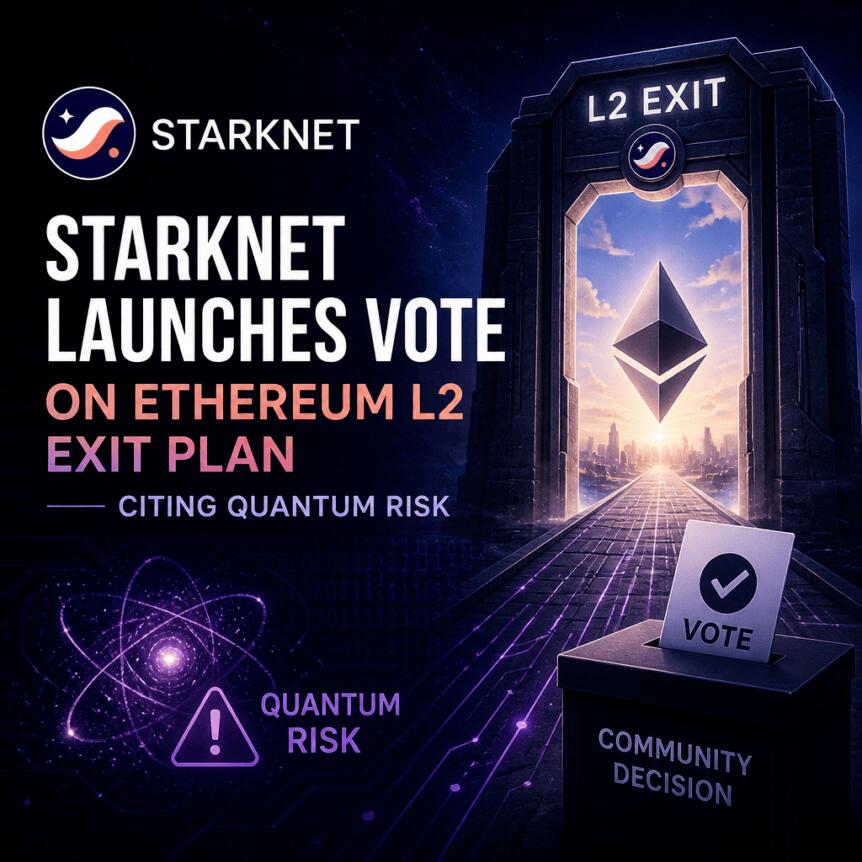
Starknet has launched a seven-day, non-binding governance vote that asks STRK holders whether the Ethereum layer-2 should investigate turning itself into an independent layer-1 built with post-quantum security in mind. The poll was opened Thursday and will run until Oct. 22, with results published afterward.
The proposal does not authorize a transition on its own. Instead, a “Yes” vote would indicate support for additional research into a possible path toward becoming a post-quantum layer-1, while further proposals and formal governance steps would still be required. A “No” vote would oppose the idea, and voters can also choose to remain neutral pending more information.
Key takeaways
Starknet opened a non-binding seven-day STRK vote to explore whether it should pursue an independent, post-quantum layer-1 future. Voting closes Oct. 22; the outcome signals research preference, not approval for an immediate migration timeline. StarkWare says Starknet’s current reliance on Ethereum—particularly its bridge and data availability—remains a quantum-security dependency. StarkWare frames the effort as a way to pursue quantum-resistant security without waiting for Ethereum’s upgrade schedule.What Starknet is actually putting to a vote
According to the governance proposal published on Starknet’s forum, the poll provides three options: support further research, oppose it, or stay neutral until additional details are available. Starknet emphasizes that the vote is non-binding, and a “Yes” outcome would not authorize the network to become a layer-1 by itself.
StarkWare, the organization developing Starknet, signaled that the next steps would be handled through additional governance processes if the community chose to move forward. In other words, the current vote is meant to establish whether the idea deserves deeper investigation rather than to map out execution.
Why the push is about post-quantum security
StarkWare’s argument centers on the timeframe and dependencies involved in quantum-resistance upgrades. The developer says Starknet currently relies on Ethereum infrastructure, including its bridge and data availability mechanisms, and that these components are still exposed to quantum-security concerns.
By pursuing an independent post-quantum layer-1, StarkWare believes Starknet could reduce or remove those Ethereum-linked dependencies and pursue quantum-resistant security on its own schedule. The company’s CEO, Eli Ben-Sasson, told Cointelegraph that “quantum-proofing crypto is urgent,” adding that the initiative needs to move quickly and contrasting what he described as faster progress for quantum security versus slower timelines at major L1 networks.
The governance action appears to align with earlier internal planning. In June, StarkWare unveiled a three-phase quantum-resistance roadmap for Starknet, which covered signature upgrades, migration of smart contracts, and the question of Ethereum-dependent infrastructure. That roadmap suggests StarkWare has already been thinking about both application-layer migration and the underlying infrastructural dependencies that could limit “quantum-proofing” effectiveness.
Looking at the broader ecosystem: Ethereum’s post-quantum work
Starknet’s proposal also arrives as Ethereum developers pursue their own post-quantum security initiatives. Earlier coverage from Cointelegraph noted that Ethereum developers established a dedicated post-quantum team in March, with an aim of introducing initial protocol-level protections by 2029.
In this context, Starknet’s vote can be read as a deliberate attempt to avoid waiting for Ethereum’s pace on protocol upgrades—at least for parts of the stack StarkWare views as tied to Ethereum’s current security assumptions. While Ethereum’s approach is focused on protocol-level defenses, Starknet’s framing is more operational: it targets the infrastructure layer that, in StarkWare’s view, keeps quantum-security work constrained by Ethereum’s upgrade schedule.
At the same time, StarkWare has not presented a timetable for becoming an L1 as part of the vote. The process remains exploratory, meaning investors and builders should treat the proposal as a strategic direction check rather than a concrete migration plan.
How STRK holders are being asked to interpret the proposal
StarkWare and Starknet also previously teased the concept. In separate X posts on Oct. 8, both Ben-Sasson and Starknet framed the move as a potential attempt to become “the first fully quantum-resistant network” by 2027. However, the current governance poll still does not commit to a shift in chain identity, governance structure, or execution timeline—its immediate purpose is to gauge community support for research.
This distinction matters for market participants. A research-oriented “Yes” vote may signal confidence that post-quantum independence is a worthwhile objective, but it does not guarantee delivery schedules, engineering scope, or the governance sequence that would be required for a true layer-1 transition. Readers should also watch for future governance proposals that would specify what “research” entails—such as technical designs, risk assessments, and how Starknet would handle continuity, security, and any remaining dependencies during the transition window.
As of now, the clearest confirmed elements are the vote mechanics (non-binding, three options, closing Oct. 22), the stated rationale (Ethereum bridge and data availability as quantum-security dependencies), and the absence of a stated timetable for an eventual layer-1 outcome.
For the next few weeks, the key thing STRK holders and observers will want to monitor is how the community frames follow-up steps after the poll closes—especially whether subsequent proposals begin to define technical requirements and migration pathways, or whether voters opt to pause while more information is gathered.
This article was originally published as Starknet Launches Vote on Ethereum L2 Exit Plan Citing Quantum Risk on Crypto Breaking News – your trusted source for crypto news, Bitcoin news, and blockchain updates.




 Bengali (Bangladesh) ·
  English (United States) ·