
 4 hours ago
5
4 hours ago
5 
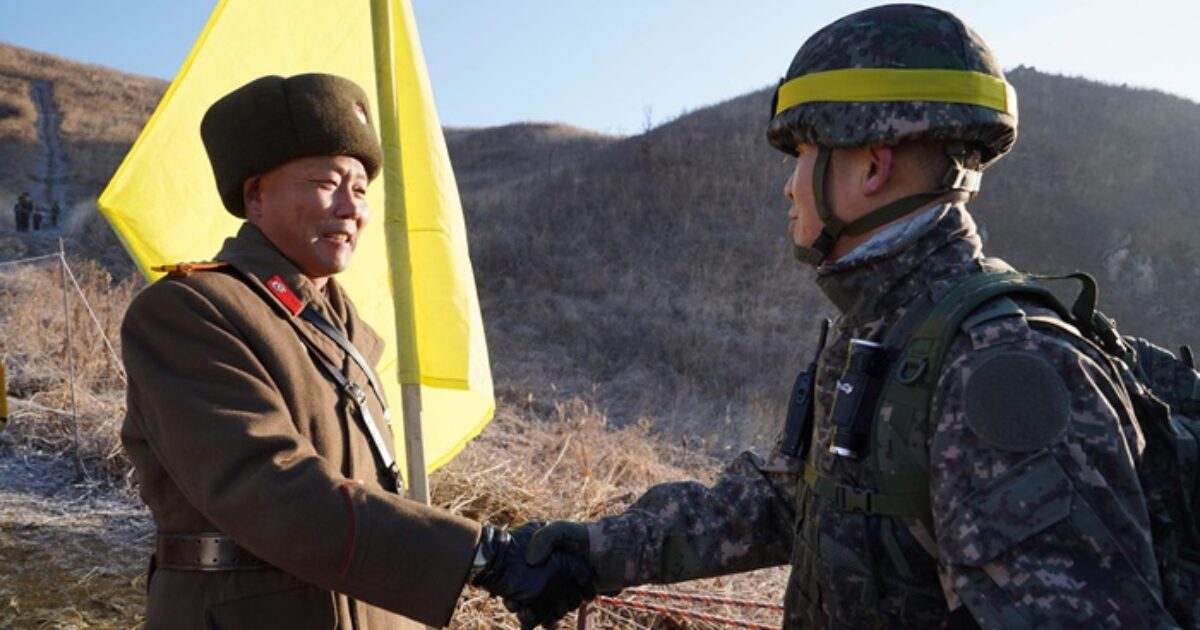
 North Korea has formally renounced reunification with South Korea in its constitution. Photo courtesy of Korea.net.
Three soldiers from South Korea’s 25th Infantry Division were injured on Sept. 21 in a suspected landmine explosion south of the Military Demarcation Line in the western Demilitarized Zone. All three were taken to the Armed Forces Capital Hospital. One reportedly suffered an injury requiring amputation. No deaths were reported.
The military has not confirmed whether the device was a North Korean mine, a South Korean mine, or a remnant from the 1950–53 Korean War. An investigation is underway.
An estimated 800,000 mines are buried across the DMZ, according to military data cited by Yonhap. In 2015, two South Korean soldiers were wounded, one of whom lost both legs, after North Korean soldiers crossed the MDL and planted mines along a South Korean patrol path, according to Seoul. Pyongyang denied the accusation.
On Nov. 20, 2025, a South Korean Army staff sergeant was seriously injured during a mine-detection mission in Paju. North Korean soldiers have also been killed or wounded by accidental explosions during Pyongyang’s fortification work.
The latest explosion occurred amid Pyongyang’s broader shift toward treating South Korea as a hostile foreign state rather than a partner for reunification. At the ninth plenum of the Workers’ Party’s 8th Central Committee in December 2023, North Korean leader Kim Jong Un declared that peaceful reunification “can never be achieved” and directed that South Korea be treated as the North’s “principal enemy.”
The following month, Kim told the Supreme People’s Assembly that Pyongyang would dissolve the Committee for the Peaceful Reunification of the Fatherland, along with its economic-cooperation and inter-Korean tourism bodies. In 2024, state media confirmed the demolition of Pyongyang’s Arch of Reunification, a monument built by Kim’s father to symbolize peninsular unity.
At the Workers’ Party’s 9th Congress in February 2026, North Korea enshrined the “two hostile states” framework in the party charter, which takes precedence over the constitution. Kim said North Korea “has absolutely nothing to discuss with South Korea, the most hostile entity” and would “permanently exclude South Korea from the category of compatriots.”
The Supreme People’s Assembly also adopted a constitutional revision, reported in March 2026 and confirmed by South Korea’s Ministry of Unification in May. The revision removed references to reunification, ethnic unity, and shared nationhood and added a territorial clause excluding South Korea. 38 North noted that it left the maritime Northern Limit Line undefined, preserving room for future disputes.
Pyongyang’s policy shift has been accompanied by physical fortification of the border. Since 2024, North Korean forces have laid landmines, cleared vegetation, built anti-tank barriers, and constructed tactical roads along the northern side of the DMZ. Satellite analysis comparing land use between 2024 and 2025 found that forest area had decreased while grassland increased.
In June 2026, South Korean officials reported that North Korea had erected fences within 80 meters of the MDL and cleared ground for mines within five to 10 meters. Initially expected to take more than four years, the fortification work could now be completed within two to three years. Near Yeoncheon, satellite imagery from August showed that a North Korean tactical road may extend across the MDL.
On Aug. 20, 2026, North Korea fired 10 short-range ballistic missiles less than 24 hours after Kim Jong Un’s sister, Kim Yo Jong, dismissed President Trump’s offer to scale back joint military exercises with South Korea and meet with Kim as “not worth commenting on.”
On Sept. 12, North Korean state media confirmed a joint firepower drill involving a ballistic missile launch, one day after the trilateral Freedom Edge military exercises concluded. On Sept. 20, North Korea launched approximately 10 more short-range ballistic missiles, following through on a threat to respond to a U.S.-South Korean military drill. Kim Yo Jong said shortening the drill would not change its “provocative, aggressive nature.”
South Korean Defense Minister Ahn Gyu-back told parliament that Seoul estimates North Korea possesses between 80 and 120 nuclear warheads. The Stockholm International Peace Research Institute estimated that North Korea had approximately 60 assembled warheads in early 2026.
At the same time that North Korea is escalating tensions, South Korean President Lee Jae-myung is pursuing reconciliation, although Pyongyang has rejected substantive engagement. Lee, a member of the progressive Democratic Party, took office in June 2025 following the martial-law crisis and the impeachment of his predecessor, Yoon Suk-yeol.
Six days after his inauguration, Lee ordered the military to stop loudspeaker propaganda broadcasts along the DMZ. North Korea silenced its broadcasts the following day without comment, and Seoul began dismantling its speakers in August.
In his Aug. 15 Liberation Day address, Lee outlined three principles for inter-Korean policy: respect for the North Korean regime, no pursuit of unification through absorption, and no hostile acts. He has said Seoul should “see North Korea as it is, not as we want to see it.” His government has also urged civic groups to stop launching leaflet balloons across the border.
In November 2025, Lee’s government cosponsored the UN General Assembly resolution on North Korean human rights alongside the Trump administration. This marked a departure from previous liberal administrations, including that of Moon Jae-in, which had avoided cosponsoring such resolutions to preserve engagement prospects. In December, Lee downgraded denuclearization as an immediate demand in favor of a phased approach intended to bring Pyongyang back to negotiations.
Apart from silencing its loudspeaker broadcasts, North Korea has rejected Lee’s broader outreach. At the same congress in February 2026, Kim Jong Un rejected Seoul’s approach, calling “the conciliatory posture outwardly advocated by the current ruling regime of the ROK” a “clumsy deception and a shoddy work.” In the same statement, Kim left open the possibility of engagement with the United States.
The post South Korean Soldiers Wounded as North Korea Fortifies the DMZ appeared first on The Gateway Pundit.





 Bengali (Bangladesh) ·
  English (United States) ·