
 2 hours ago
5

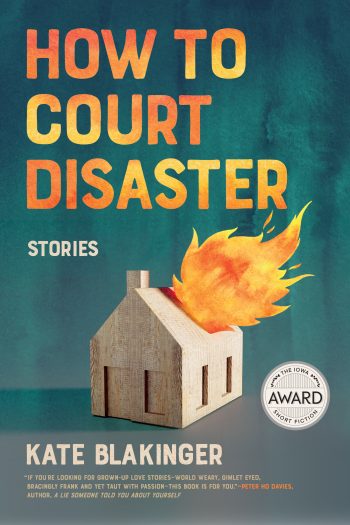
A book cover can do a lot to set the reader’s expectations. Take the cover of Kate Blakinger’s collection, How to Court Disaster (University of Iowa Press, 2026), with its miniature wooden house, roof ablaze with cardboard cutout flames raging and billowing up into a tiny atmosphere. The book’s design builds a perfect metaphor for Blakinger’s narratives, in which her characters’ lives have exploded into chaotic situations whose aftermath readers get to witness.
Blakinger’s debut won the Iowa Short Fiction Award and features stories that originally appeared in outstanding journals like The Gettysburg Review, Catamaran, Epiphany, The Iowa Review, Alaska Quarterly Review, and Harpur Palate, which is where I first encountered her story, “Tracks.” Reappearing now as the final story in Blakinger’s collection, “Tracks” depicts one of the most fascinating moments of unrequited love I’ve read in short fiction.
Each of Blakinger’s characters is searching for something they thought they once had, or something that was never there in the first place: In “Tracks,” Angela’s fervor for her lake surfer boyfriend, Rex, isn’t returned with quite the same passion, which leads her to find a new outlet for that intense love in a way that surprises everyone, especially the reader. The wife in “Ice House” longs for the version of her husband from before his car accident. Gracie in “The Hothouse Lounge” lusts after her roommate, Joanne. And Celeste searches for answers in an Italian cavern after her daughter’s death in “Trick of the Dark.”
Earlier this fall, Blakinger and I spoke over the phone about shrapnel, spelunking, and how stitching a story collection together feels like crafting a mix tape.
This interview has been edited for length and clarity.
* * *
The Rumpus: What was the first story in the collection to get published? Can you walk me through how that story came about?
Kate Blakinger: Sure. The first one to be published was “Beast,” which came out in The Iowa Review under a different title. It was a weird, wonderful experience writing that story, a kind of magical situation where I wrote it in four days, and then I didn’t really have to make any major edits. That almost never happens for me.
It came out of an assignment I got in grad school: a retelling of a fairy tale. So I had the original fairy tale to work with and against, and this looming deadline to meet, and, back when I was a grad student, I didn’t really have to attend to anything else in my life: no other job, no kids. For those four days, I could just live in my pajamas and write, so all of that helped.
Rumpus: Versus the usual process of writing something, revising the hell out of it, submitting it, receiving far more rejections than acceptances, perseverance and then maybe, just maybe, eventual acceptance? Wash, rinse, repeat?
Blakinger: Usually it’s much more of a slog. Both parts of it: the writing and the submitting. When I write, I’m mostly a pantser. The ideas that bubble up organically are almost always more interesting than anything my conscious mind could’ve come up with in advance. As a result, since I don’t really have a plan, I do sometimes get stuck and have to regroup and rethink. And sometimes I’m so stuck that I have to move over to a different story and then come back after some time has passed. Then, I can see that first story that I hit a roadblock on more like a stranger would, as if someone else had written it. That distance usually opens up a way forward.
Rumpus: If something’s not working here, it’ll work someplace else.
Blakinger: Exactly. It’s helpful for me to always be writing something. I don’t necessarily write every day, but I do like to always have a project underway, something my mind is actively turning over. One weird effect of this process of toggling between stories, though, is that occasionally certain things bleed over. While making final edits to the book, for example, I cut a detail from one story that echoed something from another story. It was distracting.
Rumpus: Do you remember what that recurring detail was?
Blakinger: In “The Hothouse Lounge,” the narrator’s brother has this wound from the Iraq War, where all this shrapnel is embedded under his skin. These bits shift and surface slowly, over time. I had a character in another story, “Dogs Who Break My Heart,” who also had that same type of wound. For the book, though, this seemed confusing. I didn’t want readers to think this might be the same character showing up in different stories. So my copy editor and I decided to take this detail out of that second story, where it seemed more incidental.
Rumpus: That bleeds nicely into my next question. I’m always curious about how authors of story and essay collections decide to assemble those works together—how they decide to structure them. Here in How to Court Disaster, for example, I love that you’ve got these long, focused stories for about the first three-fifths of the book, and then you get into several flash and shorter fiction selections, and then it opens back up into these last two longer stories. From what you remember, how did you build the overall collection? Who was part of that decision, and what was behind it?
Blakinger: It was really all my decision. The ordering happened before I submitted the manuscript. I didn’t really know how to approach it at first. I had to experiment a lot. One helpful thing I did was to take the first and last sentence of every story and print them out. Then I physically arranged the sentences in different orders, trying to get a feel for what it would be like to move from a particular last sentence into another story’s first sentence. This helped me to settle on a provisional order.
Once I had that, I read the full manuscript and realized that some of those choices didn’t feel quite right to me. So I moved things around more. It was very much like trying to put together a mixtape—trying to get the transitions right and also trying not to clump things that were too alike too close to each other. I made these choices intuitively, but your observation about story lengths is interesting. A slow or sagging middle section is always a risk in a book. The impulse to put some shorter pieces in the middle may have come out of a desire to keep the overall momentum up through that middle section. Once I submitted the collection, the University of Iowa Press didn’t want to switch the order around or make major changes, maybe out of respect to the contest judge’s choice.
Rumpus: The contest judge was Jess Walter, correct?
Blakinger: Yeah. His novel Beautiful Ruins is a favorite of mine, so it was such an incredible honor to have him reading and responding to my stories.
Rumpus: I love that. I can imagine how awesome getting that email must have been, but it’s absolutely, 100% deserved. This collection’s so damn good.
I know I’m shifting gears here, but throughout several of the stories, there’s this current of unanswered longing. Can you talk about how this thread worked its way in?
Blakinger: Having a character who’s yearning for something and then unable to really make good on those desires is just a really fruitful situation for a story. Longings create motivation to act. Really, that’s what I’m always hoping for, to get my characters making choices, for good or for ill. For Gracie in “The Hothouse Lounge,” having a crush on her roommate means her home life is messy. It means there’s pressure on her in all parts of her life, and acting on her desire creates new complications for her. In “Ice House,” the narrator’s desire is bound up with grief. Her husband has been changed by the accident. There’s no undoing that, so the question for her becomes something like: Can she find her way back to that love she’s remembering with the person he is now? In “Tracks,” you’re so right that the relationship is lopsided, but by the end, I’d say Angela’s clocking Rex’s immaturity in ways she hadn’t at the start. Her desires change as she becomes more sure of herself.
Rumpus: In each of these characters, too, there’s this great breadth between what they want and how much they’re not going to get it, and I just really love that.
You mentioned in your author’s note for the book a bit about the research you did for some of the stories: for example, spelunking and the existence of the Timavo River in Italy’s Karst Plateau for the story “Trick of the Dark” and then the history of Cabeza de Vaca for the backdrop to “A Lesser Man on Land.” But for people who haven’t read the collection yet, can you walk us a bit through how the research you included helped you build the stories here?
Blakinger: Research for fiction is interesting because often what you’re looking for is texture or details to make your stories feel realistic, and you don’t always know what those details are going to be. You don’t know what you’re searching for exactly. So a lot of times when I was doing research for these stories, I focused on reading widely, and then unexpected things would surface as I read, and those details would get folded in. Sometimes, they’d change the trajectory of the story.
A lot of research happens before I even know I’m writing a story. I’m just reading about something that interests me. The idea for the story comes out of that reading. For the caving details, I’d actually gone caving a long time ago in Puerto Rico. But I never considered setting a story in a cave until I read a book called Underland: a Deep Time Journey, by Robert Macfarlane. It’s this amazing nonfiction book that explores all kinds of underground spaces. There was a chapter about the Karst Plateau cave system that rekindled my own memories of this caving trip I’d taken. That trip sparked all these resonant feelings: a bit of fear, a bit of wonder, and then this rush of euphoria when we reached a point where there was this opening in the ceiling above us and all this sunlight was suddenly pouring into the cave. That memory flashed to mind while I was reading this book. And I kept thinking, “I need to write about a cave.” Something about it just kind of pulled at me.
Besides researching cave systems, I also read a lot about the merchant marine. Ships feature in a couple of these stories. Again, a lot of this reading came first, before I’d written a word, though I did have to do some fact-checking research later on. Because I don’t always write about places where I live—places that I’m super familiar with—I do sometimes have to check details as I write.
Rumpus: Can you write about Philadelphia, where you’re based now, or is it still one of those places that are more difficult to use since you live there?
Blakinger: I think there’s something unique about cities. In a city, you have all these different communities that are a little bit separate. I mean, they overlap, but there are a lot of different worlds contained in a city, even in a single neighborhood. So I feel as though I can write about Philly now in part because, even though I live here and have for many years, I still feel like I’m a little bit of an outsider to certain parts of the city. That gives me a distance that I find useful as a writer.
A couple of the stories do have some Philly in them. It usually does help to no longer live in a place, to observe it from afar.
Rumpus: I love that. You mentioned that “Beast” was the first story that you wrote and which would eventually pop into the collection. But what was the last story that you wrote for the collection?
Blakinger: That was “Trick of the Dark,” which was actually originally a chapter from a novel that I set aside. In that chapter, I began following Celeste, though she was only a minor character and the events of her life really had nothing to do with what was happening in the main narrative of the novel. This was perhaps an early sign that the novel wasn’t working. It was kind of like I was trying to escape the novel through writing a chapter that didn’t belong. The real challenge was turning that chapter into a story, giving it more shape and finding an ending that worked.
Rumpus: I ask because, in that period between where you started off with “Beast” and where you wound up with “Trick of the Dark,” how would you say that you’ve changed modes or styles or trajectories or processes as a writer, from that first story to the last story in the collection?
Blakinger: My writing itself did change a bit and also my process changed. I think early on in grad school, I really was just trying to figure out how to tell a good story and trying to do simple things well. This shows up in stories like “Tracks,” where the action unfolds in one continuous take. I was just trying to figure out how to write a good scene and keep that scene interesting until enough tension had built up for it to work as a story. But then with later stories, the structures got more complicated. Some of them have two alternating points of view. Others are braiding two narratives together. I became interested in challenging myself to try to make more complicated structures work within the tight confines of a short story.
As far as process goes, I think one thing about grad school is that you learn so much craft while you’re there, but you don’t necessarily learn what process works best for you. You’re in this artificial situation where you have deadlines and you also have time. You’re there to write. That’s what you’re supposed to be doing. But then you graduate and you maybe don’t know how to fit your writing into your life in a way that works, now that your life is more complicated and has more moving parts. At least, that’s how it felt to me. I didn’t understand what writing process worked for me for a really long time.
These days, I know that I need to write scene by scene and revise as I go. I can’t write a fast, shitty first draft where I just power straight through. I have to go back in and revise and make each scene crystallize enough to suggest what might come next. Getting the scene right lets me see into the dark ahead. And if I get really stuck, I love to brainstorm in a notebook or make little diagrams. So while I’m not outlining in advance, I think at certain points in the process I’m kind of mapping the story while it’s already underway.
Rumpus: You’re building that map as you go along. And even though you’re a pantser, you’re still putting together the plan as you’re working your way through it.
Relatedly—and I’m always curious about this—who are some of the authors or books or collections you had to read in order to figure out the shape or the language used in any of the stories for How to Court Disaster? Who have been some of your direct influences on this particular book?
Blakinger: Definitely Denis Johnson and Jesus’ Son. And also this collection called Red Ant House by Ann Cummins. That was a real touchstone for some of the earlier stories. She just captures the voices of her characters in such a wonderful way.
Also Mary Gaitskill, who I think conveys her characters’ complicated inner states with incredible precision, and I love that about her work. And then Louise Erdrich, of course. She has a marvel of a short story called “The Stone” that I think about often. In terms of specific stories, “Beast” was very intentionally in conversation with Angela Carter and Kelly Link.
I remember I first read a Kelly Link story in a literary magazine. She hadn’t published a book yet. I was on the subway, and I remember reading that story from start to finish and being so absorbed that I missed my stop because I was just in a trance. It was so good.
Rumpus: That’s got to be like the best compliment ever that an author could get. “Hey, I missed my stop because I was so engrossed in your work.” That’s fantastic. I love that.
You’d mentioned a little bit ago that you’d been working on a novel. Now that How to Court Disaster is out, what are your current projects? What are you working on now?
Blakinger: I am working on a novel, a different one than I mentioned before. I mean this time around publication demands all kinds of other writing from you. So I’m not really immersed in the novel right now. But I have enough there that I know I’m going to go back to it once I have more time on my hands. It’s about grifters, art-making, and mother-daughter relationships. Meanwhile, I’m writing essays of various kinds.
Rumpus: I’m glad the University of Iowa Press has you for this. They’re keeping you busy with regards to promoting and marketing and things like that.
Blakinger: The Press has been wonderful to work with. Publishing a book is strange, though. I don’t know how you felt when your book came out, but for me, it feels like I’ve now got this new job that I’m not really qualified for, and I haven’t really been given any job training and I’m just trying to do my best. I don’t think being good at sitting alone and thinking about imaginary people really helps much when it’s time to promote a book.
The post Seeing into the Dark Ahead: a Conversation with Kate Blakinger appeared first on The Rumpus.





 Bengali (Bangladesh) ·
 English (United States) ·