

Envision a situation where you wake up to an order of artwork that you have done several months ago. There is no need to take a product off a shelf and print it or run to the post office.
This is what print-on-demand is all about.
Through POD, merchandise is produced once a client orders it, making artists have an opportunity to convert existing designs into merchandise without them being stored at home. A reality check is needed on passive income, though: the fulfillment can be passive, but you need to design, promote and optimize your store to do something.
So what can this look like for an artist?
What POD Makes More Passive
The easiest way to understand POD is to separate creative work from repetitive production work.
| The artist handles | The POD provider handles |
| Artwork and product ideas | Producing ordered products |
| Pricing and branding | Packing and fulfillment |
| Promotion and audience building | Shipping orders |
| Testing what customers want | Production equipment and stock |
A platform such as artiststore.com allows creators to sell merchandise without buying inventory upfront, with production and fulfillment handled only after a customer places an order.
Once a design is listed, the same artwork can generate multiple orders without the artist making each product by hand.
That is where the “passive” part begins.
Success Story 1: Bazil Zerinsky Turned Art Into a Full-Time POD Business
Artist and illustrator Bazil Zerinsky moved from the United States to Greece after leaving a 12-year career in the wine and spirits industry. She had long wanted to earn from her art, but selling original pieces did not initially bring the results she hoped for.
Then she discovered print-on-demand and connected it with Etsy.
Her experiments gained traction, and she eventually moved her designs to Printify. Rather than sticking to one product, Bazil tested different items, noticed what her audience bought, and expanded the winners. Printify’s case study says she later made a full-time living from her POD business in Athens.
Her biggest lesson is that POD is not effortless money. Bazil describes it as more passive than managing inventory and shipping yourself, while noting that listings, customer service, mockups, and promotion still require time.
What artists can learn: Let fulfillment become repeatable, not your creativity. Test products, learn what sells, and keep improving.
Success Story 2: Nadia Ahmed Escaped the Packing Routine
Artist and illustrator Nadia Ahmed built an online business around her drawings, prints, and merchandise. One illustration—a pair of ghosts in a pumpkin patch—went viral in 2021 and brought a surge of attention to her work.
More orders, however, can also mean more printing, packing, and shipping.
Nadia had already experienced doing that herself. She told Printful that fulfilling several orders a day was becoming time-consuming and would not be practical if volume grew dramatically. Switching to POD allowed Printful to handle printing and fulfillment while she focused more on the creative and business sides.
What artists can learn: A popular design is exciting. Packing that same design all day? Maybe less so. POD can separate earning from physically producing every order.
Success Story 3: Falleen Angeel Expanded With an On-Demand Store
Léa, the artist behind BOKE-Cr0w, shows how POD can work even when you already have a shop that people love. Before moving her products to Artiststore, she had reached 354 Etsy sales and earned a 5-star rating.
It was not a first shop of a beginner, this was a step of an artist who has already confirmed that there is a market where her work is appreciated.
In the items found in her current shop, like stickers, keychains, prints, pins, and standees, demonstrates how one artist can repurpose prior artwork as various types of products without the necessity of having inventory on hand. In such an arrangement, Artiststore helps by handling print-on-demand production and fulfillment, so the artist can focus more on the creative side.
What artists can learn: POD can support artists who are already growing, not just those who are just starting out.
How to Build Your Own POD Income Stream
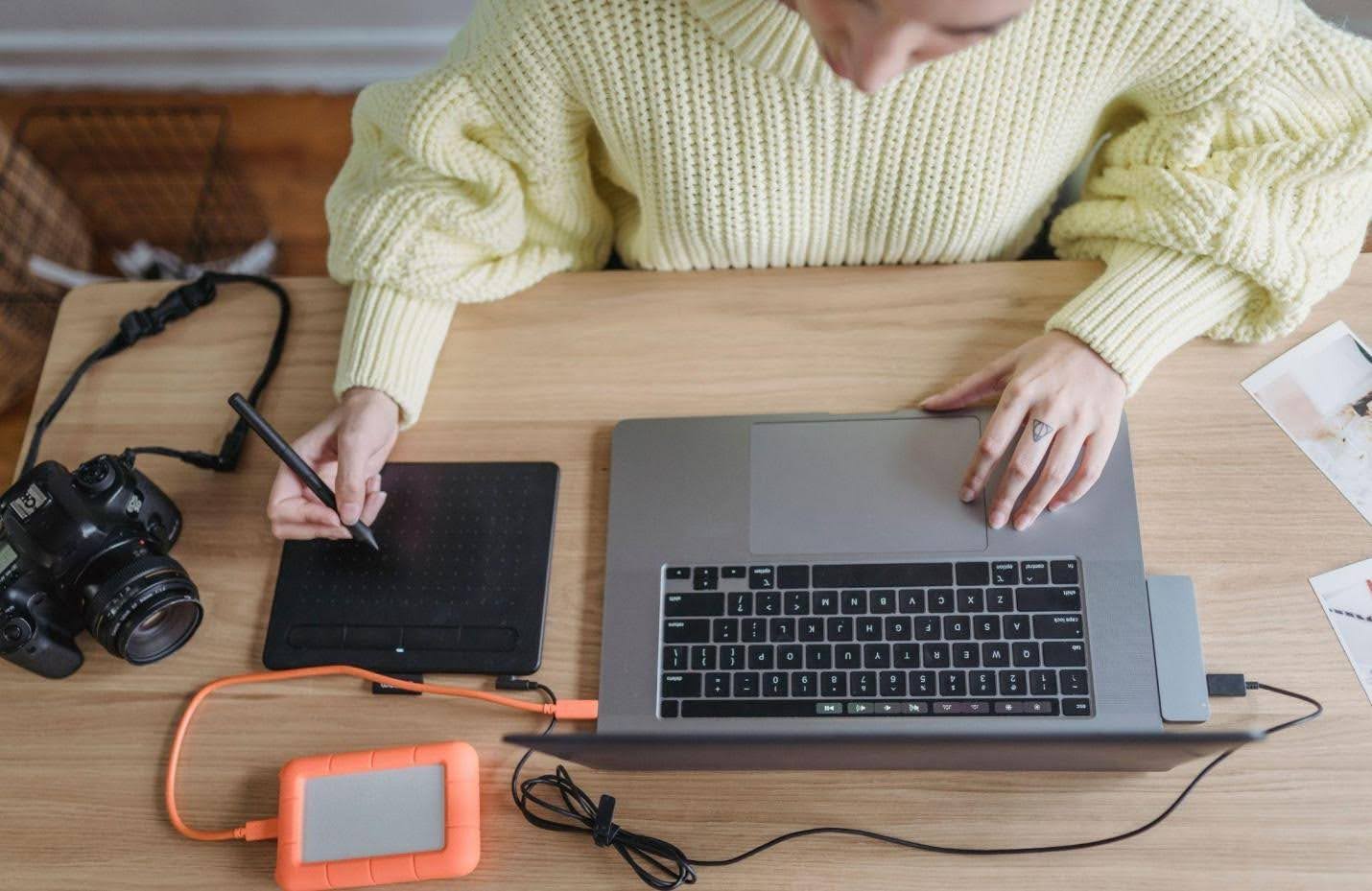
Artist working on a laptop with a drawing tablet and creative tools.
Do not upload your entire portfolio on day one. Start with a small experiment:
Choose proven artwork. Begin with designs followers already save, share, or ask about. Pick a few products. Match each design to products it actually suits. Check the result. Order or review samples when possible and see how the artwork translates. Launch and promote. POD removes inventory work, not the need to tell people your products exist. Study the response. Expand what earns attention or sales and rethink what does not.Important note: A design that performs well as a post will not automatically become a bestseller. Treat each product as a test.
Final Thoughts
The most useful part of POD is not the promise of “money while you sleep.” It is having more room to grow without doing everything by hand.
Bazil built a full-time POD business. Nadia found a way to keep growing without spending her days packing orders. Léa moved an already proven merch business into a new setup that gave her another way to sell.
Different paths, same idea: create, learn what your audience responds to, and let fulfillment take some of the weight off your shoulders. That is a much more realistic version of passive income for artists.




 Bengali (Bangladesh) ·
  English (United States) ·