
 11 hours ago
7
11 hours ago
7 
By MATTHEW HOLT
Strap in for the tale of why your hero is spending most of his life down YouTube rabbit holes of cardiology videos while blundering his way around many many medical centers and exposing many problems with American health care even before he gets close to the operating table. Yes it’s Matthew Holt’s pre-surgical complications – the complications that have arisen before he even gets his failing aortic valve fixed. And yes this is a multi-parter! Part 1 here
So on the Friday afternoon I was readying for my video call when there was a car parking emergency. I had to move two Sprineter vans and a car belonging to guests who were all out apres skiing out of our driveway so my wife could get her car out of the garage to get to an appointment she had. Although I was as quick as I could, I was about 10 minutes late for Dr Beygui but he very nicely called me up wondering if I was still okay to do it, was very cordial even though I made him wait, and we had a nice chat. He basically didn’t give me any new information in this conversation and yes UCSF did get paid for it! He was mostly assuming that I couldn’t walk a couple of blocks without getting short of breath but at the end of it we agreed that because I was in good physical shape and able to go snowboarding all day I would go ahead with a knee surgery later in the summer and only come back to him when I became symptomatic.
Starting in March I got the requisite knee imaging (I had an MRI and 2 X-rays confirming my meniscus is gone and knee was pretty trashed), met with Dr Bini and the ortho team and started prepping for the surgery later that summer–which basically meant going to the gym and doing lots of weights and resistance training on my knees.
A little later I got an unexpected call from Dr Beygui’s physician assistant who told me that he was still trying to line me up for the open heart surgery. I told him I was still keener on a TAVR. He said that I shouldn’t have a TAVR because the TAVR valves only last 5 to 7 years. Yeung from Stanford’s original report told me they lasted about 10 to 12 years. Emarihah the UCSF cardiologist said that they thought they lasted 10 plus years but there was no good data. Given you can probably have one TAVR and then have another put inside when the first one fails and then maybe even another (TAVR in TAVR in TAVR), these numbers actually matter!
Here’s the crux of the TAVR issue. If you can add 10 + 10 + 10 that gives you another 30 years of life which sounds pretty good to somebody in their early 60s. But if you can’t get more than 5 to 7 years out of a TAVR and can only do one more “TAVR in TAVR”, then you’re getting 10 to 15 years before you need to have a very complicated open heart surgery because it’s now replacing two different artificial valves. In that case I might not survive and I wouldn’t even be old enough to be President!
As you can see this decision is starting to get a little bit complicated.
But the good news was that I could stop thinking about it because my heart wasn’t getting worse and the orthopedics (and anesthesia) team at UCSF was happy to do the knee replacement.
As we were all steaming down this path I got a call from Dr Beygui’s scheduling assistant. My initial agreement had been to have an echocardiogram 6 months after the last one which would actually have been after the knee surgery. I’m not sure how much coordination between the departments there was given what happened a bit later but Dr Beygui requested that I have an echocardiogram before any surgery. As I was going in anyway to have a CT in mid-June to prep for the knee surgery, I said fine.
In another great drama of American health care it turns out that my insurance had changed. For most of the first half of the year I purchased a Blue Shield of California HMO on the ACA exchange called Covered California. In May my wife got a job and we then moved over to being covered by her employer’s insurer (well, ASO TPA as it turns out) Cigna.
Cigna and the entire University of California Health system decided to have a dispute which threatened that Cigna would not cover UCSF starting on July 1st. I won’t go into the crazy logic of why an insurance plan that one buys on an annual basis starting in January has contracts with providers that expire in the middle of the year, but welcome to America. Because of this the orthopedic team moved my surgery date up into late June just 4 days after all the prep imaging including that echocardiogram.
Oh and a few weeks earlier I had had a very minor snowboarding fall going very slowly in soft slushy snow. I banged my shoulder but for some reason it didn’t get any better. I actually went and had some physical therapy which seemed to help, but as I was hanging out so much at UCSF, I also had an appointment with the shoulder specialists. They sent me for a pretty uncomfortable MRI and the result from that was that I had total tears in all my rotator cuff tendons. The recommendation for that is surgery that also has a long recovery, but if you ignore it for too long the muscles can atrophy. Claude was very depressed for me when it interpreted that MRI report!
A spanner in the works
Those of you familiar with sod’s law can guess what happens next. The result of the echocardiogram was that the aortic stenosis had gone from being severe to being very severe. The precise number was that my peak velocity went from 4.6 m/s in Jan to 5.1 m/s in June just 4 and ½ months later.
I discussed this with my trusted health confidant and Claude guessed that this might be a problem and the anesthesia team might not want to have me get the knee surgery.
The next sequence of events reveals that nobody in American healthcare talks to each other.
The echocardiogram report came back Wednesday night and on Thursday morning (June 18) I got a call from Dr Beygui’s physician assistant. He wanted to line me up for an immediate angiogram to check whether my heart had any other conditions to prep for surgery. He also wanted me to talk with Dr Beygui on Monday. He’d previously tried to get me an appointment that day but it had been cancelled.
I pointed out that it may be tricky to talk on Monday because I was going to have a surgery that day with Dr Bini. He said, well I don’t know about that and I said perhaps you should communicate with the orthopedics group and he said that’s a different apartment and I don’t deal with them..
I sent a message using Mychart to Dr Bini’s team and his NP wrote back saying it is likely that “hearts trumps knees” but that we need to talk to anesthesia. As it happens I had had a prep call with the anesthesia team literally about 3 hours before I had the echocardiogram. They knew I had aortic stenosis and weren’t too worried but were going to get back to me after the echo result.
Now the result was back I did not hear from them. So far I have two departments or maybe three not wanting to talk to each other. I did have the phone number of the person from anesthesia who gave me that prep call, and I texted him later on Thursday afternoon asking if they recommended any changes.
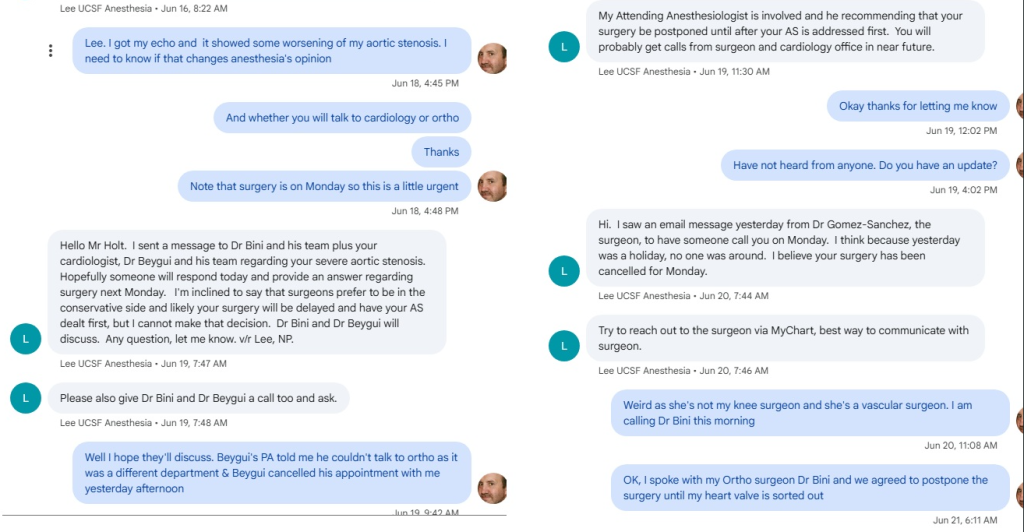
It’s now the middle of the day on Friday and I haven’t heard from anybody. Then I got a text message back saying the head of anesthesia is a bit uncomfortable with me having surgery. He also said that he saw a message from Dr Gomez-Sanchez telling someone to call me on Monday. I’d never heard of Dr Gomez-Sanchez but Google informs me she is a leading vascular surgeon at UCSF. Why she got dragged into my case I still do not know!
Finally I heard from the ortho Dr Stefano Bini who had the wrong phone number for me and had been trying to get in touch. He basically told me that we should suspend the knee surgery until I fix the heart. So no knee surgery.
So now we’re in late June and I look on UCSF my chart the next week and discover I have a heart valve surgery date for July 17th.
At this point I realize things are getting pretty serious and that I better figure out what to actually do.
(Part 3 coming soon)
Matthew Holt is publisher of THCB



 Bengali (Bangladesh) ·
  English (United States) ·