
 2 hours ago
2
2 hours ago
2 
Hasan Dudar’s debut collection, Carryout, follows a Palestinian-Lebanese family through their years in the shifting landscape of Toledo, Ohio. Dudar places the migrant experience at the heart of his book and offers a poignant examination of displacement and belonging in the Arab American community.
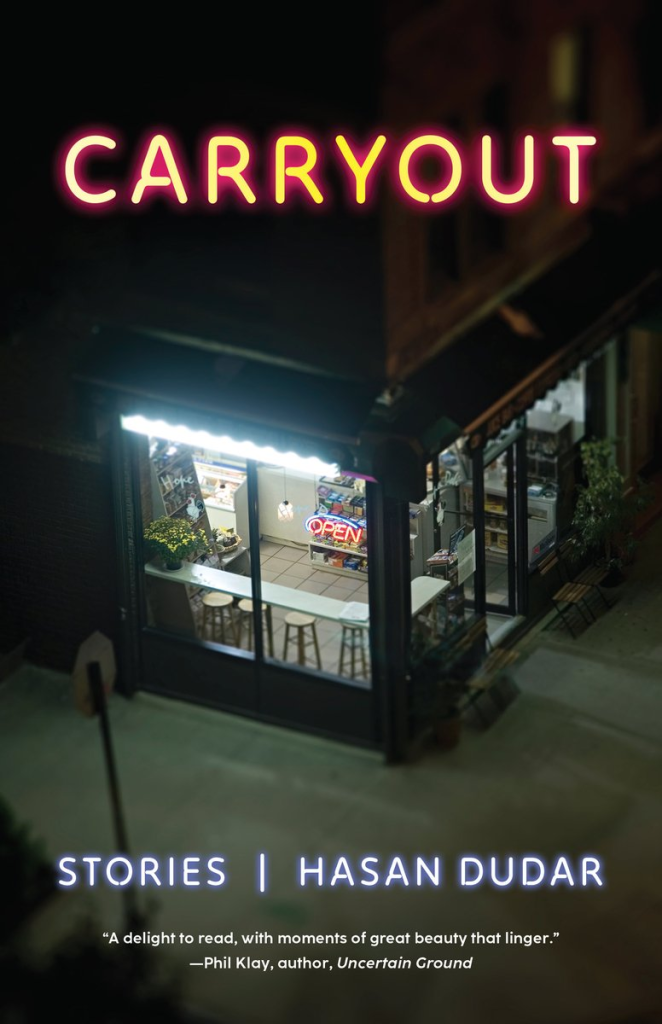
When Ziad Idilbi, a Palestinian refugee from Lebanon, meets Salma, a Lebanese refugee fleeing the war in Beirut, they are bound by a shared longing for their homeland. A desire to settle, build their own roots, leads them to buy a corner store in Toledo, across from the General Motors factory, amid a vibrant Arab community. Over decades, their lives and those of their children unfold. Mustafa, their oldest, navigates identity as a Lebanese American in the aftermath of 9/11. Walid, their youngest, broods and writes poetry, and later in life, becomes invested in his father’s refugee past. And Nawal, the only daughter, often remains in the shadows except for one tale about friendship and betrayal.
Hasan Dudar is a Toldeo native, based in Washington DC. In conversation over Zoom, Dudar told me he approaches fiction as a place to explore otherness, as a Palestinian, as a Muslim, and as an Arab. This resonates through Carryout, where the lives of this one family bring us closer to their experience, that of many Muslims and minorities trying to battle the nightmare that is America. We spoke about the Palestinian struggle, living in the US as Muslims under the shadow of Islamophobia, Western imperialism causing cultural and linguistic erasure in other parts of the world, and more.
Bareerah Ghani: I love the opening story, following Ziad in his early years in the US, especially the line, “That was no way to live, we knew, with half a mind on hold, treating every place like a hotel.” It is particularly poignant in Ziad’s case because his family are Palestinian, and they can’t return home. How do you contend with this fact that Palestinian refugees and others from war-torn places are essentially sentenced to a life of perpetual unease and false hope?
Hasan Dudar: That was one of the big questions of the book, and also one of the big questions in my own life, and that of my family. I’m a Palestinian-American, also Lebanese-American, by way of my mother. But the Palestinian identity somehow sticks through it all, and I think it’s because it’s one of those things that’s been unresolved. It’s a wound that really hasn’t healed.
This is what we see with Ziad. He is a Palestinian who was born in Lebanon. He grew up among Arabs, and yet he feels different. That is the essence of Palestinian identity––wherever you are, you feel a little different. And for the Palestinians in Lebanon, their predicament hasn’t been addressed properly. They’re still non-citizens after nearly 80 years. That has been felt through the generations.
I don’t want to generalize. There are so many different facets of the Palestinian identity. But I think one of the key parts is this sense of exile and displacement. You’re denied the acknowledgement of what’s taken place. And whether you’re born in Gaza, or West Bank, or Akka, where my father’s family came from, that sense sticks with you.
To experience the full breadth of life, you have to fail, taste something of your own folly.
BG: I’m curious about the epigraph. “On and on and on and on!” from A Portrait of the Artist as a Young Man by James Joyce. To me, it reflects displacement, but also resilience and survival. Can you share how and why the quote spoke to you?
HD: It comes from a longer passage that’s talking about our human capacity to both fall into error, and to find glory. And to experience the full breadth of life, you have to fail, taste something of your own folly. The passage ends with that line, which I thought captures life very well. How it doesn’t stop. And you continue to fail, and you continue to succeed, and it’s winding, sometimes you go backwards, sometimes sideways, sometimes you don’t know what direction you’re going, but you’re going on and on.
That constancy, the ability for life to surprise us, to upend us, is something I was after in my own work, especially dealing with characters who are displaced—something which is upending as much as it is full of constant surprises. You are forced to start over in many ways. And not just immigrants—for all of us this may be the case—we just sense it acutely in the life of the immigrant and the displaced. There are setbacks, major and minor, daily or yearly, but continuing may be its own form of glory.
BG: In “The Howara”, Walid talks about his family getting together and remembering the past but nothing is remembered as it was. What are your thoughts on the power of nostalgia in sustaining the idea of and sentiment around the homeland?
HD: Oh, it’s so strong. This book was born of nostalgia. When I began this, it was the first time I had really left home in a way that felt permanent. I had gone to Berkeley. From Ohio to California, it all felt different, and I was young. I really started to miss home, and that was very surprising to me. Because when you’re growing up, your whole being kind of rebels against being home. But in Berkeley, I found myself yearning for the life I had in Toledo, and the people that I was surrounded by. My father was sick at the time, and I would take any opportunity to go back home. On those visits, I really started to see the place with fresh eyes, what I’d left behind. My family, my community. Toledo, among the Arab community, was very village-like. People just dropped by. My parents had sold their convenience store, pretty much retired, and so had a lot of their friends. They had time on their hands, and they’d just visit my father. On those breaks, I would sit and listen as they shared their own nostalgia, about old Toledo when they first came, how good it was, and then sharing stories about Beirut, and if they were from different parts of Palestine, what it was like there in the cities and the villages.
I see nostalgia as a yearning to get back to an ideal that maybe you didn’t know was an ideal at the time. I think identity is so much molded by memory, and nostalgia is a way of forming yourself. You can never go back, but in that futile effort of attempting to go back, whether through telling stories, remembering, misremembering, a lot is gained. Your identity, personality, community, it can all form from there.
BG: Families in the book want Ziad to marry their daughters because they worry their later generations would lose their identity as Arabs, as Muslims. I wonder about the traumas we carry and how those might be broken through marriage. I would love your thoughts on this in connection with marriage as a way to influence identity, preserve heritage, especially for later generations.
The ability for life to surprise us, to upend us, is something I was after in dealing with characters who are displaced.
HD: Marriage is a very personal choice. To each their own, but in the context of being a minority somewhere, like in the US, wanting to stay within the same religion or ethnicity are serious, valid concerns. In terms of future generations, I can only speak from my own life. My wife is Lebanese, she mostly grew up between here and Lebanon. Our daughter speaks some Arabic, and this year, she got really into Ramadan. I wonder, would she have those things if both parents were not Arabic speakers, Muslim?
Another way I view this––with everything that’s been going on, my wife and I are chatting about the news in Lebanon, Iran, and we’re being careful of what we say around our daughter, because she’s young. But she still has the idea that Lebanon means something to us, and Palestine means something to us, and she’s now kind of starting to ask questions. It’s one of those moments that remind me of what it was like growing up. Every day my parents would turn on the news, my dad would always say in Arabic, ولّعت , like, it’s on fire now, and there was always this idea, that this is something important to him. That’s sort of where I learned from my parents about what was going on in Lebanon, in Palestine.
BG: In one place, you write that Lebanon hardly belonged to those who remained. And earlier in that chapter, Ziad meets a business contact in the Middle East who says something to the effect that soon, everywhere will be the same. I couldn’t help but think about Western imperialist notions driving cultural and even linguistic erasure in many parts of the world.
HD: The West has been influential through its culture’s ability to attract talent, viewers, and imitators. Worldwide, especially in the last 30 years, there’s been a struggle within cultures and countries, with people left wondering, do you assimilate to this more homogenous, westernized notion of the world or do you hold on to what’s more specific to you? And in a way, something specific to these characters, and to the Arab world more broadly, is the issue of Palestine. These characters are holding on to it, because it still needs holding on to, and where does that put them in relation to the world around them?
So the notion really came from the characters, how they viewed returning to the Arab world and Lebanon, in particular. I always try to take the character’s lead. They often know best. How did they view Lebanon, where even the Lebanese were being displaced? How did they view the Arab world, where you didn’t have to uproot yourself to live a life of Western comfort? And is this, in a way, its own uprooting? Perhaps there are many ways of being displaced, and the Palestinians, like Ziad, have mainly experienced one of those ways. It’s a terrible displacement, and through it, I sense Palestinians have held on to the identity to avoid having uprooted what’s left. In many ways, when it comes to assimilating, others may feel less guilt about it than someone like Ziad, who is more burdened, who feels there is more at stake.
BG: For Muslim immigrants in the US, this question of assimilation has been especially pressing in the last two decades. You masterfully depict the climate of terror in the Muslim community post-9/11. Given that Islamophobia continues to persist, how do you as a Muslim living in the US grapple with this reality, especially in your work as a journalist?
HD: I think there’s a lot of pressure on immigrants, on minorities, and on Muslims, more recently in the U.S. Things are asked of those groups that aren’t asked of others. There’s a sort of perfection that’s demanded of us. If someone screws up, does something illegal, it comes down on the whole community. The margin for error is very narrow. And there is a fear, a sense of doubting yourself, questioning your belonging.
I was fortunate to grow up in a community of Arabs and Muslims. The Arab community in Toledo goes back to the 1880s, and the Muslims maybe, the 1920s or so. It’s a very historic community that has really integrated itself in a lot of ways, but also remained itself in a lot of ways. I always found it kind of miraculous. I think that’s something the immigrants have, especially the children of immigrants and minorities, that other communities may not have access to. You get to come here, and you get to do it all over again. You get another chance at life, at your own self. And I think that’s something very original. That’s sort of what inspired me as I wrote this book. A lot of the people who were in my parents’ circle of friends in the Muslim or Arab community, they were eccentric. Which is to say, they had their own center. I felt that these people were so free, and authentic. They could be talking about wanting to go back to Lebanon, or the West Bank, wherever, and how life in America is awful, and why they came here and are regretting it. And then in the next sentence, they will say how wonderful it is. And all of it is true. They mean it all, and it’s sincere. They’re not apologizing for that mess of contradictions. I think that when we come here, we are asked to kind of give up all of that contradiction. It’s like, just sign up for this identity, and that’s it. But it’s so much more complex than that.
Identity is so much molded by memory, and nostalgia is a way of forming yourself.
BG: In my own community, I’ve noticed that people who migrated back in the day had this resolve to stay true to their roots, to hold on to our culture and identity. I feel like over time, my generation has slipped away. I see many Pakistanis whose kids don’t speak Urdu, and I find that appalling, because I think your language is so much of your culture and your identity, and you’re not passing that on. But their explanation is it’s just easier for the kids, and they can assimilate better in schools.
HD: It’s tough. I think we’re less social in a lot of face-to-face ways than we used to be. Growing up, we lived one house over from my uncle’s, and people were always at each other’s place. There was just always something going on in the community. I think that that impacted people’s identity, their language, their relationships with the community. I don’t want to speak for Toledo, because that may still be the case. I haven’t lived there in a while, at least as a father. But there was a kind of casual intent to get together, and that allowed so many other things to happen. Now you really have to fight for it.
My daughter understands Arabic. She can speak it, but she only really has me and her mother to speak Arabic with. When she went into daycare full-time, she was mostly speaking Arabic, but she quickly realized, where is this going to get me? I need food, I have needs. And so, it’s a fight, just on Arabic alone. For me and my wife, it’s not like: you have to learn this, this is important to us. It’s more like: this is part of who we are, and how we understand the world, so why wouldn’t we pass it down, or expose her to it? Once she’s old enough, if she wants to keep speaking it, it’s up to her.
BG: In “The Litani,” in the face of yet another experience of discrimination post 9/11, Mustafa notes his dad is always saying “Leave it to God.” For me, this idea of surrender is so integral to being Muslim, but I’m curious about your thoughts on the line between surrender and inaction, especially in face of injustice.
Palestinian Poets on the Role of Literature in Fighting Genocide
Summer Farah, Samah Fadil, Priscilla Wathington, and Rasha Abdulhadi discuss countering Zionist propaganda and mobilizing art into action

HD: That was kind of a recurring line, a recurring sense among the characters. I wanted something that felt true to where they were, to how they viewed the world. I think it can be many things at once. Leaving it to God can kind of be a capitulation. “I’m powerless here in these worldly matters.” But I also think that it can be a guiding principle; sometimes when you let go, things fall into place. And in these characters’ lives, I wanted to explore how they were in a world that they perhaps couldn’t change. And the only thing that they could really change is their approach, and it’s not to see the other side as right. It’s like when Ziad tells his son, let them have it-–don’t go after what’s not yours. It can be a liberating thing.
In the face of injustice, you should fight, stand up for your rights. But in that particular story, they’re facing the question of: Is there any changing this? You know who you are, and know what you stand for, and sometimes that’s as much as you can do. Sometimes, it’s not so much a capitulation or surrender as it is to understand that this wouldn’t change the reality of the injustice. I don’t have the answer for what would change a lot of these injustices. I think if people had those answers, it’d be a much simpler and better world. But I think through fiction and literature, you look at how people respond to these issues of power dynamics, of powerlessness, of being othered. And you try to look for what’s true to that character in that moment.
The post Othered Into Belonging as a Palestinian American in Toledo, Ohio appeared first on Electric Literature.




 Bengali (Bangladesh) ·
  English (United States) ·