


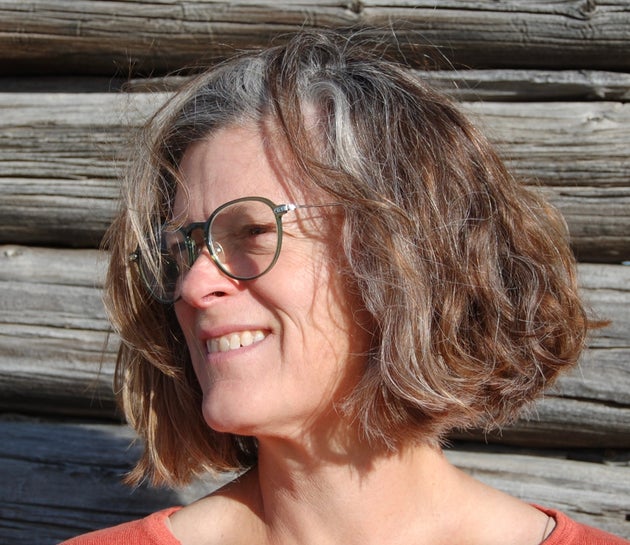
 The author today.
I recently listened to an episode of The Oprah podcast that explored what it described as the “rising trend” of family estrangement.
It included personal stories from adult children who had cut contact with their parents, from parents who had repaired their relationships with estranged children and from parents who had not.
Oprah also invited a panel of three experts – all therapists – to offer their perspectives.
Overall, I thought they did a great job looking at the issue from multiple angles. But one of the experts, therapist and author Dr Joshua Coleman, presented his point of view in words that left me feeling dizzy, nauseous and cold.
According to Coleman, “the old days of ‘honour thy mother and thy father,’ of ‘respect your elders,’ have given way”. He blames the shift partially on social media content about “toxic families” which he says encourages “inflammatory reactions” to parents’ behaviour.
He also says that therapists are partially to blame, for pathologising parents with language like “narcissist”, “gaslighting” or “boundary-crosser”.
But throughout the podcast, he uses similar words to describe the children who decide to cut off their parents: “conflict-avoidant”, “depressive”, “overreactive.”
While he accedes that some parents are abusive, he goes on to claim that the majority who have been cut off are loving and caring. Making the choice to go no contact, he says, “is positioned as a sort of virtuous act of protecting our mental health. I think that’s a problem”.
Coleman’s personal experience of being cut off from his adult daughter for several years, and working as a therapist with other estranged parents who are baffled and angry, led him to write a book entitled, Rules Of Estrangement: Why Adult Children Cut Ties And How To Heal The Conflict. He uses the book – as well as his platform at The Washington Post, and now Oprah’s podcast – to counsel parents whose children have cut contact.
But his message is, in my opinion, focused on the wrong culprit, treating estrangement as the problem, rather than a solution – as a last resort – to a real and intractable problem.
I decided to go no-contact with my mother after 50 years of confusion and suffering. All of my attempts to talk to her had failed. When I tried to tell her how I felt, she would attack me about something else entirely, or she would say I was “too sensitive,” making “a mountain out of a molehill”.
I had never seen any of the social media accounts that Coleman refers to, and I didn’t have a name or label for my troubles with my mother, but I did know that it took me weeks to recover every time we spoke. Something needed to change, and it did: I figured out that I didn’t deserve to be treated that way. The “us” problem had a “me” solution, one that required space and breathing room.
Coleman said that parents and adult children need to figure out how to talk to each other, but he would not concede that going no-contact might be part of that process.
Before cutting him off, Coleman says his daughter tried to communicate about the abandonment she felt after he remarried and had more children, and he responded to her, in his own words: “defensively and angrily.”
He acknowledged that a shift happened only when he realised that he was making it all about himself, and he needed, instead, to listen to her and find the truth in what she was saying. This only happened after a period of estrangement.
 The author's son and her mother playing their last game of Parcheesi in 2006.
My mother was a divider, driving wedges between me, my sisters and our extended family. She undermined my choices and routinely demeaned my husband and our two children. Once, while she was visiting, we included my mother in our weekly family meeting, which we always began with a round of compliments.
My mother, a therapist herself, couldn’t do it. Her face twisted into a horrifying mask of discomfort. Insults dressed up as compliments – the “you aren’t as awful as you used to be” kind – came through her gritted teeth. I stopped her before she got to the kids.
You’d think the necessity of putting space between us would have been obvious to me then, but I was still very much influenced by our culture’s elevation of family as your central core, and I believed that love meant finding a way to get along, no matter what.
When Oprah asked one of the adult children in the audience to explain why he had gone no-contact, he described a situation similar to mine, but he, unlike me, had recognised his parents’ insults and manipulations as intolerable abuse from the get-go and cut contact to protect his children.
Without acknowledging that the young man had already tried to talk to his parents, Coleman expressed his only concern was that the young man was modelling to his children “that people can be cut out of your life”.
Luckily, the two other experts – Dr. Lindsey Gibson and Nedra Glover Tawwab, both therapists and authors – pushed back on Coleman’s characterisation by telling the young man that, on the contrary, he was teaching his children about boundaries and that they have a right to set boundaries.
And that, I believe, is the crux of the issue – boundaries. But even more so: rights.
We are at a cultural inflection point now with family estrangement, in much the same way we were with divorce 50 years ago. Back then, keeping the family intact at all costs was seen as the “virtuous” choice. Those costs, of course, were borne by the ones with less power, usually women, who were often told by family, counsellors and clergy to stay in abusive and otherwise intolerable relationships.
Unfair labour practices and financial systems made it difficult for women to leave even after they won the legal right to divorce. Only when both parties in a marriage can set boundaries, and have a right to leave if those boundaries are broken, can an uneven power dynamic become a negotiation between equals.
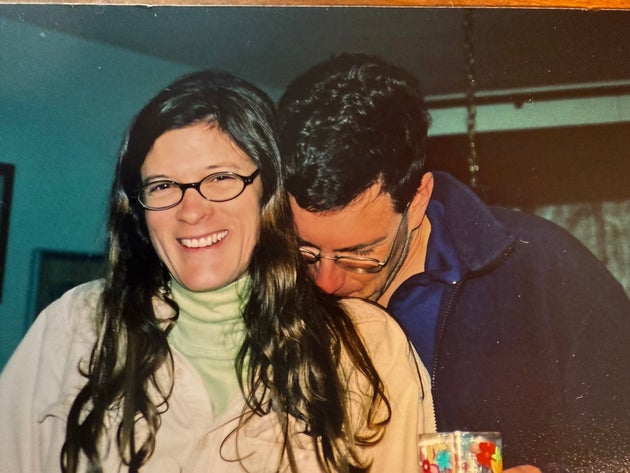 The author and her husband in 2005.
We are experiencing a backlash to this evolution of marriage, just as we are seeing pushback such as Coleman’s on the change in cultural attitudes toward family estrangement. Up until recently, it was frowned upon when adult children distanced themselves from their parents. It was taboo to even talk about it.
This gave parents cover in avoiding the self-reflection that might allow them to empathise with and reconnect to their adult children. When an expert like Coleman confirms their beliefs that they are the aggrieved party, the parents don’t have to recognise their grown children as adults who have the right to set boundaries for themselves. They don’t have to consider repair over control.
Toward the end of Oprah’s podcast, Coleman offered one more observation: We have “radically expanded our views of what constitutes harm,” and are now penalising parents for things that were not considered out of bounds at the time. I wanted to ask him, “Is that such a bad thing?” Our definitions of harm may have changed, but the suffering it caused was always there.
Harm done is harm done, regardless of a person’s level of understanding or intent. It is one of our jobs as parents to teach our children that there are consequences for their actions and they must take responsibility for their mistakes and make amends. How then can a parent refuse to do the same?
But the most lasting impression came from one word a young woman used in answer to Oprah’s question: What did she feel after breaking contact? She replied, “I knew peace for the first time.”
That was the big surprise for me after I cut contact: I also felt peace for the first time in my life. Grief, too, but no anger. Just clarity, and a groundedness in the knowledge that I had made the right decision for myself and that I had the absolute right to make that decision.
As a parent, I have made mistakes and my grown kids have been angry with me at times, but I try to be humble and empathetic and available, and to listen whenever they need to talk. If one of my children needed to separate themselves from me, I would be sad. But I would also respect their right to make that decision, even if I disagree with it. Who wouldn’t want peace for their child?
Lea Page’s memoir about family estrangement, Exhale into the Wind, is forthcoming from Sibylline Press, spring 2028.
Do you have a compelling personal story you’d like to see published on HuffPost? Find out what we’re looking for here and send us a pitch at [email protected].








 Bengali (Bangladesh) ·
  English (United States) ·