
 2 hours ago
3
2 hours ago
3 
TLDR
Brent crude rose to $85.57 and WTI climbed to $80.46, both up nearly 3% on Tuesday The U.S. military reinstated a naval blockade on Iran and began enforcing it from Tuesday Trump proposed a 20% fee on cargo transiting the Strait of Hormuz, which could add ~$16/barrel in shipping costs Two UAE tankers were struck by Iranian cruise missiles in Omani waters, killing one crew member Tanker traffic through the Strait of Hormuz dropped to its lowest level in two monthsOil prices jumped nearly 10% on Monday and extended gains on Tuesday as tensions between the U.S. and Iran escalated sharply in the Strait of Hormuz.
Brent crude futures rose 2.7% to $85.57 per barrel on Tuesday. West Texas Intermediate climbed 3% to $80.46 per barrel. Both benchmarks hit their highest levels in about a month.
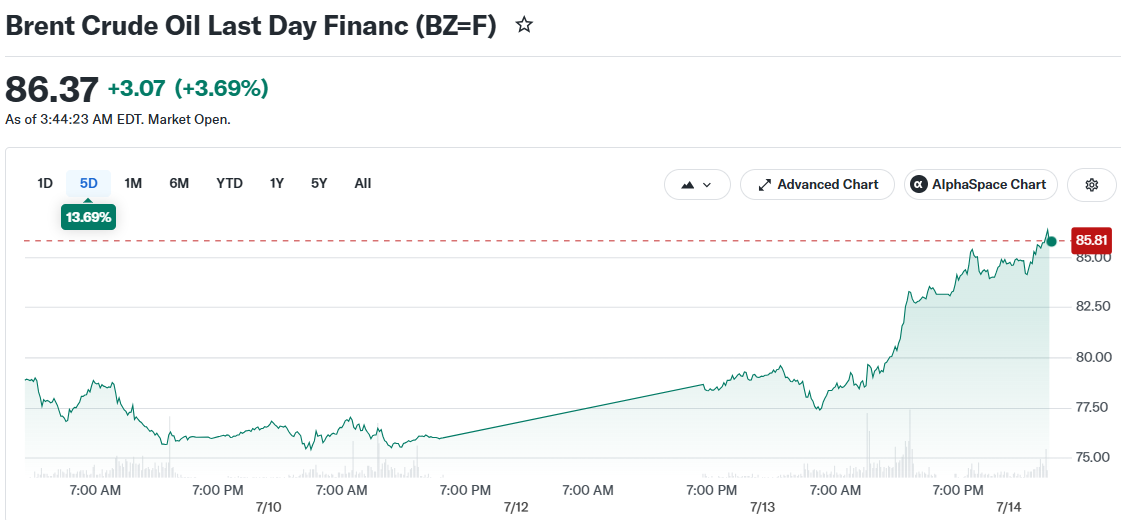 Brent Crude Oil Last Day Financ (BZ=F)
The surge followed President Donald Trump’s decision to reinstate a naval blockade on Iran. The U.S. military said it would begin enforcing the blockade from Tuesday, targeting vessel traffic linked to Iran while allowing neutral commercial ships to pass.
Trump also announced a 20% fee on all cargo moving through the Strait of Hormuz to cover security costs. ING analysts estimated this could add roughly $16 per barrel to shipping costs on large crude carriers, well above Iran’s earlier proposed $1-per-barrel toll.
BREAKING: President Trump says the US is reinstating its blockade of the Strait of Hormuz for Iranian ships and customers.
Trump says the US will now be known as "The Guardian of the Strait of Hormuz" and will be "reimbursed" at a rate of 20% on all cargo shipped.
It appears… pic.twitter.com/MtjidgWMMM
— The Kobeissi Letter (@KobeissiLetter) July 13, 2026
Monday’s session saw Brent post its biggest single-day gain since May 2020, rising 9.6%.
Attacks on Tankers Raise Alarm
The situation in the Strait of Hormuz turned more serious after Iran struck two UAE tankers with cruise missiles in Omani territorial waters. One Indian crew member was killed and eight others were wounded, according to the UAE Ministry of Defence.
Iran also launched drone attacks on U.S. assets in Kuwait and struck another vessel in the waterway.
The U.S. military carried out a third consecutive night of strikes against Iran on Monday. These strikes came after weekend exchanges of missiles and drones effectively ended a fragile understanding reached last month to ease tensions.
Tanker movements through the Strait of Hormuz dropped to their lowest level in two months, according to shipping data.
The Strait handles roughly one-fifth of global oil consumption. Analysts said any further disruption to tanker traffic could push prices even higher.
“While a full closure hasn’t occurred, the competing objectives of both sides have made the supply picture highly uncertain,” said Tim Waterer, chief market analyst at KCM Trade.
Regional Tensions Spread
Yemen’s Houthi movement fired missiles at Saudi Arabia on Monday after accusing the kingdom of bombing an airport under its control. Analysts warned that if the Houthis extend attacks to Saudi crude exports in the Red Sea, more supply uncertainty could follow.
Tehran warned that continued U.S. military action could trigger further attacks on regional energy infrastructure.
The oil price jump weighed on equities and raised inflation concerns as investors reassessed the impact of higher energy costs on global growth and central bank policy. U.S. crude stockpiles were also expected to have fallen last week, adding further upward pressure on prices.
The post Oil Prices Rise 10% as U.S. Reinstates Iran Naval Blockade and Attacks Hit Strait of Hormuz Tankers appeared first on CoinCentral.





 Bengali (Bangladesh) ·
  English (United States) ·