
 3 hours ago
4
3 hours ago
4 

Key Points
The job hasn't changed, but the degree required to get it has. Over the past three decades, one profession after another has raised its educational entry price: a bachelor's became a master's...a master's became a doctorate...a short training course became a year of mandatory classes.
These new requirements are adding years of tuition and borrowing for careers that pay roughly what they paid before the new requirements were added. The labor market simply doesn't pay more because you got more education.
Economists call it degree inflation, and the most surprising part isn't the cost. It's who decides "what's required". In many licensed fields, the degree you must "buy" isn't set by Congress or your state legislature. It's set by private organizations most Americans have never heard of: accrediting agencies.
And because of how the higher education system is wired, a single change by one of these groups can raise the required degree standards for an entire profession in all 50 states at once, with no election, no hearing in your statehouse, and no vote by anyone you can vote out.
That system is now squarely in Washington's crosshairs. The Department of Education's negotiated rulemaking committee reached consensus on May 21, 2026, on new regulations that would put a stop to this practice. The Department had named "credential inflation" as an explicit target when it launched the committee in January.
To understand why that matters for your family's college costs, you first have to understand a system that almost nobody outside higher education knows exists.
Would you like to save this?
How The College Accreditation System Works
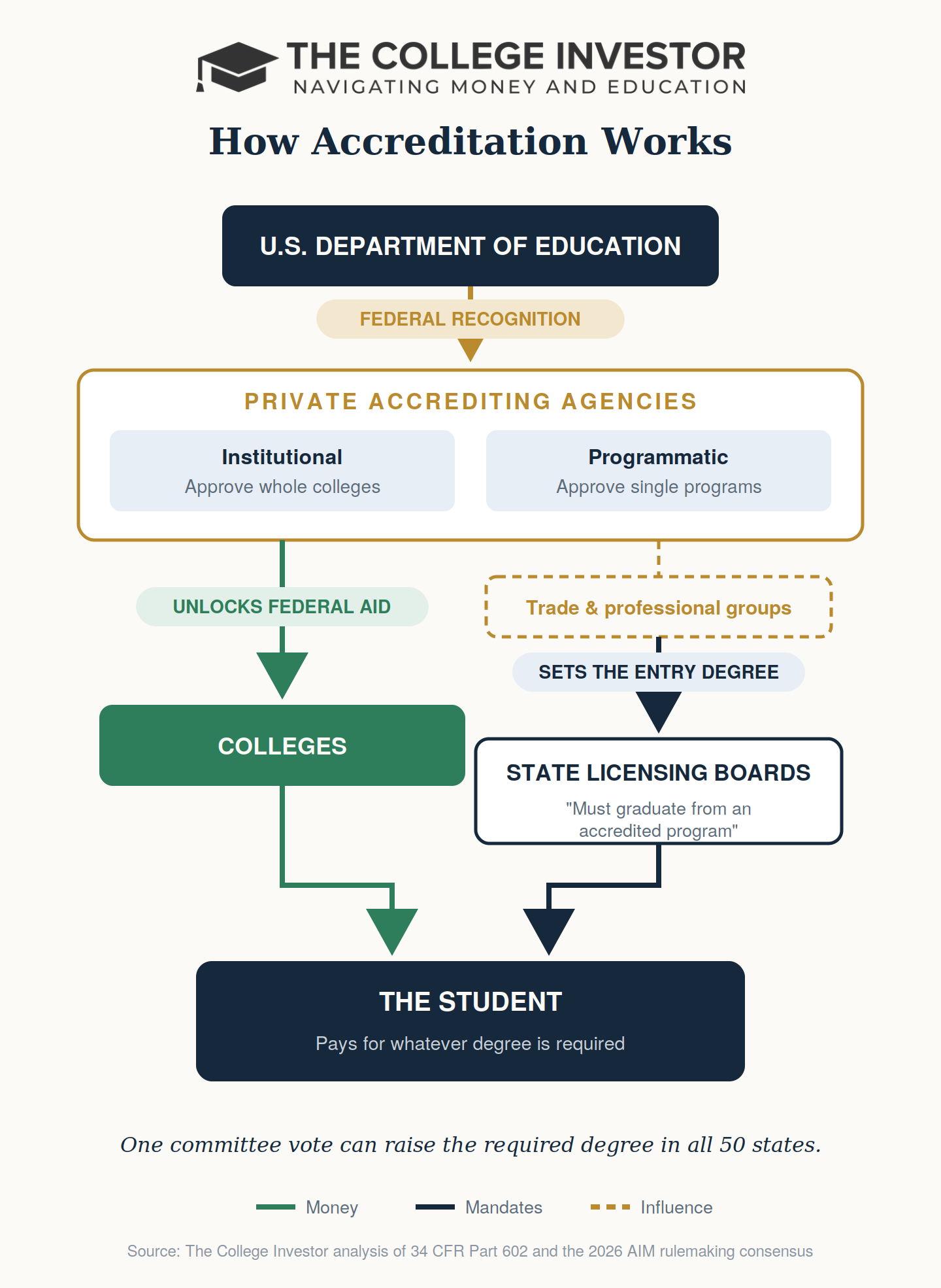
Here's the part that surprises most people: the federal government does not accredit colleges. No government agency inspects your university and certifies its quality. That job belongs to private, nonprofit accrediting agencies, which are membership organizations run largely by the colleges and professions they oversee.
The Department of Education then "recognizes" accreditors it deems reliable, and that recognition is the master switch for federl money. A college can only offer federal student aid (Pell Grants and federal student loans) if it's accredited by a recognized agency. No accreditation, no federal aid, and for most schools, no viable business.
This is why accreditors are called gatekeepers: they stand between $100 billion a year in federal student aid and the schools that want it.
There are two layers. Institutional accreditors (names like the Higher Learning Commission or SACSCOC) approve entire colleges. Programmatic accreditors approve individual programs within them: the pharmacy school, the nursing program, the occupational therapy department. These programmatic agencies are typically founded by, and housed next to, the professional associations of the fields they oversee.
Then comes the final link in the chain, and it's the one that turns a private standard into public law: state licensing boards.
When your state licenses pharmacists or physical therapists, it almost never writes its own educational requirements. It simply requires graduation from an accredited program. That one phrase outsources the state's judgment to the private accreditor.
So when an accreditor decides to raise the entry degree for a profession, every state's licensing requirement rises with it automatically, with no legislature ever taking a vote.
Degree Inflation In Action
Here's a few examples of degree inflation in action:
Physical Therapy
Physical therapy is the cleanest example of the whole machine at work. In January 2016, the field's accreditor, CAPTE, made the Doctor of Physical Therapy the required degree for every accredited entry-level program. Because states license new PTs only from accredited programs, the bachelor's and master's pathways that trained generations of therapists are no longer offered anywhere in the country.
Everyone already licensed was grandfathered, which is why the staff page at a typical clinic still shows "PT," "MPT," and "DPT" credentials side by side. Three different degree levels, one license, the same patients, the same work — and essentially the same pay.
The Bureau of Labor Statistics reports a single median wage for the occupation, and industry salary guides are blunt that what moves a PT's paycheck is experience, specialty, setting, and location — not degree level. That mixed roster is degree inflation made visible: the practitioners themselves are proof the job could be done, and is still done every day, without the degree now required to enter it.
The change didn't reflect on anyone in the field — it simply made it more expensive to become a PT without moving the paycheck on the other side.
Pharmacy
Pharmacy had the same thing happen. Pharmacists used to enter the field with a five-year bachelor of science, but then the accreditor forced everyone to the Doctor of Pharmacy.
The Chronicle of Higher Education flagged both fields as "credential creep" back in 2007.
Occupational Therapy
Occupational therapy is facing this crisis right now.
In August 2017, the field's accreditor, ACOTE, mandated that every master's program convert to a doctorate by 2027 (PDF File). The backlash was immediate: practicing therapists, employers, and educators pointed out there was no outcome data showing doctorate-holders got better jobs or pay (PDF File) than master's graduates doing identical work.
After two years of internal conflict, the mandate was rescinded in 2019 and the master's path survived. But the reversal came from member revolt (not because of any law) and many universities converted their programs to the pricier doctorate anyway.
Nursing
Nursing is facing the same pressures as other health professionals. However, the main pressure is actually come from states who are making it more expensive to become a nurse.
New York's "BSN in 10" law, enacted in 2017, requires new nurses to earn a bachelor's within ten years of licensure. North Dakota once required a BSN outright but repealed it in 2003 amid a nursing shortage.
Accounting
The accounting profession's 150-hour rule, which forced CPA candidates into effectively a fifth year of college, was adopted state by state at the urging of the profession's national association.
However, it's now being dismantled, with Ohio first in January 2025 and more than 30 states following with pathways that swap the extra year of school for an extra year of work experience. California's new law eliminates the 150-unit requirement outright.
Cosmetology
At the certificate level, the numbers get grim. Certificate programs like cosmetology are one of the most impacted degrees on the "low earning degree" list that would ban federal student loans.
And you can see how licensing issues make this degree so expensive:
Every state licenses cosmetologistsCompleting the required classes costs more than $16,000 on averageStudents borrow over $7,300 to do it on averageCosmetology courses generate the fifth-largest share of student loan borrowers of any program in the countryHalf of workers in many states earn under $30,000 per yearThis is all for a job that many of the workers have been doing themselves since they were teenagers. But here's the craziest stat: the training to become a cosmetologist averages about a year of coursework, compared with roughly a month for an EMT... the person who responds when you call 911.
Random Employer Requirements
Employers add their own layer. A Harvard Business School analysis of 26 million job postings found that 67% of postings for production supervisors demanded a bachelor's degree, while only 16% of the people already doing that job had one.
A follow-up FREOPP analysis later found a partial "degree reset," with requirements dropping from millions of postings in the last several years.
What The New Rule Does
The new regulatory language from the Department of Education's Accreditation, Innovation, and Modernization (AIM) negotiated rulemaking, goes after the accreditors directly.
The consensus text (PDF File) says a recognized accrediting agency may not "act to restrict access to employment in a profession, occupation, or vocation" unless it presents clear and convincing evidence to the Secretary of Education that the restriction is necessary to protect the public, that the expected public benefits outweigh the costs of reduced access to the profession, and that no less restrictive alternative would work.
The rule then defines restricting access in exactly the terms that describe the last 30 years of degree inflation: taking steps to increase credentialing standards, and increasing the cost or level of required education or training.
How The Test Would Work Using The Occupational Therapy Example Above
Under this rule, ACOTE's 2017 doctoral mandate couldn't have taken effect on a committee vote. The agency would have needed to prove to the Department of Eduction (before acting) that the doctorate was necessary for public safety and that no cheaper option existed.
Given that even OT programs acknowledged there was no evidence the doctorate produced better outcomes (PDF File), that attempt would almost certainly have failed.
The rule also adds "firewalls" to attempt to keep affiliated associations from steering the accreditor's decisions through the people it appoints and the money it controls — turning a supposedly independent quality check into the profession's own gatekeeping arm.
Programmatic accreditors must be "separate and independent" from their affiliated professional associations: separately elected decision-makers, separate dues, an independently set budget, public representatives making up at least one-seventh of the decision-making body, mandatory conflict-of-interest controls, public disclosure of all association relationships, and even physically separate offices.
Meeting these requirements would now become conditions of federal recognition. And if an accreditor raises a degree requirement without clearing the evidence bar risks, it risks losing its recognized status - which in turn would stop the federal financial aid pipeline for its schools.
Because the committee reached consensus, the Department is bound to use this agreed text in its rule, which would take effect July 1, 2027. However, higher education groups expect legal challenges before then.
What These New Rules Won't Fix
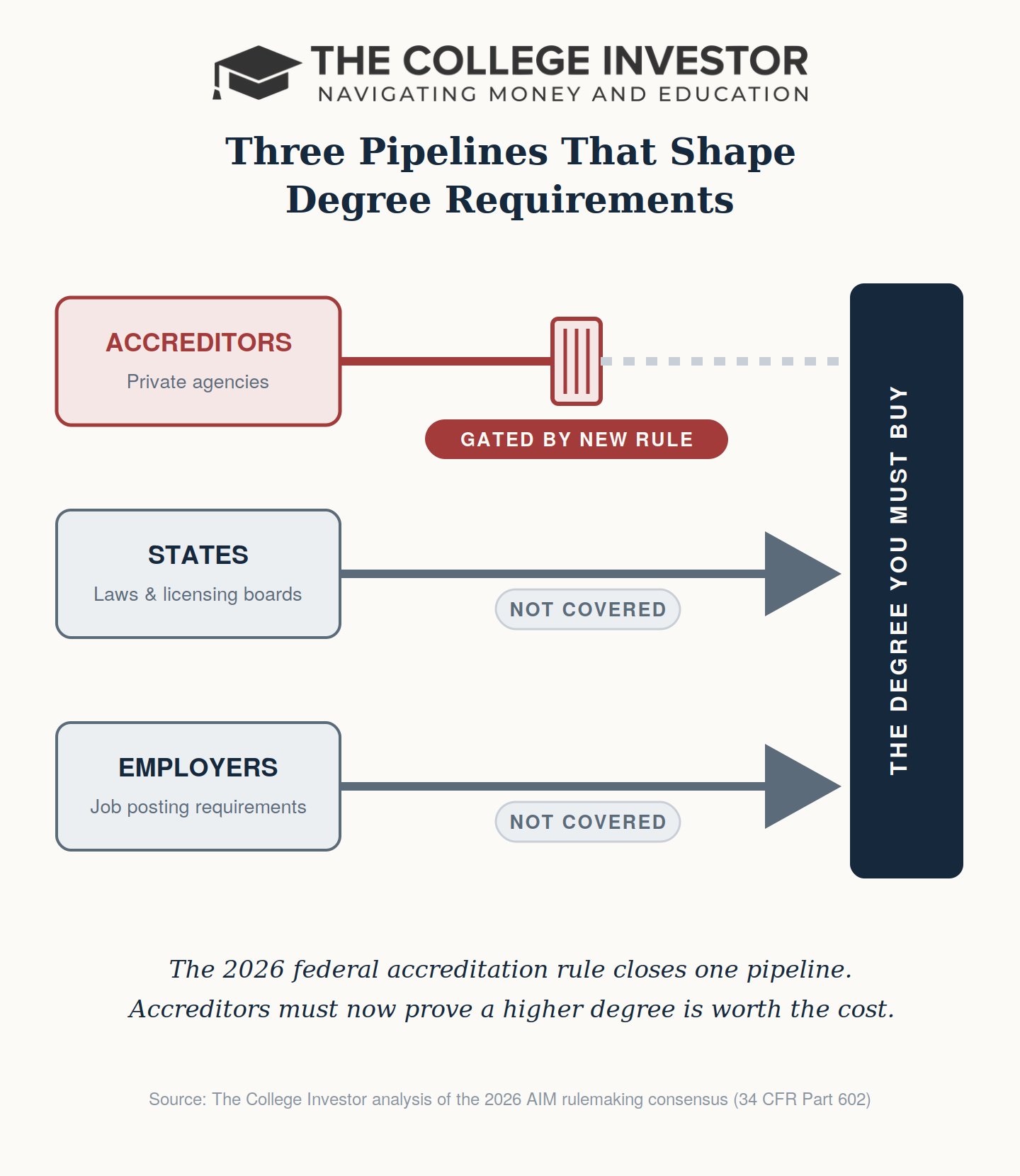
It's important to note that degree inflation can happen three ways:
AccreditorsState LawsEmployersThese new rules only impact accreditors.
State legislatures and licensing boards remain free to raise requirements on their own. As such, the rule doesn't touch BSN-in-10 or cosmetology hour mandates.
The rule even mentions it explicitly: accreditors are permitted to align their standards with state licensure requirements, industry standards, and employer hiring practices. So the pressure to raise credentials doesn't vanish, it simply relocates to state legislatures, where professional associations must now win the fight in public, state by state, instead of once at the accreditor.
This makes the entire process to increase degree requirements slower and more visible, which is arguably the point.
Employer degree preferences in job postings are also entirely outside the rule's reach.
And accreditors that never seek federal recognition (such as business education's AACSB) operate outside this system altogether.
What This Means For Your Family
Every time an agency increases the entry-level degree requirement, it has the same impact: more years of tuition, more student loan borrowing, and more years of delayed full earnings, all for the same job at roughly the same pay.
This rule arrives at the same moment as another force pushing in the same direction: the graduate borrowing caps in the One Big Beautiful Bill Act, which took effect July 1, 2026.
Grad PLUS loans are gone for new borrowers. Graduate students are capped at $20,500 per year and $100,000 total in federal loans, while professional students at $50,000 per year and $200,000 total.
The collision with degree-inflated fields is already measurable. According to a PEER Center analysis we covered in April, 63% of physical therapy borrowers currently take out more than the new limits allow, one of the highest rates of any graduate field.
And the doctorate-holding physical therapists at the center of this story were initially excluded from the higher $200,000 "professional" tier under the Department's definition, a fight that has already produced a 23-state lawsuit and an injunction temporarily allowing the higher limits.
In other words: the accreditor required the doctorate, and now the federal loan system may not allow students to finance it.
Together, these two policies squeeze degree inflation from both ends:
The accreditation rule limits how much education can be requiredThe student loan caps limit how much required education can be financedA program that stretches to a doctorate now faces students who literally cannot borrow enough federal money to pay for it. And a separate provision in the same rulemaking pushes accreditors to judge programs on their economic returns relative to total cost using federal earnings data.
This means that a long, expensive credential that doesn't pay off becomes an accreditation liability rather than a revenue strategy.
There's a flip side families should watch. The new student loan borrowing limits, without cheaper programs could simply push borrowers into private loans. And our analysis of why private lenders can't fill the gap found that credit requirements alone would exclude over 40% of potential borrowers.
The optimistic scenario (shorter, cheaper pathways into licensed professions) depends on schools and accreditors actually responding to the new incentives rather than shifting costs onto students.
Don't Miss These Other Stories:
Editor: Colin Graves
The post New Department of Education Rule Makes Accreditors Prove Degrees Are Worth The Cost appeared first on The College Investor.





 Bengali (Bangladesh) ·
  English (United States) ·