

The December 2026 issue of Reason explores Argentine President Javier Milei's accomplishments and what is yet to be done.
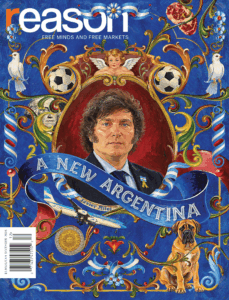 Reason
Argentina has spent 80 years failing to keep its currency stable. During the 2023 presidential campaign, Javier Milei promised a reform to stop the pattern: abolish the peso and adopt the dollar.
Dollarization was central to his platform. Argentina's monetary institutions had failed too many times to be trusted again. The solution, he said, was to take the currency out of the Argentine government's hands altogether. More than two years later, the peso is still here, and as president, Milei has largely stopped talking about the dollarization he once saw as essential.
Milei's government has made real progress against inflation. Monthly inflation has fallen from 25.5 percent when Milei took office to roughly 2 percent today. That's a genuine achievement. But inflation fell faster under both Ecuador's dollarization in 2000 and Argentina's own currency board in the early 1990s, and neither coincided with a recession as severe as Argentina's recent one.
Dollarization was meant to keep today's progress from becoming just another stabilization that failed to survive the next election. Why did it disappear from Milei's agenda?
Trusting the Government Doesn't Work
The standard advice to a country with Argentina's problems is to do what its more economically stable neighbors do: run a sound fiscal policy, let an independent central bank manage the currency, and allow inflation to fall over time. Peru, Uruguay, and Chile have all followed versions of that path.
Argentina has tried it too. Repeatedly. In the 1990s it adopted a currency board, and beginning in 2016 it tried inflation targeting under a well-regarded central bank. Both were technically reasonable, but each ended in a currency crisis that made future stabilization efforts harder to trust.
The problem was never a shortage of competent technocrats. Argentina keeps alternating between two economic policy regimes: One government stabilizes the currency and balances the budget, then a populist party takes over, prints money to fund spending the country can't afford, wrecks the currency, and loses power. The gap between the two policy approaches is so wide that no exchange-rate regime is sustainable. Argentina can neither fix nor float its currency. The government that inherits the mess then must convince markets and voters that this time is different, even as it relies on the same institutions that just failed.
The problem isn't that any particular president lacks credibility. The country's institutions lack credibility, and for good reason: Argentines have watched this cycle repeat for 80 years.
That currency board is the closest Argentina has come to formal dollarization. Its collapse is also why a currency board isn't a credible option today. The regime ended in the catastrophic 2001 crisis, when the government changed the law and dismantled the peg. Argentines learned that a fixed exchange rate is only as durable as a government's willingness to uphold it. The idea behind formal dollarization is to close this vulnerability.
Dollarization takes the currency out of politicians' hands. Abandoning a fixed exchange rate can take little more than a phone call. Reversing dollarization would mean reintroducing a currency no one wants, an act far more radical and visible than merely abandoning a peg.
That means dollarization can cut inflation without the drawn-out output loss associated with a gradual, reversible disinflation. When people believe a regime truly can't be undone, they stop planning around a future devaluation rather than waiting to see whether the government finishes the job.
The Cost of a Currency Nobody Trusts
Wealthy Argentines and large firms have spent decades building defenses against their own currency: dollar accounts abroad, inflation-indexed contracts, ensuring the ability to reprice quickly when costs rise. Most people who can afford to opt out of the peso already have. Many economists describe Argentina as "informally dollarized": The dollar is the currency that Argentines actually save in, though it lacks legal-tender status.
But not everyone can opt out. A small business owner must hold pesos to make payroll, buy inventory, and pay taxes. A family living paycheck to paycheck may have little opportunity to save in a foreign currency. When monthly inflation reaches double digits, a peso earned on Monday can be worth meaningfully less by Friday. The people least able to reprice, hedge, or convert are the ones who absorb that loss in full.
There's a less visible cost too. Every hour a small business owner spends repricing inventory, chasing a dollar hedge, or tracking shifting exchange rates is an hour not spent serving customers or improving the business. Inflation taxes not just savings but attention.
Currency controls compound the problem. Small importers who need dollars to buy inputs from abroad have often had to navigate a maze of exchange restrictions and multiple exchange rates just to run their businesses, while larger firms with financial sophistication and political access find workarounds.
Inflation falls hardest on people with the fewest tools to escape it. Dollarization would help every Argentine business and household, but most of all those with no way to protect themselves.
Why Dollarization Didn't Happen
If the case for dollarization is this straightforward, why didn't Milei go through with it? The most charitable explanation is that his government never fully understood how to carry out a dollarization plan.
In a 2025 interview, Economy Minister Luis Caputo said dollarization had been ruled out because Argentina lacked enough dollars. That claim doesn't hold up. Countries that have dollarized, such as Ecuador in 2000 and El Salvador in 2001, didn't need to convert every sucre or colón into dollars on day one. Physical currency was exchanged gradually, over periods ranging from nine months to two years, while bank deposits and tax payments were redenominated into dollars almost immediately. In Ecuador, the central bank's own dollar reserves grew during the transition rather than shrank.
The government's on-again, off-again interest in a 100 percent bank reserve requirement—a policy no dollarized economy has ever actually run at scale—points in the same direction. Ecuador also dollarized amid a banking collapse and a default, conditions considerably worse than anything Argentina faced when Milei took office. If Ecuador could do it under those circumstances, then Argentina could have done so at the start of Milei's term and could certainly do so now, from a stronger position than it had at the outset. The constraint was political, not technical.
A Lasting Solution?
A May 2026 International Monetary Fund report found that Argentina's gradual disinflation path would require roughly a decade of sustained discipline to succeed. With another presidential election in 2027, there is no guarantee the strategy will remain in place long enough to succeed.
None of this means Milei's stabilization program is doomed, or that dollarization was ever guaranteed to succeed. But two good years, even four, are no substitute for a lasting solution, and a legacy built on a temporary stabilization is not a legacy at all—it is a preface to the next crisis. Workers and small-business owners bear the brunt of every currency crisis, and they have heard versions of "this time is different" before. Whether Milei is remembered as the president who ended that pattern or merely postponed it may depend on a reform he has stopped talking about.
The post Milei Campaigned on Dollarizing Argentina. As President, He Stopped Talking About It. appeared first on Reason Magazine.




 Bengali (Bangladesh) ·
 English (United States) ·