
 1 month ago
54
1 month ago
54 
Valeria Luiselli is no stranger to incorporating tangible records of the world in her writing. In The Story of My Teeth, she exchanged audio recordings with a group of Grupo Jumex workers at a juice factory in Mexico. In Tell Me How It Ends, she listened to, transcribed, and interpreted the testimonies of undocumented children. In Lost Children Archive, the protagonist is a sound documentarist. In Echoes from the Borderlands, Luiselli moved beyond the page to bring the US-Mexico border to life in a 24-hour sonic essay/chapbook that was originally presented as a sound installation. Her newest novel, Beginning Middle End, is written in fragments and includes the sounds of volcanoes exhaling and fishermen singing, among other recordings from Sicily accessible via a QR code in the book.
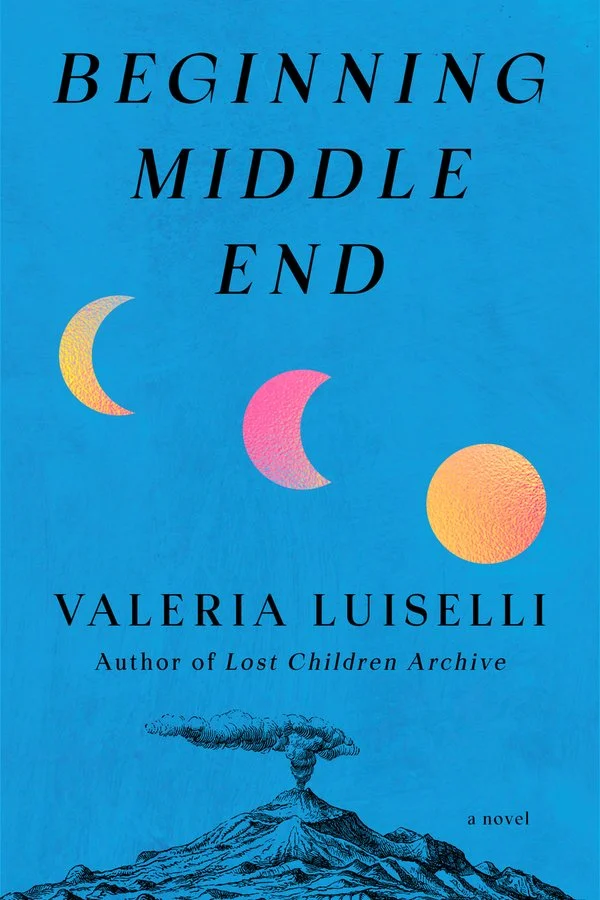
Beginning Middle End is a mother-daughter road novel that journeys through time and genre. The story unfolds in vignettes as an unnamed narrator and her 12-year-old daughter travel to Sicily to return an archeological relic that the mother’s grandmother had taken years before when she migrated to Mexico. Interspersed polaroid pictures, postcards, and sounds become records of their lives, blurring the boundary of narrative forms as the novel dives into geography, mythology, and archeology. Yet, the beating heart of the story remains these four generations of women, all storytellers in their own way. The narrator/mother is writing her own novel about a mother and daughter on a journey; meanwhile, the daughter is documenting their trip through letters and photographs to her grandmother, whose memory is rapidly failing––archiving memories for the one who is losing them.
The result: a novel that folds time and writing itself. A tripartite novel with three suitcases, a title in three parts, and a fourth layer nestled inside, like the great-grandmother of the stolen relic and the memories the characters in Beginning Middle End are trying to piece together. The story leaves the reader wondering how fractured memories can be preserved and told through fabricated narratives. What is it to live in the middle when memories are fading away?
Valeria Luiselli and I are both Mexican writers, born on the same day of the same year, both living in the United States. Via Zoom, we talked about sounds, migration, tectonic plates, translation, and the power of fiction and narrative to shape children’s imaginations.
Ofelia Montelongo: As I was reading the novel, I kept thinking about how themes of displacement and the mother-daughter relationship have been central to your earlier work. How did your earlier work migrate into the imagination of this novel?
There’s always a moment in a novel when you have to abandon a path because you are already on another. Those abandoned paths are ones that I often pick up again in another book.
Valeria Luiselli: There is a line of continuity in many of my books. Maybe not a line that traverses all of them. I certainly see a very clear line from Los ingrávidos or Faces in the Crowd (2011), through this tiny thing I wrote that very few people have read called Swings of Harlem––a map of swings in Harlem where I started using Polaroid photography for the first time while documenting, in that case, a neighborhood and the swings in the neighborhood. And then, from Swings Of Harlem to Lost Children Archive and, of course, Tell Me How it Ends as well, but that’s a very straightforward, nonfictional testimonial piece.
OM: How are the narrators and main characters different in each story? And different from you as the author?
VL: The characters are not the same. The narrator has a different profession in each of the books. In Los Ingrávidos she’s a translator, in the Lost Children Archive, she’s a sound documentarist. And in the Beginning Middle End, she’s a fiction writer.
The narrator somehow has grown alongside me. You know, it’s like she’s a kind of presence in my life, as are her children, stepchildren, and half children. It’s sort of this lightly alternate world that communicates. Not so much with mine, but with my curiosities, with my pains, with my desire to understand things a little deeper.
I always end up writing about what I don’t know when I start writing a book, and the process of writing it is a process of me trying to get closer to knowing something. It’s the process of inquiry and research, deep essaying, trying things out, and there are always things left unexplored or not explored to the depth at which I would have liked to explore them. There’s always a moment in a novel when you have to abandon a path because you are already on another. Those abandoned paths are ones that I often pick up again in another book.
OM: One of the narrative forms you use in this book is sound, something you’ve also explored in your previous work. Can you talk about that choice and what drew you to it?
VL: In Lost Children Archive, I started delving deeply into sound. Sound as a medium, and as a space for deeper listening and deeper attention. But I explored it more at a level of fiction and theory. I read about it, I imagined it, I explored on paper, but I didn’t explore it in life. Shortly after, that exploration led me to a much deeper involvement in sound with Echoes from the Borderlands, where a daughter is also present, and I formed a collective with two other collaborators. Together, we’ve been documenting soundscapes in the borderlands for almost six years.
That was a seed that was planted in Lost Children and later bloomed into this project. Similar to Echoes from the Borderlands and Lost Children, I started having a deeper curiosity about observing the natural world and thinking about deserts and borders—not only human-made borders, but deeper, even tectonic borders, and trying to understand natural phenomena. I explore that much further in Beginning Middle End. It also takes place on a border.
OM: What kind of sounds can the reader expect on Beginning Middle End?
Sicily is an island that has belonged to everyone and to no one; no one belongs to it, and everyone belongs. It’s a very bizarre kind of borderland.
VL: There is an entire layer of sound that we recorded on-site in Sicily, and we recorded all the winds mentioned. We recorded underwater soundscapes and currents, beautiful volcanic exhalations––which sound a little like thunder, so I really hope the listeners understand that what they’re listening to is a volcano and not thunder. Strangely, volcanoes and thunder sound very similar.
We recorded fish markets where fishermen are screaming, saying things, and singing about swordfish. We have this entire sonic landscape that we are spreading together with the narrative, and not a single sound is stock sound. All sounds were recorded there. They’re very subtle. They’re more like a sort of Greek chorus, an emotional undercurrent for the novel. That translation work, like going from text to sound, has been such a beautiful experience, and as with everything, there are things lost in translation.
For example, the images are not part of the sound. When you are listening to it, you do not have images, but you have the entire sonic landscape, which is a very embodied way of being in a space, just as images allow you to see and embody a space.
OM: What is the significance of Sicily in the story? And how does it represent a border?
VL: Sicily is the border of Africa and Europe. But it is, first of all, a tectonic border, meaning the tectonic plate of Africa meets the tectonic plates of Europe under Sicily. As a result of the friction between those two tectonic plates, there is volcanic activity in the area, the bizarre winds, and the strange currents.
It’s a geological tectonic border, but it is also a geopolitical tectonic border. Most of the migration that eventually arrives on the European continent makes its first landing in Sicily and its surrounding islands.
Sicily has always been an island where all the cultures of the Mediterranean and, expanding outward even inland areas around the Mediterranean, have met, have clashed, have made wars, have coincided, have co-inhabited. It is an island that has belonged to everyone and to no one; no one belongs to it, and everyone belongs. It’s a very bizarre kind of borderland.
OM: Speaking about borderlands, the theme of migration is part of the story—perhaps not as pronounced as in other books you have written, but still there. The mother and the daughter are migrating somewhere.
VL: Everyone might have to migrate at some point. It is human history. Be it political violence, environmental catastrophe, or whatever other reason, it has always dictated great diasporas and migrations.
We never know who is next. People in richer nations tend to forget their own past of migration. Italians forget that they had to migrate out of poverty and that they migrated to Cuba and Mexico. My Spanish grandfather migrated to Cuba at age 12 to work as a carpenter.
Years later, he went to Veracruz, then settled in Mexico and worked in a factory. Contemporary Spain and Italy might not remember how much they owe to their people in America and the U.S. We just never know who’s next.
OM: It is interesting to consider that the characters are migrating toward their memories. The narrator talks about the three parts, beginning, middle, and end, but there is also a fourth part, the great-grandmother Nanna. The mother and daughter are looking to recover her memories. Memories that are no longer there. It is like an imaginary border of memories. Can you talk a bit more about the stories that are lost due to migration?
VL: It is only through contact with the other, in this case, someone from the past, that we come to resignify and better understand our present. Coming into contact with the past—the past of a family—is an antidote to cultural amnesia.
Stories of migration have to be told and talked about to understand one’s own origins, but also the deeper past. The mythological past that informed our conception of the world, how we organize a sense of time, our narrative of catastrophes, all of that is deeply coded in the ancients.
It’s also like passing the story on to the next generation, which I think is very important not only in literature but in everyday life. What instruments do we give the next generation so they can retell and reimagine the story?
OM: The narrator is also a fiction writer who explores the possibility of writing about a mother-daughter journey, and she wonders whether, in interviews, she would be asked whether this is autofiction or based on real events. I love the layers of fiction intertwined in these possibilities, which might make others ask you, the author Valeria, if Beginning Middle End is based on a real story. I love that we will never know.
We all have a right to imagine. We should exercise it freely.
VL: Not only that, but it doesn’t really matter, I mean, I understand human curiosity, we all have it. We all want to know what happened—todos somos chismosos—it’s part of the delight of human conversation. In terms of trying to understand a work of literature better, it really doesn’t help us. It’s a dead-end street, because there’s no yes or no answer.
Did this actually happen? Yes. So, what?
Did this actually happen? No. Okay. So does it really shine light on a piece of work? I really don’t think so.
It’s a kind of non-consequential conversation. If it’s real or not, who cares? I mean, we want to know, but really, it doesn’t matter.
OM: It’s also an invitation to the reader to create their own fiction, and wonder, “Do they return the mosaic? What happens next?”
VL: I think we all have a right to imagine. We should exercise it freely. I like to leave doors open for that in my work, not only for readers to be a very active part of the construction of a story, but even for my future self.
First of all, because I don’t know how to be in the world if I’m not writing actively. I do very badly in the real world if I’m not also in the process of constructing another reality. I have learned to trick myself into leaving, in each book that I open, the door for the next. An invitation for the next.
OM: Let’s talk about translation. Your work has been translated into various languages, and you have also translated at least one of your books. How was the translation process for this book?
The Empty Spaces: The Story of My Teeth by Valeria Luiselli
VL: This is the first book I [wrote] where I wouldn’t even use the term translation. I wrote it in both languages, period. I didn’t translate from one to the other. I just wrote it in those languages. I had previously done something like that with Tell Me How It Ends, but it was different because I first wrote a version in English and then translated it. What English there was, I translated into Spanish, but what really happened was that I wrote a lot more in Spanish than I originally did in English. That became the essay of Los niños perdidos, and then that was re-translated [into English], partly by the translator Lizzie Davis. That book went through several stages and layers of writing in one language, translating, then re-translating, and it became a book thanks to that back and forth.
In this case, I simply wrote both of them in both. The chronology of it is messy; it’s not quite retellable. Not linear. Which also means it’s not a translation. I wrote it in both languages.
The post Migration Touches Every Life appeared first on Electric Literature.




 Bengali (Bangladesh) ·
  English (United States) ·