

Writing in The New York Times, journalist and 1619 Project creator Nikole Hannah-Jones recently copped to the fact that she sent her daughter to poorly performing New York City public schools out of an ideological commitment to ending what she sees as structural or systemic racism, among other ills. She notes that she and her husband, who are both African American, attended integrated schools and benefited from the experience. Which helps to explain why her husband was at first steadfast against her plan. "As I told Faraji my plan, he slowly shook his head no. He wanted to look into parochial schools, or one of the 'good' public schools, or even private schools."
But Hannah-Jones ultimately won the argument by standing firm to her political commitments. "I understood that so much of school segregation is structural," she writes, "a result of decades of housing discrimination, of political calculations and the machinations of policy makers, of simple inertia. But I also believed that it is the choices of individual parents that uphold the system, and I was determined not to do what I'd seen so many others do when their values about integration collided with the reality of where to send their own children to school."
"In Fighting for Every Black Child, Did I Betray My Own?" has become a viral sensation in large part because Hannah-Jones fully and openly documents the undeniably substandard education her daughter was receiving at places like P.S. 307, which is currently allocated at least $43,927 per pupil according to city databases (the amount is higher still if certain related costs like transportation and lunch programs are included). And because she includes not just her husband's initial misgivings but her daughter's unmitigated anger when she realizes her education was being sacrificed on her mother's ideological altar. "Did you know my school was bad like this when you decided to put me here?" the daughter, Najya, asks early on. Later in the piece, Najya, now 16 years old and attending a competitive public high school of her own choosing, tells her mother, "Sometimes I wish instead of always thinking about other kids, you would have thought about me. I never really got the education I wanted." In an episode of the popular radio program This American Life, Najya is harsher still, saying, "There's no benefit that came out of you putting me in those schools. There's no benefit at all. Could you tell me a benefit?"
Oddly—and unconvincingly—Hannah-Jones attacks "school choice" throughout her story, as if it is the problem rather than a solution for students trapped by limited educational opportunities. I'll come back later to some of the ways in which I think Hannah-Jones' analysis is deeply mistaken, but for the moment, I want to explain why the story struck me with such intensity, even though I graduated high school fully 45 years ago (!) in 1981.
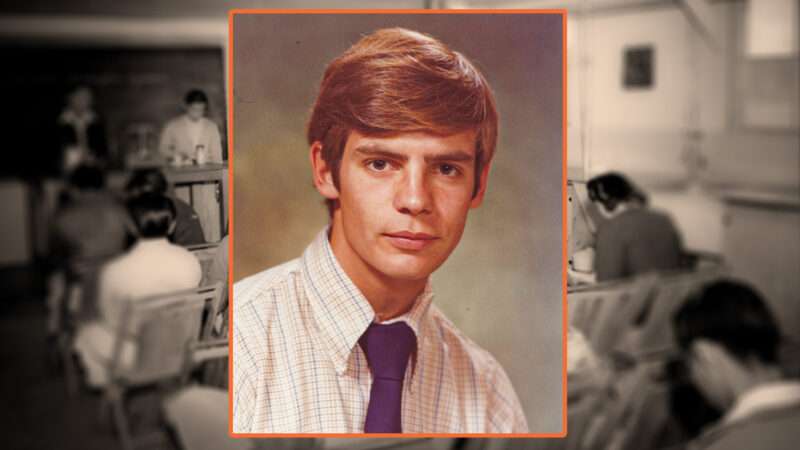
It's because my parents, just like Nikole Hannah-Jones, sent me to clearly inferior schools because of a misplaced sense of duty borne out of the past. Ironically, this didn't mean sending me to rotten public schools in a big city but to mediocre Catholic schools in the New Jersey suburbs in the 1970s.
My father and mother were born to Irish and Italian immigrants in the 1920s in New York City (father) and Waterbury, Connecticut (mother); their families were struggling long before the Great Depression hit and stayed that way until sometime after World War II. My parents married in 1950 and lived in Brooklyn but didn't have kids for almost a decade (the youngest of three, I was born in 1963). Like many New Yorkers, they moved out of the city toward the end of the 1960s, buying the one house they would ever own in Middletown, New Jersey, about 50 miles away from Manhattan and then on the very edge of commuting distance.
My father was a high school dropout and worked as an officer manager for a shipping company. My mother graduated high school in 1945 on a business track and worked as a bookkeeper until she had kids. We had enough to eat, but money was always palpably tight, even after my mother went back to work when I was around 10 years old. On a few occasions as a teenager, I paid utility bills out of my savings from after school or summer jobs to avoid service interruptions (my deeply embarrassed folks always paid me back). My parents bought a car about once a decade, and it was always a stripped-down model. (For reasons that remain obscure to everyone but the salesman, they bought a 1979 Chevy Malibu that did not have even an AM radio, much less air conditioning.)
Through my whole childhood, we went on exactly two vacations (a four-day trip to Washington, D.C. and a weeklong stay at a beach cottage in Lavalette, New Jersey, a 35-mile drive from my hometown). Unlike some of my friends' parents, my mother and father had no expensive hobbies, but even still, especially during the peak stagflation years of the 1970s, more than a few Christmases were as sparse as the branches on the artificial tree we used for about 20 years straight. Despite their own lack of education, they made it clear that my siblings and I would go to college but also were upfront that they would not be able to pay for it.
The one indulgence—if that's the right term—they insisted on was sending my brother and sister and me to St. Mary's, the local Catholic elementary school, even though the public school, Middletown Village, was closer and better appointed along virtually every conceivable dimension. When it came time to attend high school, they sent my brother to the expensive and highly regarded all-boys Christian Brothers Academy. That was a real reach for them, but so was Mater Dei, the now-shuttered parochial high school my sister and I attended. (They breathed a deep sigh of relief when I told them I didn't want to attend an all-boys school.)
I know it was a reach for them because about two weeks before my graduation in 1981, I was called down to the principal's office, where I was told that I owed $950 on a $1,000 tuition bill. My parents, it seemed, had paid a $50 deposit the previous August and then kept deferring the bill. If the account wasn't settled, the principal said, I couldn't get my diploma or walk during the ceremony. I scoffed at the news and told the principal that there must be some sort of mistake. But when I recounted the conversation to my parents that evening at dinner, they shrugged and said, "That sounds about right." There was a kicker, too: They didn't have the money on hand to pay the balance. So I footed the bill out of my own savings, which I'd earmarked for my coming stint at Rutgers University in the fall.
Among the several things that got under my skin was just how academically weak Mater Dei was compared to either of the two public high schools in Middletown. For instance, my school—which had a Latin name, fer chrissakes!—offered just two years of Latin, where the publics offered four. We had French and Spanish for three years; they had those for four years, plus German. Our math classes topped out at pre-calculus, where they offered college-equivalent courses in actual calculus. The primary and secondary schools I attended (and even paid of pocket for!) had no music instruction or bands of any sort. At the time, Middletown public school teachers were among the best paid in the state, whereas my high school teachers were reduced to working as lifeguards and waiters during the summers.
And yet sending me to these schools, no matter how threadbare or deficient, was a curious point of pride for my parents, who finally paid me back four years later when I graduated college. They drove up to New Brunswick, took me out to a fancy restaurant after the ceremony, and proudly gave me a cashier's check for $1,000. I nodded, thought for a moment, felt a rush of simultaneous gratitude and anger, and then told them, "You know, it's a little light if you add in interest." My father, whose sense of sarcasm I had inherited, laughed, and my mother playfully slapped my hand.
It wasn't until many years later that I learned why they were so committed to sending their kids to Catholic school, which they often called private school, to emphasize (I think) a sense of economic achievement and class advancement. In a similar way, they had insisted we learn how to swim properly and to play tennis—two activities that were the province only of swells when they were young and underprivileged. During a visit a year or so before he died in 1997, my father explained to me that when he was a kid in Brooklyn during the Depression, he attended schools run by St. Augustine's parish. "We're giving this to you for free, they told us, but we expect you to send your kids to Catholic schools when you have them." And so he did.
And I felt that rush of gratitude and anger again, tipping more toward anger, if I'm being honest, as I realized again I had paid a bill I shouldn't have had to. To their immense credit, and despite their lack of financial resources, my parents had always been kind and compassionate and supportive toward my siblings and me. Everything had turned out fine, and it's hard to imagine how my life might have been different, or better, had I attended different schools as a kids.
Yet when I hear Nikole Hannah-Jones' daughter say, "I never really got the education I wanted," I feel it. When it comes to education, parents matter as much or more than any other factor at work. But just like generals, parents are often, if not always, fighting the last war. If mine were paying a debt incurred in the past (leave aside the dubiousness of extracting promises from struggling kids in the Depression), Hannah-Jones seemed determined to make her daughter replay a struggle that had already been fought. She and her husband attended integrated schools and thus "are both beneficiaries of educational opportunities that were forced into existence by generations of Black parents willing to put their most personal stake—their own children—in the fight for school equality for all Black children."
Somehow that led to a decision to put Najya in a bad school despite options. As Stony Brook University sociologist Musa al-Gharbi writes, in many ways Hannah-Jones is simply play-acting. For instance, by her own account, she didn't simply send her daughter to the school that she would have been assigned by residential status. Instead, she chose to send her to P.S. 307. And still, al-Gharbi argues:
Very little changed about her daughters' life prospects as a result of being sent to these schools. It's not like there's a plausible scenario wherein NHJ's kid is going to be unable to get into an elite school if she wants to go to college. She isn't going to end up poor or working class (or even conventionally middle class) because her parents didn't send her to elite K-12 schools. This is a fact.
He notes that Najya's parents are multi-millionaires, that her mother is a MacArthur "Genius" Grant winner, a Pulitzer Prize winner, and an endowed chair at Howard University. The rest of us are not so lucky.
Yet an increasing number of parents are exercising all forms of choice. In New York City, that means pulling kids out of traditional public schools, with the nation's largest school system losing about 123,000 students since the 2019–2020 school year. For the nation's Catholic schools, it means decades of decline. In the mid-1960s, about 5.6 million children attended Catholic schools, but in 2025, that figure was just 1.7 million. Jude Schwalbach of Reason Foundation, the nonprofit that publishes this website, writes that all sorts of school choice programs are expanding in virtually every state.
We can only hope that parents are putting their kids' interests above settling old scores.
The post Like Nikole Hannah-Jones, My Parents Put Ideology Over Pedagogy in Sending Me to Catholic School appeared first on Reason Magazine.





 Bengali (Bangladesh) ·
  English (United States) ·