
 3 hours ago
4
3 hours ago
4 
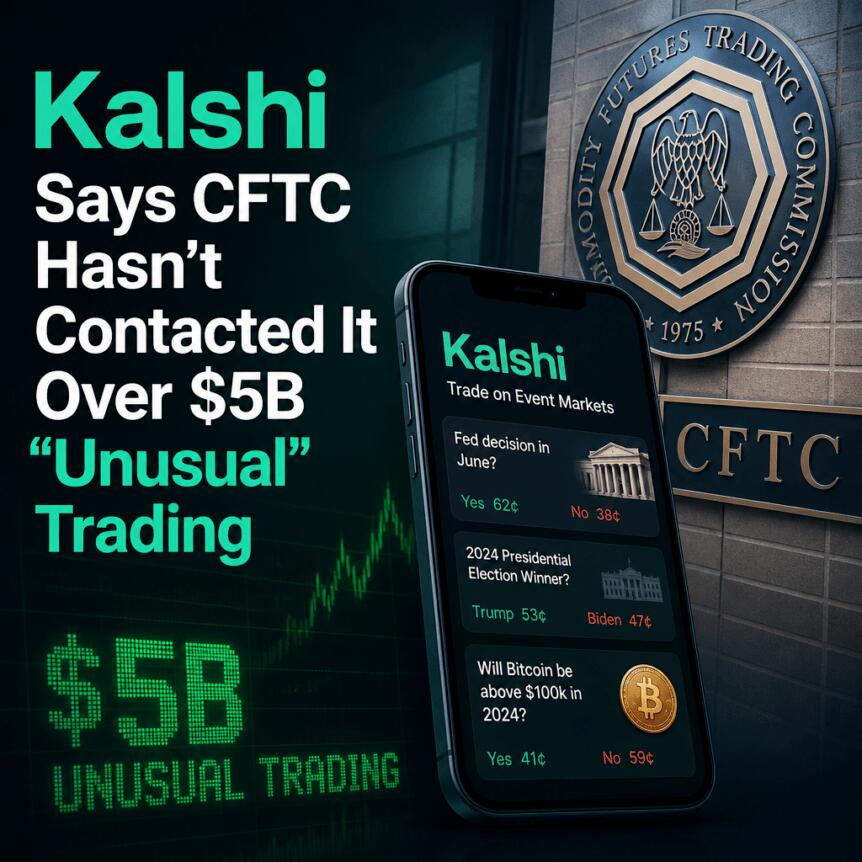
Kalshi has pushed back against reports that the U.S. Commodity Futures Trading Commission (CFTC) is reviewing a suspicious pattern of trading in its Ether perpetual futures market. The exchange says it has not been contacted by regulators and doubts there is any formal examination underway.
The controversy centers on a reported cluster of rapid, nearly identical trades around roughly $5,500 each, allegations that some observers are framing as potential wash trading. The dispute comes as Kalshi’s perpetual futures business has expanded quickly since its May launch.
Key takeaways
Kalshi says it has not received contact from the CFTC and does not believe a formal review is taking place. The CFTC scrutiny described by the Wall Street Journal relates to a repeated $5,500 trade-size pattern in Ether perpetual futures. Kalshi attributes repeated order sizes to liquidity incentive programs that reward makers for resting orders within a price band—not to rewards for executed trade volume. Kalshi argues the activity reflects normal market-making dynamics with many takers hitting a fixed-size resting order, rather than wash trading. The Journal also reported equity-linked incentives tied to trading-volume targets, which Kalshi’s response did not directly address.CFTC review report meets Kalshi denial
On Tuesday, The Wall Street Journal reported that the CFTC is examining a pattern of rapid trades clustered around $5,500 in Kalshi’s Ether perpetual futures. The report cited a person familiar with the matter and said the trading behavior has sparked allegations of wash trading.
Kalshi responded by disputing the premise of any regulatory action. Elisabeth Diana, head of communications at Kalshi, told Cointelegraph that the company “has not been contacted by the CFTC” and “doesn’t believe there is any formal examination.” She further characterized the chatter as “rumors seeded by competitors,” adding that the behavior is consistent with liquidity incentive programs common in financial markets.
Diana urged people not to rely on social media claims, stating: “Don’t believe everything you read on X.”
What the reported trade pattern suggests
The trades described by the Journal occurred within one of Kalshi’s perpetual futures markets, where participants speculate on the price of an underlying asset without taking spot ownership. In this case, the underlying is Ether.
According to the Journal, trades of roughly $5,500 each accounted for more than $5 billion in Ether perp volume over the past month. The scale of the repeated-size activity is important because wash trading allegations typically emerge when volume appears to rise without genuine economic risk transfer between independent parties.
The Journal also reported that Kalshi offered some traders opportunities to buy equity in the company if they met trading-volume targets. It said the incentives included waived trading fees and monthly cash payments designed to encourage large traders to provide liquidity.
While those incentive structures may be familiar in traditional markets, the details matter in crypto derivatives—particularly when regulators or market observers are trying to determine whether activity is driven by genuine hedging and price discovery or by self-referential execution designed to simulate demand.
Kalshi’s explanation: liquidity programs and market-maker resting orders
In a blog post published on Wednesday, Kalshi sought to clarify why trade sizes appeared repeatedly similar. The company said the recurring $5,500-sized trades reflect programs that pay market makers to keep buy and sell orders available at specified sizes and within set price ranges.
Kalshi’s central claim is that incentives reward the availability of resting orders rather than the volume of trades that ultimately execute. In other words, the firm argues that the structure of its liquidity mechanism can naturally produce repeated execution sizes when many takers interact with a maker’s fixed quotes.
However, Kalshi’s post did not directly address the equity-purchase opportunity tied to trading-volume targets as described by the Wall Street Journal. That omission leaves an open question for readers: even if the trade-size pattern can be explained by market-making design, how equity- or cash-linked targets influence participant behavior remains a separate issue worth watching.
Market-making dynamics vs. wash trading allegations
Kalshi’s response leaned heavily on how derivatives markets function. The company noted that market makers support trading by continuously quoting prices they are willing to buy and sell at, offering other traders ready counterparties. In that framework, market makers can earn from spreads but face losses if prices move against their quoted levels.
In contrast, “takers” are the traders who accept the resting prices offered by market makers. Kalshi argued that the reported fixed-size executions align with a market maker posting orders of a consistent size, then being hit by many takers.
Kalshi also said traders could profit when prices moved on other exchanges, by buying or selling at a market maker’s outdated price. The company further claimed that the activity involved “hundreds of distinct traders,” with takers “pretty consistently right” and the maker “pretty consistently wrong.”
On that basis, Kalshi characterized the pattern as evidence of “genuine economic activity rather than wash,” explaining that wash trading typically shows volume increase without either side taking meaningful profit or loss in the way expected from independent risk-taking.
In essence, Kalshi is arguing that the direction of outcomes—rather than the repetition of trade sizes alone—helps distinguish real liquidity provision from trades that are structured to look active without reflecting true trading interest.
What to watch next
If regulators pursue inquiries, the key remaining uncertainty is whether investigators focus on the liquidity mechanism itself or on the broader incentive ecosystem—especially any elements tied to trading volume targets and equity access. Market participants will likely watch for additional clarification from the CFTC, further documentation from Kalshi, and whether similar patterns appear consistently as perpetual futures markets mature.
This article was originally published as Kalshi Says CFTC Hasn’t Contacted It Over $5B “Unusual” Trading on Crypto Breaking News – your trusted source for crypto news, Bitcoin news, and blockchain updates.





 Bengali (Bangladesh) ·
  English (United States) ·