
 1 hour ago
2
1 hour ago
2 
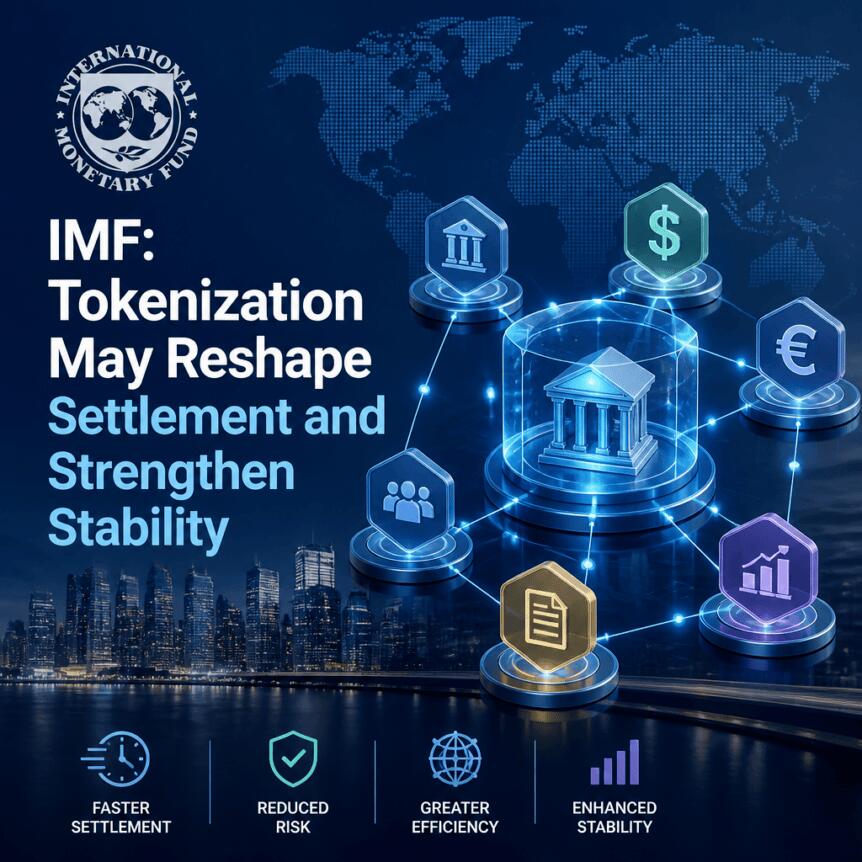
The International Monetary Fund has issued one of its most direct endorsements yet of tokenization’s potential to reshape traditional finance, arguing that moving assets, settlement, and recordkeeping onto shared ledgers could dramatically shorten today’s typically multi-day settlement cycles.
In a blog post published Thursday, Tobias Adrian—financial counselor and director of the IMF’s Monetary and Capital Markets Department—stated that tokenization should be viewed as more than a niche crypto concept. He also cautioned that the same shift that could improve efficiency may move critical financial risk away from familiar intermediaries and toward the underlying infrastructure, including smart contracts, distributed ledgers, and the service providers that operate them.
Key takeaways
The IMF argues tokenization can streamline settlement and recordkeeping by using shared ledgers, potentially reducing multi-day processes to near-instant transactions. Adrian warns that tokenization changes the location of risk, with vulnerabilities potentially shifting from banks and brokers to blockchain and infrastructure layers. The IMF highlights a regulatory gap: without common standards and coordinated oversight, tokenized markets could fragment across incompatible platforms. Market institutions are already preparing for tokenized finance, with major players reportedly working on tokenized deposit infrastructure. U.S. regulators are moving to apply existing securities rules to tokenized assets while discussing potential experimental pathways.Why the IMF’s stance matters for tokenized markets
The IMF’s position is notable because it frames tokenization as an architectural change to how financial markets function, not simply a technological upgrade. Adrian’s central claim is structural: when the same system handles asset representation, transfers, settlement, and recordkeeping, the industry can reduce operational handoffs that currently add time and friction.
That “compressed settlement” argument is a key reason tokenization attracts attention from both technology teams and incumbent financial institutions. In practical terms, shorter settlement windows can support faster settlement finality, reduce certain operational dependencies, and improve liquidity dynamics by making transfers easier to complete.
Risk migration and the standards problem
Alongside the efficiency thesis, Adrian introduced a counterweight: tokenization may shift where systemic risk lives. In traditional setups, intermediaries play a dominant role in managing settlement and operational dependencies. With tokenized infrastructure, Adrian argued that risks can move toward the underlying technology stack—smart contracts, distributed ledger mechanics, and the organizations providing related services.
He further warned that if regulators and industry participants do not establish common standards and coordinate regulation, tokenized markets could splinter. Fragmentation across incompatible platforms would not just create inconvenience; it could also introduce new forms of systemic risk by increasing complexity and reducing transparency around how assets move and settle in different ecosystems.
This is where the IMF’s message goes beyond general technology optimism. Tokenization can only deliver its promise if networks interoperate safely and if the governance, compliance expectations, and operational controls are consistent enough to support market-wide confidence.
Institutional momentum: tokenized deposits and broader research
The IMF’s comments arrive as traditional finance accelerates its own tokenization programs. Earlier coverage from The Clearing House—a payments and banking group whose owners include JPMorgan Chase, Bank of America, and Barclays—has been reported as planning a tokenized deposit network in early 2027. The reported goal is to keep deposits within the regulated banking system while enabling faster, programmable payment flows.
The IMF’s thinking also aligns with research highlighted by the report’s surrounding context. According to PwC research, tokenization could address long-running inefficiencies in traditional finance, including payment settlement and the transfer of asset ownership. In addition, a May report from Moody’s pointed to growing preparations among traditional institutions for a shift toward tokenized finance.
Taken together, these threads suggest tokenization is moving from concept to execution inside mainstream institutions—making the IMF’s emphasis on standards and coordinated regulation more urgent, not less.
Regulators trying to define tokenized finance in real time
A major theme in Adrian’s post is that policymakers have a narrow window to influence how tokenized markets develop. He argued that key design choices—such as what settlement assets are used, how governance works, whether interoperability is supported, and what role central banks should play—will largely determine whether tokenization improves system performance or adds systemic fragility.
In the United States, the Securities and Exchange Commission has taken steps to clarify how existing securities laws apply to tokenized assets rather than building a completely separate framework. The debate also includes potential mechanisms for supervised experimentation, with Cointelegraph noting that the SEC has signaled it is considering an “innovation exemption” that could allow market participants to test blockchain-based trading platforms for tokenized securities while a broader regulatory approach is developed.
For market participants, this matters because the regulatory path influences product design and compliance strategy. Tokenized markets are not only software deployments; they also require durable interpretations of custody, disclosure, trading conduct, and market structure rules—especially as assets migrate from legacy rails to programmable settlement systems.
As institutions push forward with tokenized network initiatives and regulators work through existing laws and possible pilot pathways, the next phase to watch is whether industry standards and interoperability efforts keep pace—because the IMF’s warning about fragmentation is likely to become the deciding factor between tokenization becoming a mainstream efficiency upgrade or a patchwork of systems with rising operational and systemic risk.
This article was originally published as IMF: Tokenization May Reshape Settlement and Strengthen Stability on Crypto Breaking News – your trusted source for crypto news, Bitcoin news, and blockchain updates.





 Bengali (Bangladesh) ·
  English (United States) ·