
 1 hour ago
4
1 hour ago
4 
Key Points
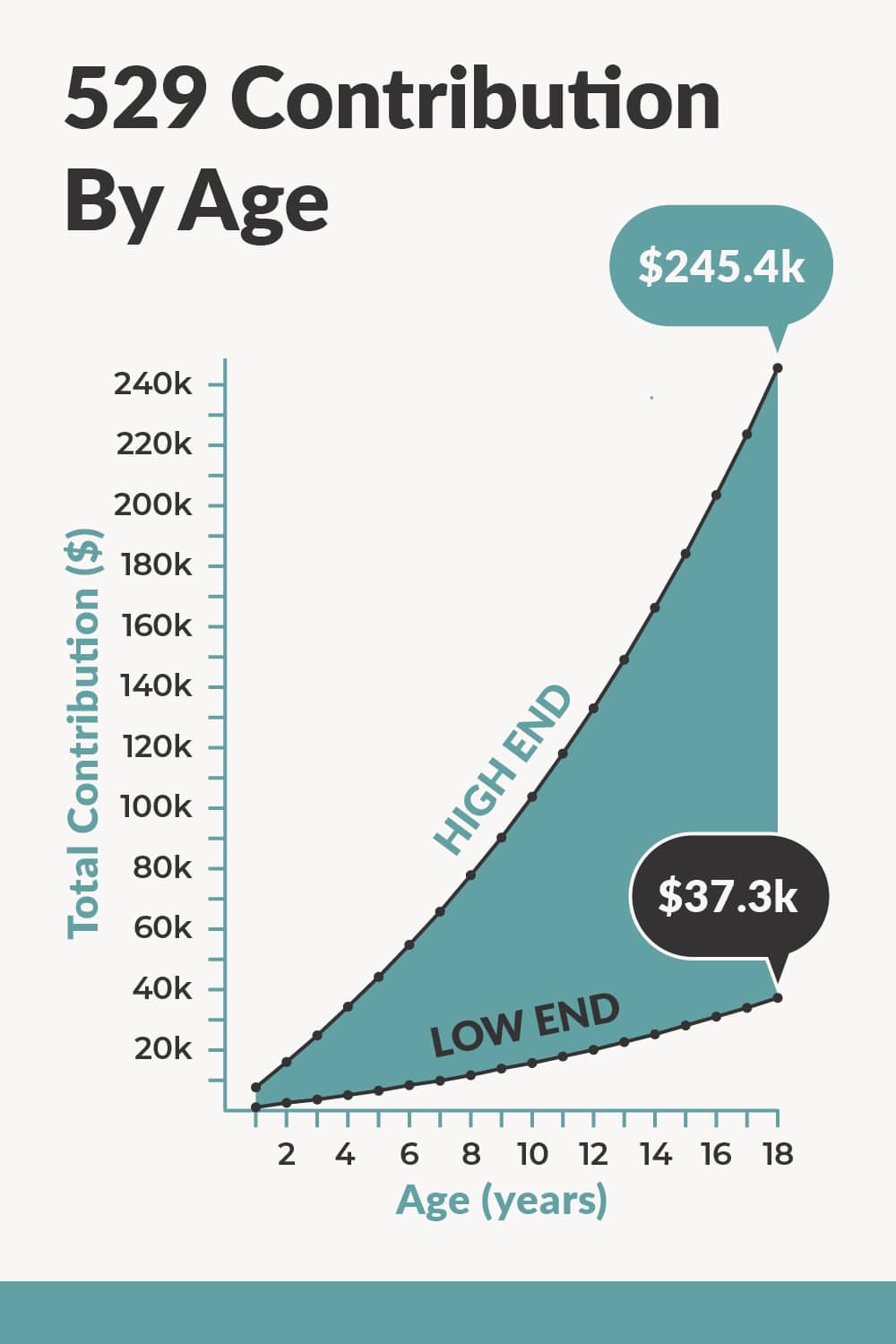
How much should you have in a 529 plan? The short answer: about $96 a month from birth, or roughly $37,000 by the time your child is 18, if your goal is to cover a solid chunk of in-state tuition and fees.
If you want to pay for everything at a public university, housing and food included, plan on about $630 a month gets you to $245,000 at 18. Everything in between helps, and so we break it odwn.
The real trouble comes from rising tuition costs and how much every "college savings calculator" says you need to save for your child's education. According to The College Board, the average published price for 2025-26 is $11,950 in tuition and fees at a public four-year in-state college and $45,000 at a private nonprofit college. Add housing and food and the average total budget is $30,990 in-state and $65,470 private. Plug those into a calculator with a "pay it all" assumption and you're told to save $1,300 a month. Add that to your own retirement savings and there's nothing left.
When you start plugging those numbers into the college savings calculator, suddenly you're supposed to start saving over $500 per month for your child. Then, add that into your own savings for retirement, and you're not going to have anything left for yourself each month!
So let's dive in and see how much you should have in a 529 plan.
Would you like to save this?
Average 529 Balance By Age
Here's what the data says about where families are today:
Average 529 account: $35,956. The College Savings Plans Network counted 18.2 million accounts holding $653.5 billion as of June 30, 2026. That's per account, not per family, and some families with multiple children may have more than one.Parents with a 529 have $45,752 saved for college on average, and contribute about $9,000 a year, according to Fidelity's 2026 College Savings Indicator. Parents without a 529 have $24,387. A record 84% of parents are saving something, and 45% have opened a 529.The average household with college money set aside has $42,307, up 61% since 2020, per Sallie Mae and Ipsos's How America Plans for College 2026. Only 39% of those families use a 529; 53% keep it in a plain savings account.Two things to take from this. The average balance at 18 is barely one year of in-state cost with housing, so "average" is not the goal. And the roughly $21,000 gap between families with a 529 and without one is mostly tax-free growth plus the discipline of an account with one job. If you don't have a 529 plan yet, here's where to open one.
Follow The Order Of Operations For Saving For College
The full-sticker number gives me the same sticker shock it gives you. It's also the reminder of why everyone should follow the Order of Operations For Saving For Your Kid's College.
The key phrase is Y.E.S.:
(Y) YOU: Your own financial house comes first. If you can't make rent or buy groceries, there are bigger issues to fix. The YOU bucket also includes your retirement accounts and an emergency fund. I've said this hundreds of times: you can't get a loan for retirement. Fidelity's 2026 survey found 55% of parents with student loans say those payments delayed their own retirement saving, and 88% say the debt is exactly why they want to save for their kids. Do both, in that order.
(E) Education Savings Accounts: Once you're saving for yourself, save for your child in an education account like a 529 plan. If your baby was born in 2025 or later, a Trump account with its $1,000 federal seed is worth claiming too, as a complement to a 529, not a replacement.
(S) Savings: After the 529, a regular savings or custodial investment account covers the things that don't count as education expenses: a car, a security deposit, a gap year.
How Much You Really Need To Save In A 529 Plan
Part two of the "scary" number is that it assumes you'll pay 100% of the sticker price. You don't have to. Maybe you'll cover tuition and your child handles housing with a job or a scholarship. Maybe you'll cover part of tuition. Maybe you'll set a dollar target and stop.
It's THEIR college, not yours. There are plenty of ways for them to close the gap, from finding scholarships to federal student loans, and the sticker price isn't what most families pay anyway. College Board's estimate of average net tuition and fees after grants is about $2,300 at public four-year in-state schools and $16,910 at private nonprofits for 2025-26. Here's The College Investor's full breakdown of how to pay for college.
So instead of stressing about $1,300 a month, here are the assumptions I use, and the two targets that come out of them:
College costs rise 4% per year.The 529 earns 6% per year.I contribute monthly from birth and stop at 18 (sorry, but you're out of the house now).The account pays out over four years starting at 18.Low end: cover about 40% of in-state tuition and fees ($11,950 today). That's $96 a month, or about $1,150 a year, and it pays out roughly $10,300 to $11,600 a year for four years.High end: cover the full in-state cost, tuition plus housing and food ($30,990 today). That's $630 a month. It's also about what a private school costs after typical merit aid, so it doubles as the "private but realistic" target.If you want your own state's numbers, our 529 plans by state page has the costs and the plan we recommend for each state.
How Much You Should Have In Your 529 At Different Ages
1 | $1,189 | $7,816 |
2 | $2,451 | $16,144 |
3 | $3,791 | $24,923 |
4 | $5,213 | $34,276 |
5 | $6,723 | $44,206 |
6 | $8,327 | $54,749 |
7 | $10,029 | $65,941 |
8 | $11,836 | $77,824 |
9 | $13,755 | $90,440 |
10 | $15,792 | $103,834 |
11 | $17,955 | $118,054 |
12 | $20,251 | $133,151 |
13 | $22,689 | $149,179 |
14 | $25,277 | $166,196 |
15 | $28,025 | $184,263 |
16 | $30,942 | $203,444 |
17 | $34,039 | $223,807 |
18 | $37,328 | $245,427 |
Want to calculate your own situation? The College Investor's 529 Plan And College Savings Calculator runs the same math with your current balance, your contributions, and your own return assumption.
Our 529 plan contribution limits page has the aggregate limit for every state.
Started Late? Catch-Up Numbers By Starting Age
Most of the parents in our comments didn't open the account at birth. Here's what the same two targets cost per month if you start from zero later:
Birth | $96 | $630 |
5 | $159 | $1,040 |
10 | $304 | $2,000 |
13 | $535 | $3,500 |
Lump sums do a lot of the work if they come early. A single $19,000 gift at birth, the 2026 annual gift-tax exclusion, grows to about $54,000 by 18 at 6%, which clears the low-end target on its own. A $95,000 superfunded contribution (five years of exclusions at once) grows to about $271,000, which clears the high end. That's why grandparent gifts matter more in the first five years than in the last five.
529 College Savings Plan Guidelines
From the results, the goal for most families should land between $37,328 and $245,427 in the account at 18. That's a wide range, so remember what the columns mean.
The low end covers about 40% of tuition and fees at a public four-year college, with housing, food, and the rest of tuition coming from the student, scholarships, or current income. The high end covers the whole in-state bill, housing included. It is not private-school sticker price; that's $65,470 a year today with housing, and almost nobody pays it. Average net tuition at private nonprofits is $16,910 because the schools discount heavily, so if your child is headed to a private university, the high end plus merit aid is the realistic plan.
In the low-end scenario, the 529 can pay out roughly $10,300 to $11,600 a year for four years, which at 4% college inflation is a little over 40% of in-state tuition in 2044.
What Changed For 529 Plans In 2026
The rules moved in your favor since this page was first written, and they change how much "too much" is:
Gift limits. You can put $19,000 per child per year (or $38,000 as a couple) into a 529 in 2026 without filing a gift-tax return, or superfund $95,000 ($190,000 as a couple) in one year and elect to spread it over five.K-12. Starting in 2026, a 529 can pay up to $20,000 a year per student for private elementary and high school, up from $10,000, and the eligible list now includes tutoring, curriculum, test fees, and dual-enrollment costs.Trade school and licenses. Since July 2025, a 529 can pay for credentialing and training programs: welding, cosmetology, CDL, CPA and bar exam prep, and the continuing education that keeps a license current. Your child doesn't need a four-year degree to use the money.Leftover money. Up to $35,000 can be rolled into a Roth IRA for the beneficiary once the account is 15 years old (34 states follow the federal rule; check yours). You can also change the beneficiary to a sibling, yourself, or a future grandchild.Are You Saving Too Much?
Sometimes. A reader with $91,000 in a 529 at age six asked me this, and my answer was yes: at 6% that balance alone grows to about $183,000 by 18, three-quarters of the high-end target with no new contributions. Past that point, every extra dollar is a dollar you didn't put in your own retirement account, and if the child ends up with a scholarship or picks a cheaper path, the earnings on non-qualified withdrawals are taxed plus a 10% penalty. The 2026 rules above make over-saving less costly than it used to be, but not free. Once you're on track for the column you chose, redirect the surplus to yourself.
Where To Open A 529 Plan
You can invest in almost any state's 529 plan, not just your own. If your state offers a tax deduction or credit for contributions, that usually decides it; our Best 529 Plans for 2026 ranking shows why the state tax break beats a slightly lower fee for most families. If your state offers nothing (California, for one), pick on performance and cost: low fees, solid index options, and easy automatic contributions.
Find your state in our 529 plans by state page to see the plan we recommend, or see the best brokers to open a 529 if you'd rather hold it alongside your other accounts.
Recommendations To Help Save For College
Even $96 a month can feel like a lot. Here are three ways to get there without touching your budget:
Save your child's gift money. Grandparents, aunts, and uncles hand over at least $200 a year in most families. Route it to the 529 and you're nearly 20% of the way to the low-end annual contribution before you've saved a dollar of your own. A service like Backer makes this easy with a shareable gifting link; here's how to gift money to a 529 if you'd rather do it directly.Use shopping rewards. Upromise pays cash back into a linked 529 for everyday spending at participating retailers. It won't fund the account by itself, but a few hundred dollars a year of found money adds up over 18 years. Sign up here.Earn the difference. Instead of asking where to cut, ask how to add $100 a month. Our list of 50+ ways to earn extra money on the side is a place to start, and $100 a month of side income covers the low-end contribution on its own.Common Questions
What is the average 529 balance by age?
The only public by-age data is Sallie Mae's 2018 survey: about $7,900 for ages 0–6, $15,400 for 7–12, $27,600 for 13–17, and $27,800 at 18+. The overall average account is $35,956 as of June 2026 (CSPN). Use the table above for targets; the averages fall short of even the low-end goal.
How much should I have in a 529 by age 18?
$37,328 covers about 40% of in-state tuition for four years. $245,427 covers a full in-state ride including housing and food. Both assume 4% college inflation and a 6% return.
How much should I put in a 529 per month?
$96 from birth for the low-end target, $630 for the full in-state ride. Starting at age 5, those become $159 and about $1,040; at age 10, $304 and about $2,000.
Can I keep contributing after my child turns 18?
Yes. There's no age limit on contributions or on the beneficiary, only the state's aggregate account limit.
What happens if my child doesn't go to college?
The money can pay for trade school and licensing programs, up to $20,000 a year of K-12 tuition, or roll into a Roth IRA (up to $35,000 lifetime). You can also change the beneficiary. Non-qualified withdrawals owe income tax plus a 10% penalty on earnings only.
Does moving to another state affect my 529?
No. The account and the money work in every state. Only your state income-tax deduction may change, since most states limit it to their own plan.
How does a 529 count on the FAFSA?A parent-owned 529 is a parent asset, assessed at up to 5.64%, the same as your other investments. It's not a student asset. Spend it before taxable savings, since withdrawals are tax-free for qualified costs.
Is a life insurance policy a better college fund than a 529?
No. Cash-value policies carry fees and commissions a low-cost 529 doesn't, and the "use it anywhere" pitch ignores that a 529 already works at every accredited school in every state. Here's the math.
Editor: Clint Proctor Reviewed by: Mark Kantrowitz
The post How Much Should You Have In A 529 Plan By Age appeared first on The College Investor.




 Bengali (Bangladesh) ·
  English (United States) ·