
 1 day ago
7
1 day ago
7 

The standard repayment plan for federal student loans is 10 years, but the reality is far different. According to analysis by The College Investor, undergraduate borrowers take an average of 17 to 18 years to fully repay their student loans, while graduate school borrowers average roughly 23 years.
Parent PLUS borrowers face repayment windows of 20 years on average, and private loan borrowers typically repay over 10 to 15 years.
These extended timelines are driven by income-driven repayment (IDR) plan enrollment, periods of deferment and forbearance, and the compounding effect of interest during non-payment periods.
The Covid-19 payment pause (March 2020 through September 2023) further extended repayment timelines for tens of millions of borrowers.

Would you like to save this?
Summary: Repayment Time By Loan Type
Undergraduate Federal | 17.5 Years | $19,864 | 40% Repay Within 10 Years |
Graduate Federal | 23 Years | $81,870 | Higher Balances + IDR Plans Drive Longer Repayment |
Parent PLUS | 20 Years | $54,953 | 12.7% Default Within 4 Years |
Private Student Loans | 10-15 Years | Varies | Only 1.6% Default Rate |
Undergraduate Federal Student Loans
Average Repayment Time: 17.5 Years
Despite the standard 10-year repayment plan, undergraduate borrowers take an average of 17 to 18 years to fully repay their federal student loans. Only about 40% of borrowers manage to repay within the standard 10-year window.
The Congressional Budget Office (PDF File) analyzed federal loans originating from 2009 to 2013 and found that in the first six years after repayment began, balances actually increased for 57% of loans. Borrowers made payments greater than $10 in only 38% of months where a payment was due. Loans spent just 45% of months in active repayment status, with the rest in deferment, forbearance, or other non-payment statuses.
IDR enrollment has also surged in recent years. The Urban Institute found that $51.5 billion of the 2014-15 cohort enrolled in IDR plans, compared to just $7.1 billion from the 2010-11 cohort.
According to the most recent student loan statistics, nearly 30% of student loan borrowers are in an IDR plan. Even with the SAVE plan ending, it's likely many of those borrowers will continue in IDR plans such as IBR or the upcoming RAP Plan.
IDR enrollment is a key reason why average repayment terms are so long.

Graduate Federal Student Loans
Average Repayment Time: 23 Years
Graduate and professional degree holders take an average of 23 years to repay their student loans, according to a Research.com survey. This is roughly 6 years longer than the undergraduate average, driven primarily by significantly higher loan balances.
Graduate borrowers face a compounding problem: higher balances with higher interest rates (since graduate loans are exclusively unsubsidized), combined with the fact that many graduate borrowers enroll in IDR plans that stretch repayment to 20 or 25 years.
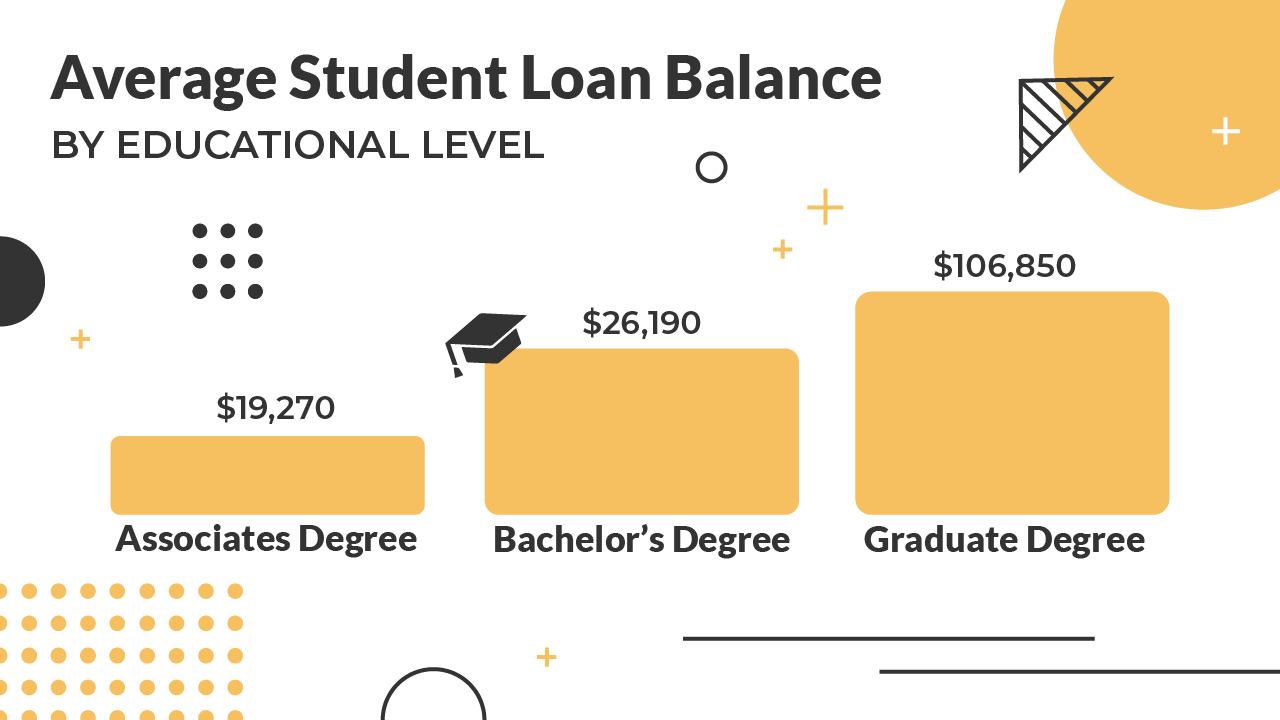
You can see the average student loan balance by educational level here:
Parent PLUS Federal Student Loans
Average Repayment Time: 20 Years
Parent PLUS loan repayment timelines vary dramatically based on plan selection. Standard repayment is 10 years, but extended repayment plans run 25 to 30 years. Many parents still carry balances 20 or more years after their child finished school.
Parent PLUS borrowers tend to be older, often approaching or in retirement when loans come due. It's also one of the big drivers of why student loan balances are growing for the oldest Americans:

Private Student Loans
Average Repayment Time: 10-15 Years
We don't have as much data on private student loans, but we can make inferences based on term length and default rates. Private student loans typically have repayment terms ranging from 5 to 20 years, with most borrowers repaying over a 10- to 15-year period.
Unlike federal loans, private loans do not offer income-driven repayment plans or student loan forgiveness programs.
According to estimates from the Education Data Initiative, 75.3% of private student loans are in active repayment, 20% are in deferment, and 1.62% are in default. The relatively low default rate compared to federal loans is partly attributable to the fact that private loan borrowers tend to have higher credit scores and cosigners.
The 17–18 year figure for undergraduate repayment and the 23-year figure for graduate repayment are derived from Education Data Initiative’s aggregation of federal data and the Research.com survey of 61,000 respondents. These figures reflect actual borrower behavior—including periods of deferment, forbearance, IDR enrollment, and default—rather than the scheduled repayment term. The Congressional Budget Office’s September 2024 analysis of 2009–2013 cohort loans supports these extended timelines by showing that the majority of borrowers see balances increase in early repayment years.
Parent PLUS repayment timelines are more variable because they depend heavily on plan selection, and no single “average time to repay” figure is widely reported. The 10–30 year range reflects the spectrum from standard repayment through extended and IDR-eligible consolidation plans.
Private loan data is less granular because private lenders are not required to report to the Department of Education. The 10–15 year estimate reflects typical term lengths offered by major private lenders.
Editor: Colin Graves
The post How Long It Really Takes To Repay Student Loans, By Loan Type appeared first on The College Investor.




 Bengali (Bangladesh) ·
  English (United States) ·