

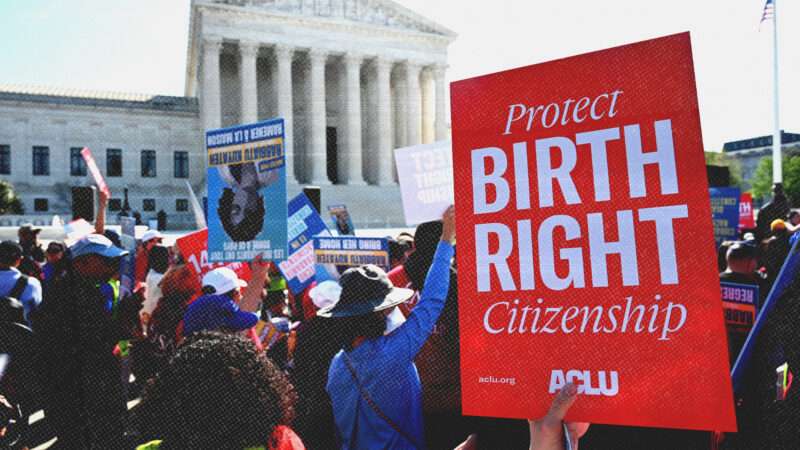
President Donald Trump made history yesterday at the U.S. Supreme Court when he became the first sitting president on record to attend a SCOTUS oral argument. Unfortunately for Trump, his presence, however attention-grabbing, is unlikely to sway the outcome of a case that he has always deserved to lose.
At issue in yesterday's oral arguments in Trump v. Barbara is the president's 2025 executive order that purports to deny the constitutional guarantee of birthright citizenship to U.S.-born children whose parents are unlawful immigrants or lawful temporary visitors.
According to Trump's solicitor general, John Sauer, the overriding factor for determining birthright citizenship should be whether or not a newborn's parents were "domiciled" in the United States, a term he defined to mean "lawful presence with the intent to remain permanently."
Yet as Justice Neil Gorsuch pointed out, "you don't see domicile mentioned in the [congressional] debates" over the 14th Amendment, which enshrined birthright citizenship in the Constitution. "We have the—the child's citizenship, and the focus of the clause is on the child, not on the parents," Gorsuch said. "The absence" of the word domicile—a word which is the centerpiece of Trump's entire case—"is striking."
Gorsuch also noted another fatal flaw in the government's position. "Today, you can point to laws against immigration that are much more restrictive than they were in 1868," Gorsuch said. "If somebody showed up here in 1868 and established domicile, that was perfectly fine without respect to anything, any—any immigration laws." Which means, Gorsuch told Sauer, "why wouldn't we, even if we were to apply your own test, come to the conclusion that the fact that someone might be illegal is immaterial?"
In other words, if the Supreme Court sticks to the circa-1868 meaning of domicile, which Sauer himself said that it should, then that term, as originally understood at the time of the 14th Amendment's ratification, would cut against Trump's executive order.
Justice Amy Coney Barrett then raised an even more ominous issue for the Trump administration. What about "the children of slaves who were brought here unlawfully…in defiance of laws forbidding the slave trade," Barrett asked Sauer. "You can imagine that their parents were not only brought here in violation of United States law but were here against their will and so maybe felt allegiance to the countries to where they were from." And "let's say they don't have an intent to stay. They want to escape and go back the second they can. Are they domiciled?"
This was a very dangerous query for Sauer, and his struggle to respond to it coherently suggested that he understood the peril he was in. After all, if the Trump administration's theory is correct, and "domicile" requires "the intent to remain permanently," as Sauer said it did, then the U.S.-born child of an enslaved person who wanted "to escape and go back" would clearly not qualify for birthright citizenship under the Trumpian view. And the descendants of such persons, born today, would also be ineligible for birthright citizenship under the Trumpian view, if applied retroactively.
The reason why that logic is so disastrous for Trump is because the Trump administration has repeatedly conceded that one of the undeniable purposes of the 14th Amendment was to make citizens out of all enslaved black Americans and their descendants. Yet if Trump's theory wins, that one undeniable purpose of the amendment would be nullified because the U.S.-born children of some enslaved people would not qualify for birthright citizenship after all.
That line of questioning from Barrett might be enough by itself to spell legal doom for Trump's executive order.
Chief Justice John Roberts offered another damning analysis of the Trump administration's case. After Sauer claimed that "the 19th century Framers of this amendment" could "not possibly" have approved of "birth tourism" or other supposed modern problems that have been allegedly caused by birthright citizenship, Roberts observed that such contemporary policy arguments have zero bearing on the case at hand. "You do agree," Roberts pressed Sauer, "that that has no impact on the legal analysis before us?"
Sauer struggled a bit in response to that one, too, before finally asserting that "we're in a new world now," one "where 8 billion people are one plane ride away from having a—a child who's a U.S. citizen."
"Well, it's a new world," Roberts replied. "It's the same Constitution."
That reply by the chief justice perfectly illustrated the bankruptcy of Trump's entire position. Instead of following the straightforward text and history of the 14th Amendment, the Trump administration wants the Supreme Court to adopt a tortured and unpersuasive new theory that rests on a different word that appears nowhere in the text of the Constitution and, as Gorsuch noted, is also strikingly absent from the relevant congressional debates. At the same time, in a case that's supposed to be about the original meaning of a constitutional provision, the Trump administration is wasting the Court's time with non-legal, modern-day anti-immigration arguments that, as the chief justice pointed out, are totally irrelevant to the originalist and textualist analysis that the Supreme Court is actually performing.
Gorsuch, Barrett, and Roberts probably hold the swing votes in this case. If they remain as skeptical of Trump's position as they sounded during oral arguments, the president's executive order is in big trouble.
The post Gorsuch, Barrett, and Roberts Raise Fatal Objections to Trump's Birthright Citizenship Order appeared first on Reason.com.





 Bengali (Bangladesh) ·
  English (United States) ·