

Dogs with squished faces may be adorable. But that cuteness can come at a cost to the dogs. Among some breeds with such flattened faces, fewer than 11 percent can breathe easily, a new study finds.
Doctors describe the skulls of dogs with flat faces, such as pugs and bulldogs, as brachycephalic (Brak-ee-seh-FAAL-ik). Finding this attractive, people have bred dogs to have these features. But a shortened skull can narrow a dog’s airways. That can cause airway blockages, which lead to snorting and heavy and noisy breathing.
The problem is known as BOAS (short for brachycephalic obstructive airway syndrome). It develops when the bones in the heads and faces of affected dogs are shorter than normal.
Researchers have long known BOAS is a big problem for pugs and bulldogs. But little was known about its risk to other flat-faced breeds. So, from 2021 to 2024, a team in England examined nearly 900 dogs across 14 short-skull breeds.
Francesca Tomlinson led the study. She’s a veterinarian at the University of Cambridge. Her team had dogs run for a few minutes. Then they ranked the dogs on a scale of 0 to 3 how easy it was for them to breathe. Those with a score of 3 had a lot of trouble breathing. Dogs scoring 0 breathed easy.
The researchers also took detailed measurements of the dogs’ heads and bodies.
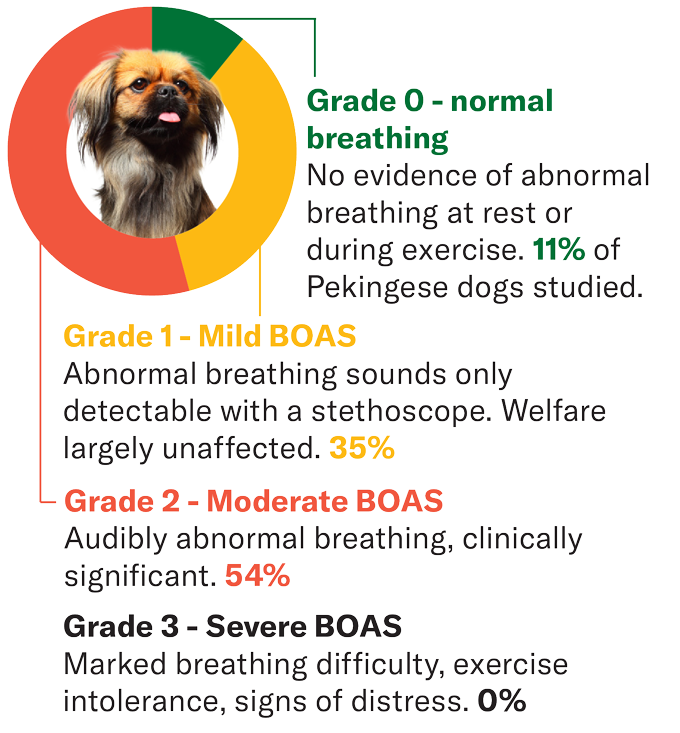
Grading breathing
The researchers used a 0 to 3 scale to record the severity of brachycephalic obstructive airway syndrome (BOAS) symptoms in the dogs examined in the study. Pekingese (shown) had one of the lowest rates of Grade 0, typified by easy breathing.
 Source: F. Tomlinson, et al./ PLOS One 2026 (CC-BY 4.0), Image: Antagain/iStock/Getty Images Plus (dog photo), adapted by J. Hirshfeld
Risk of BOAS varied a lot by breed, Tomlinson says. Boxers and Staffordshire bull terriers, for instance, rarely had breathing issues. But Pekingese and Japanese chins were at high risk, along with bulldogs and pugs. Just 11 percent of Pekingese got an easy-breathing score of 0. Even fewer pugs — about 7 percent — got this score.
A few features put dogs at particular risk of blocked airways. One was that flat face. Another was narrow, pinched nostrils. A third was having more body fat.
Tomlinson’s team shared its findings February 18 in PLOS One.
Breeding dogs to breathe easier
This study “confirms much of what the science and biology has known for decades,” says Dan O’Neill. He did not take part in the new research. But he does study the cause and spread of diseases in animals at Royal Veterinary College in London, England.
Here’s a video of an animal whose flattened face has led to clear symptoms of BOAS.Breeding such dogs to have “unnaturally short skulls reduces the ability of these dogs to breathe, sleep, exercise and live a complete canine life,” O’Neill says.
Some flat-faced breeds “have become incredibly popular,” Tomlinson notes. This is especially true of the French bulldog. Breath scores could be used to guide breeding away from very short faces, she says. Breeders could measure dogs breathing scores and try to breed dogs that score lower and lower on that scale.
This may have already started. The data for bulldogs and pugs used in this study came from research published in 2016. There’s been a lot more public awareness about short-snouted breed breathing issues since then, Tomlinson says.
She hopes that means people have already started breeding dogs with less severely squished faces over the last decade. “That could have helped move the breeds to a healthier place.”





 Bengali (Bangladesh) ·
  English (United States) ·