
 1 hour ago
3
1 hour ago
3 
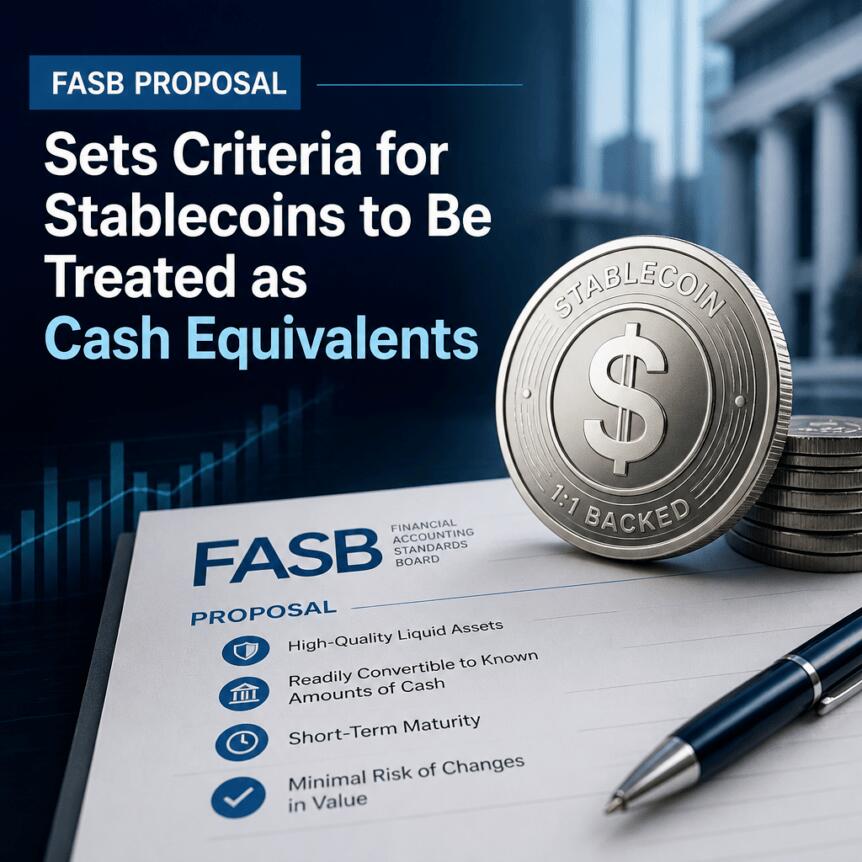
The Financial Accounting Standards Board (FASB) has proposed new guidance that would help clarify when certain stablecoins can be classified as “cash equivalents” under US generally accepted accounting principles (GAAP). The move targets long-running inconsistencies in how companies account for digital assets, especially those used in treasury management or day-to-day payments.
In a notice released Tuesday, the FASB said it is seeking public comment on an update that would add illustrative examples to the existing cash-equivalents definition without changing the core definition itself. The proposal is designed to give companies a clearer framework for evaluating whether specific stablecoins meet the standard required for cash-equivalent treatment.
Key takeaways
FASB’s proposal would add examples to GAAP cash-equivalents guidance while keeping the definition unchanged. To qualify, a digital asset would generally need an on-demand redemption right and reserves held in short-term, highly liquid assets on at least a one-to-one basis. Active secondary market trading alone would not be sufficient if holders cannot redeem directly from the issuer for a known amount of cash. Companies would still decide whether to present qualifying items as cash equivalents and must consider applicable laws and regulations. The proposal would increase annual disclosure requirements, including major cash-equivalent components and their amounts.What FASB is proposing for cash-equivalent classification
FASB said the proposed Accounting Standards Update would enhance clarity around the “cash equivalents” evaluation for certain digital assets, including stablecoins. According to the filing, the cash-equivalents definition for a qualifying digital asset would require, among other conditions, an on-demand contractual redemption right.
The proposal outlines additional redemption and reserve requirements. Specifically, it would require:
a direct redemption right with the issuer for a known cash amount, and segregated reserves held at least on a one-to-one basis, comprised of short-term, highly liquid assets.While these conditions aim to make the evaluation more consistent, the FASB emphasized that the change would not automatically classify every dollar-pegged token as a cash equivalent. In other words, a stablecoin’s price peg would not be the only determinant—its contractual redemption terms and the quality of its reserves would be central.
Why redemption rights and reserves matter more than “being pegged”
A key element of the proposed examples is that classification depends on the holder’s ability to convert the token to cash under defined terms, not merely on market activity. One example in the proposal indicates that an active secondary market would not qualify a stablecoin if the holder lacks a direct issuer redemption right.
Similarly, the guidance suggests that reserve composition can disqualify a token even if it appears stable in practice. In another example, the proposal indicates that reserves made up of a mix of crypto assets and gold would fail the cash-equivalent test because valuation risks could undermine the “highly liquid” expectation embedded in the definition.
This distinction is important for investors and reporting teams because stablecoins can vary widely in contractual redemption structure and in how issuers allocate and manage reserves. If a company uses stablecoins for treasury operations—such as parking funds temporarily—the question becomes whether those assets behave like cash in both timing and certainty of conversion.
Disclosure requirements would expand for cash equivalents
Beyond classification, the proposal would change what companies disclose. It would require annual disclosure of the significant components of cash equivalents and the related amounts. That list could include items such as Treasury bills, commercial paper, stablecoins, and money market funds.
FASB said the proposed disclosure obligations would apply to all entities that present cash equivalents, regardless of whether they hold digital assets. That means even companies not using stablecoins directly could still face the new component-level transparency requirements for their cash equivalents mix.
How the proposal connects to US stablecoin regulation
FASB’s accounting update comes after the passage of the GENIUS Act, which earlier created a federal regulatory framework for payment stablecoins in the United States. According to earlier coverage cited in the article, the law—signed in July 2025—established requirements for permitted issuers, including maintaining one-to-one reserves in assets such as dollars and short-term Treasurys, publishing monthly reserve details, and setting redemption procedures.
That regulatory backdrop may affect how companies evaluate stablecoin structures for accounting purposes, but it does not replace the cash-equivalent test. The FASB proposal is aimed at the GAAP definition and how to apply it consistently, including whether reserves meet the “short-term, highly liquid” condition and whether redemption rights are direct and contractual.
For market participants, this linkage matters because accounting treatment can influence balance-sheet presentation, internal treasury policies, and how auditors evaluate risk. A stablecoin that satisfies the GENIUS Act’s reserve and redemption concepts could be better positioned to meet the cash-equivalent framework—though the proposal still leaves room for judgment and scenario-specific analysis.
What happens next for companies using GAAP
FASB is accepting public comments on the proposed update until Nov. 19. After reviewing feedback, the board will set an effective date.
Companies that hold stablecoins for treasury or payment-related purposes may want to start reviewing their arrangements now—especially the contractual redemption terms available to holders and the actual reserve structure behind the token. Even with improved illustrative examples, the filing underscores that not every stablecoin will automatically qualify as a cash equivalent.
Until FASB finalizes the update, investors and stakeholders should watch for how issuers and auditors interpret the on-demand redemption and segregated reserve standards, and whether companies adjust their reporting processes ahead of any new effective date.
This article was originally published as FASB Proposal Sets Criteria for Stablecoins to Be Treated as Cash Equivalents on Crypto Breaking News – your trusted source for crypto news, Bitcoin news, and blockchain updates.





 Bengali (Bangladesh) ·
  English (United States) ·