
 2 hours ago
4
2 hours ago
4 
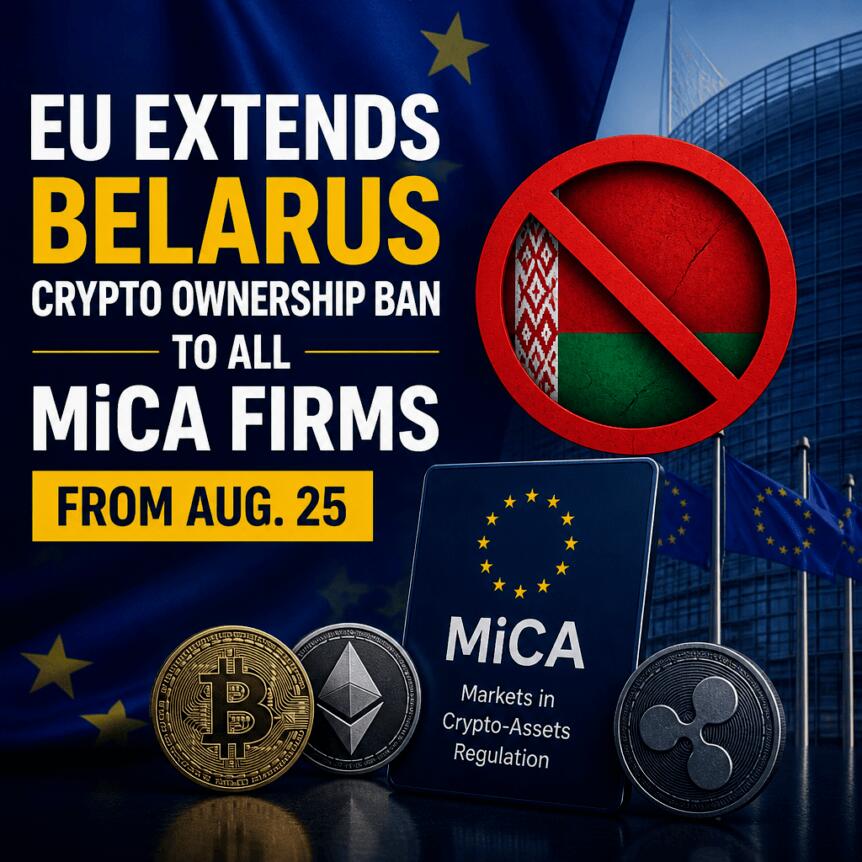
The European Union is tightening crypto-related sanctions tied to Belarus, effectively barring Belarusian nationals and residents from taking controlling roles in certain EU-regulated crypto businesses. The restriction will apply to crypto exchange and custody-related providers that fall under the EU’s Markets in Crypto-Assets (MiCA) framework, starting Aug. 25.
The change is contained in Council Decision (CFSP) 2026/1847, adopted Thursday. According to the text, the decision amends the EU’s existing sanctions structure targeting Belarus over its involvement in Russia’s war against Ukraine, broadening an earlier limitation that had been limited to wallet, account, or custody services.
Key takeaways
Belarusian nationals and residents will be prohibited from owning, controlling, or managing certain MiCA-regulated EU crypto service providers starting Aug. 25. The update in Council Decision (CFSP) 2026/1847 expands the scope beyond prior restrictions that covered only wallet/account/custody services. The prohibition includes not only ownership and control, but also holding a role on a company’s governing body. MiCA service categories covered by the amendment include trading platforms, exchanges, order execution/transmission, transfers, and investment advice or portfolio management.What the EU sanctions change covers
The Council Decision states that Belarusian nationals and residents may not own or control an EU-based entity that provides “any other crypto-asset services” as defined by MiCA, nor may they hold positions on that entity’s governing body. This effectively targets governance influence as well as economic control.
MiCA’s scope of “crypto-asset services” is broad. It includes operating trading platforms and exchanging crypto assets, executing and transmitting clients’ orders, placing crypto assets, and providing transfers. The framework also covers advisory and portfolio management activities, meaning the sanctions expansion can reach multiple lines of business beyond straightforward custody.
Although the decision was adopted on Thursday and enters into force immediately, the expanded crypto-related restriction is scheduled to begin on Aug. 25—leaving regulated firms a limited window to assess whether current ownership, management arrangements, or board composition could be impacted.
Timing matters after MiCA’s transition period ended
The EU’s move arrives shortly after the end of MiCA’s transition period on July 1, when crypto companies without the required authorizations were directed to wind down operations or face enforcement action. In that context, the new sanctions restriction adds another compliance dimension for firms working within the post-transition MiCA landscape.
Instead of focusing only on licensing and operational rules, the EU is combining MiCA market regulation with sanctions screening—especially concerning personnel and governance structures. For compliance teams, that means ownership, board seats, and day-to-day control arrangements now need to be reviewed with both MiCA requirements and the sanctions framework in mind.
MiCA licensing is meant to standardize crypto services across the EU, but sanctions can independently restrict who may participate in certain roles regardless of regulatory approval. This creates a dual gate: a firm may be authorized under MiCA rules while still being required to restructure if it falls within the sanctions constraints.
Part of a wider EU effort to limit crypto access tied to Russia
The Belarus update aligns with broader EU actions aimed at crypto platforms and financial networks allegedly used to route around sanctions imposed over Russia’s war in Ukraine. The EU has been expanding its approach through successive sanctions packages and transaction bans covering crypto-related entities.
Earlier this week, the EU, as part of its 21st sanctions package against Russia, extended a transaction ban to 14 crypto-related service platforms outside the bloc. It also introduced a mechanism that would allow the EU to prohibit dealings with any foreign crypto provider that it identifies as being used by Russia to evade sanctions.
The latest package builds on a June 11 proposal that targeted 11 crypto platforms. Taken together, the EU’s direction is clear: rather than focusing solely on traditional banking channels, it is attempting to reach crypto infrastructure that may facilitate sanctioned activity.
Beyond the EU’s own actions, the sanctions tightening has also been influenced by allied measures. The proposal was reported to follow the United Kingdom’s May 26 sanctions against Huobi Global S.A., the Panamanian company behind HTX, over alleged support for Russia-linked financial networks involving sanctioned entities A7 and Garantex. In that case, HTX denied wrongdoing, telling Cointelegraph that regulatory compliance remains a priority and that it adheres to regulatory frameworks in the jurisdictions where it operates.
Implications for operators and boards across the EU
Because the amendment explicitly covers governance, EU-facing crypto firms cannot treat sanctions compliance as purely an onboarding or customer-screening task. The wording targets who can own, control, manage, or sit on governing bodies—meaning internal corporate structure becomes part of sanctions risk management.
For businesses offering MiCA-listed services—ranging from trading and exchange operations to transfer services and portfolio management—this likely requires reviewing shareholder registers, controlling persons, executive roles, and board appointments tied to Belarusian nationality or residency.
It is also notable that the measure expands an existing Belarus-related restriction. By broadening from wallet/account/custody into “any other crypto-asset services” under MiCA, the EU is signalling that it views the crypto sector as a set of connected services rather than isolated product lines. Firms that previously believed they were outside the sanctions line due to service type may need to reassess.
For investors and counterparties, these restrictions also affect operational continuity and due diligence. Business partners may increasingly factor sanctions-driven corporate eligibility into counterparty risk assessments, especially where controlling persons or board members could become restricted under future amendments.
Going forward, the critical watchpoints are the Aug. 25 applicability date and the practical steps firms take to remain compliant—particularly any changes to ownership structures or governance appointments. The EU’s broader pattern of expanding crypto sanctions suggests that additional service categories, geographies, or transaction rules could follow, even as MiCA continues to roll out its licensing and enforcement regime across member states.
This article was originally published as EU Extends Belarus Crypto Ownership Ban to All MiCA Firms From Aug. 25 on Crypto Breaking News – your trusted source for crypto news, Bitcoin news, and blockchain updates.





 Bengali (Bangladesh) ·
  English (United States) ·