

Dogecoin fell below the 6-cent mark overnight into Sunday, November 15, 2026. According to CoinGecko, DOGE traded at $0.0584 at 5:47 a.m. CET, down 7.3 percent from 24 hours earlier. The overnight low on the Kraken exchange was $0.0554. Dogecoin was last this low in June 2023. As far as was known by the morning, there was no Dogecoin-specific trigger: the coin fell with the entire crypto market, but more than twice as hard as bitcoin. Anyone following the Dogecoin price prediction now sees the price around 62 percent below January's high for the year.
This article puts the overnight numbers into context, shows the price levels below 6 cents and explains what open interest, the long/short ratio and leverage are currently saying about Dogecoin. The live price is on the Dogecoin price page.
Dogecoin crash on November 14: price, daily range and volume
According to CoinGecko, the 24-hour high was $0.0633 and the low $0.0556, a gap of just over 12 percent. On Kraken, Dogecoin closed Saturday at $0.0573, after $0.0645 on Friday. That is a daily loss of 11.1 percent and at the same time the lowest daily close since at least late 2022: neither Kraken nor the longer daily series of the Bitstamp exchange, which goes back to December 2022, shows a lower close. The closest was October 12, 2023, at $0.0578.
The steepest part of the decline came late in the evening. Between 9 p.m. and midnight CET, DOGE slid on Kraken from just under $0.060 to $0.0554. The same hours saw bitcoin break below $64,000. Around 2 a.m. the price tested the low a second time, and between 3 and 4 a.m. it recovered by just over 4 percent within an hour to $0.0586.
Market capitalisation, the price multiplied by the number of coins in circulation, sank to around $9.2 billion according to CoinGecko. That makes Dogecoin the 13th-largest cryptocurrency. Over seven days the loss is 17.4 percent. Volume rose sharply: on Kraken, around 256 million DOGE changed hands against the US dollar on November 14. The average over the previous seven days was just under 52 million DOGE a day. Saturday thus brought almost five times the volume of an ordinary day, even though weekends usually see less trading. High volume on falling prices means that real selling took place.
When was Dogecoin last this low?
According to Bitstamp data, the last daily low of $0.0554 or below came on June 10, 2023. That day DOGE briefly dropped to $0.0545 intraday, but closed at $0.0622. That level is therefore the next historical support below the overnight price. Support is a price area where buyers stepped in in the past.
Dogecoin's all-time high, according to CoinGecko, is $0.7316 from May 2021, 92 percent above the current price. For today's investors the current year is more telling. On January 5, 2026, DOGE closed at $0.1517 on Kraken, the highest close of the year. Since then the coin has lost 62 percent. Exactly one year ago, on November 15, 2025, it cost $0.1630, around 65 percent more than today. Over 30 days the loss is just over 29 percent, after a close of $0.0811 on October 15.
Why is Dogecoin falling? Rate fears, ETF outflows and fewer stablecoins
The decline in Dogecoin is part of a broad sell-off. In the 24 hours to 5:47 a.m., bitcoin lost 3.5 percent according to CoinGecko and traded at around $64,800, while ether fell 4.5 percent to around $1,814. A crypto crash typically hits coins such as Dogecoin harder, because their price lives almost entirely on sentiment and investors cut their riskiest positions first in times of stress. Our background piece gives a detailed answer to the question why is bitcoin falling.
The trade press agrees on three burdens. The first is the rate outlook. According to CME FedWatch, the futures market on November 14 priced an 88.5 percent probability that the US Federal Reserve will raise its key rate by a quarter point at its meeting on December 8 and 9, as Bitcoin.com reports. Higher rates make credit more expensive and speculative assets less attractive.
The second burden is fund outflows. According to data from Farside Investors, investors pulled around $1.07 billion from US spot bitcoin ETFs between November 9 and 13, and $398.9 million from the ether funds, Coinpaper reports. The same outlet cites the Coinbase Institutional report, according to which the combined supply of the stablecoins USDT, USDC and DAI shrank by $11.5 billion within 30 days. Stablecoins are dollar-pegged tokens that investors use to buy on crypto exchanges. When their supply shrinks, buying power is missing.
Sentiment is reflected in the Fear and Greed Index from alternative.me, a mood gauge running from 0 for extreme fear to 100 for extreme greed. It stood at 10 points on November 15, after 13 the day before. We summarise the reasons behind the day's moves under why is crypto down.
Dogecoin itself was already lacking tailwind before the weekend. On November 14, cryptoticker.io reported that the US Dogecoin ETFs have gone a month without inflows; the details are in the article Dogecoin price and ETF flows. New buyers who could absorb a decline are therefore not currently entering the market through this route.
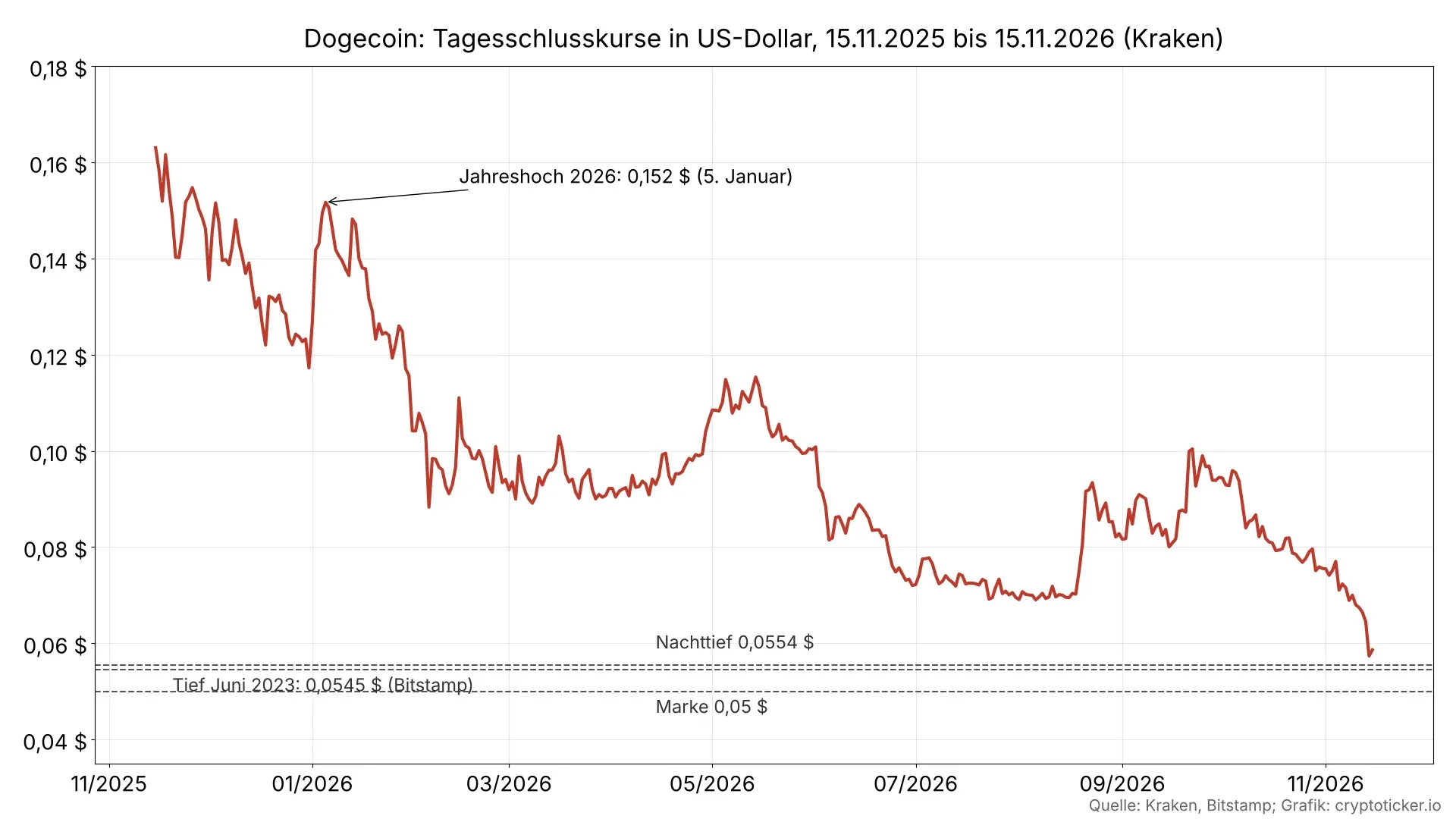 Dogecoin daily closes on Kraken over twelve months: 62 percent has been lost since the January high.
Dogecoin since its yearly high: from $0.15 to below $0.06
The chart shows Dogecoin's daily closing prices on Kraken over the past twelve months. After a brief climb at the start of the year, the price fell below $0.10 by February and then oscillated for a long time between $0.09 and $0.10. An interim high above $0.11 in May did not hold. Over the summer DOGE sank to around $0.07, and the September recovery reached just above $0.10. Since late September, the curve shows a sequence of lower highs and lower lows. In November alone, the close fell from $0.0755 on November 1 to $0.0573 on Saturday, a 24 percent loss in two weeks.
This history explains why Dogecoin is falling harder than bitcoin. Unlike coins with their own business model, DOGE offers few metrics that buyers could hold on to during a weak phase. The price depends heavily on sentiment and attention, and both are missing in a market with a fear index of 10. Our explainer What is Dogecoin covers what makes Dogecoin tick technically and why around 5 billion new DOGE are created every year.
Dogecoin among the top 25: who lost most in 24 hours
Among the 25 largest cryptocurrencies by market capitalisation, only Avalanche, down 11.4 percent, and Cardano and Litecoin, down 8.4 percent each, lost more than Dogecoin at 5:47 a.m., according to CoinGecko. NEAR Protocol followed with 7.0 percent and Solana with 6.0 percent. Bitcoin held up more than twice as well with a 3.5 percent loss, and TRON lost only 1.3 percent. Our piece on the Cardano crash covers the same night's decline in Cardano, and the piece on the NEAR crash the one in NEAR.
Dogecoin open interest: some of the bets were closed
Open interest is the value of all outstanding futures contracts on a coin. When it rises, new bets are being added; when it falls, positions are being closed, voluntarily or through liquidation. A liquidation is the forced closure of a leveraged position by the exchange as soon as the posted capital no longer covers the losses.
Public market data from the OKX exchange show two phases for the Dogecoin perpetual contract. Until the afternoon of November 14, open interest was still rising, reaching 1,247 million DOGE at 2 p.m. CET. With the evening slide it fell to 1,165 million DOGE by 1 a.m., a drop of 6.5 percent. Around 81 million DOGE in contracts were closed over those eleven hours. Since then the total has been building up again: at 5 a.m. it stood at 1,181 million DOGE.
In dollar terms, open interest fell between 5 a.m. on November 14 and 5 a.m. on November 15 from $76.8 million to $69.0 million, a decline of just over 10 percent. A good two-thirds of that is due to the lower price, the rest to closed positions. Unlike the market as a whole, the wave of forced closures in Dogecoin on OKX was therefore limited.
Other figures show how violent the evening was across the market. According to Bitcoin.com, bitcoin's fall on November 14 led to liquidations of around $1 billion across the whole crypto market in 24 hours. Later that evening bitcoin dropped below $64,000. According to TokenPost, positions worth $691 million were liquidated within an hour, $671 million of them longs and only $19.5 million shorts. None of these sources breaks out how much of that fell on Dogecoin.
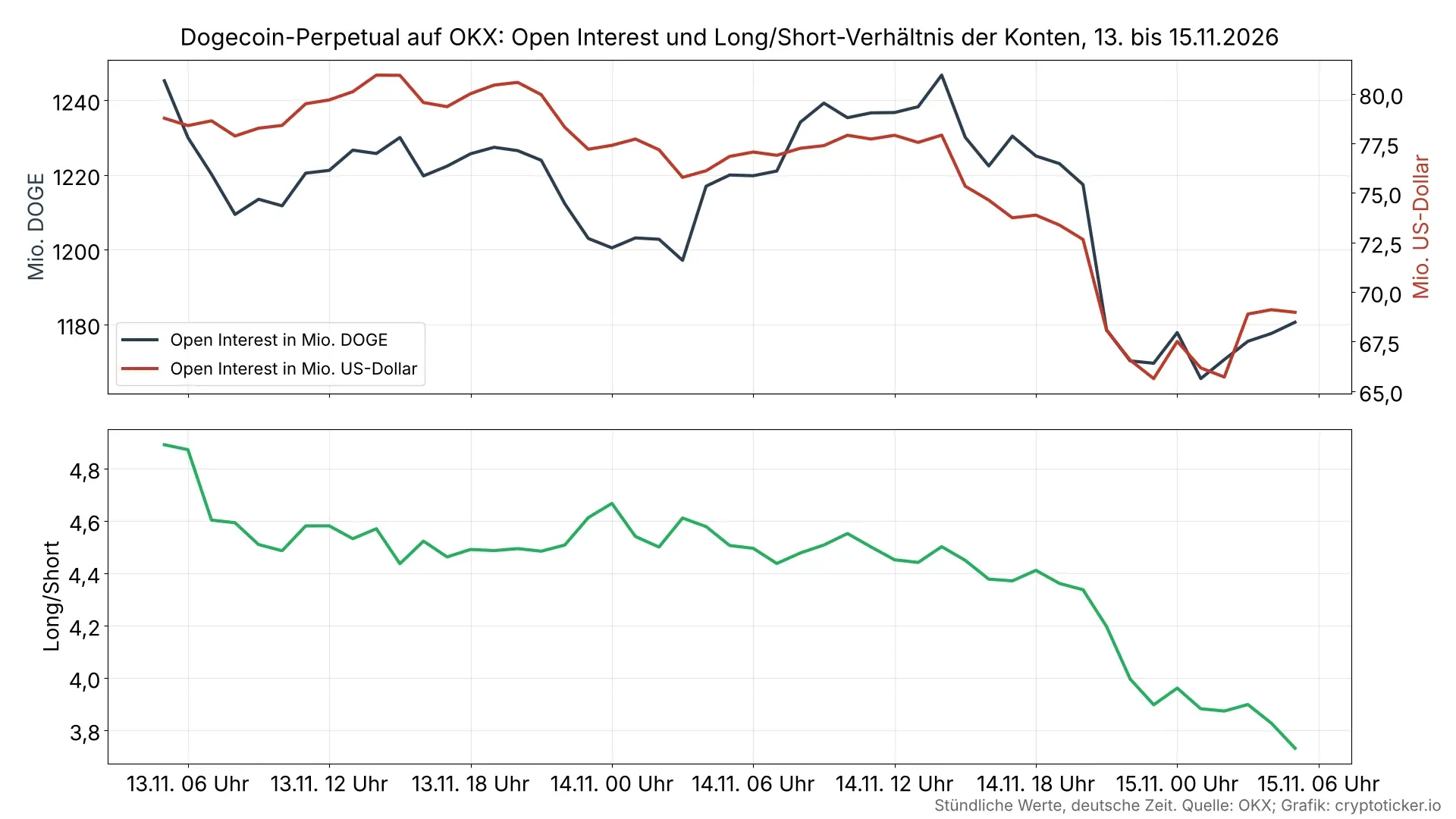 Late in the evening, Dogecoin's open interest and long/short ratio fall together.
Dogecoin long/short ratio: four in five accounts stay long
The account long/short ratio states how many accounts are betting on rising prices for every account betting on falling prices. On OKX it stood at 4.51 for Dogecoin at 5 a.m. on November 14. It remained almost unchanged until early evening, standing at 4.36 at 7 p.m. Only with the slump after 9 p.m. did it fall noticeably, to 3.90 at 11 p.m. and 3.73 at 5 a.m. on Sunday.
The share of accounts on the long side thus slipped from just under 82 to just under 79 percent. A large majority is still betting on rising DOGE prices. The contract's funding rate, the fee that flows between the long and short sides, was minus 0.007 percent per eight-hour period on Sunday morning. Slightly negative means the short side pays a small fee to the long side. If the price keeps falling, a large number of open long positions are at risk, and their forced closure would accelerate the decline. cryptoticker.io compiled this analysis itself on November 15, 2026, based on hourly OKX data over 48 hours and Kraken and Bitstamp daily closes since December 2022.
Dogecoin leverage: how long, short and the liquidation price work
Leverage multiplies the effect of every price move on the capital deployed, in both directions. At 10x leverage, a 10 percent price change moves the position by 100 percent. If DOGE rises from $0.0584 to $0.0642, a 10x long doubles its capital. If DOGE falls from $0.0584 to $0.0526, the capital is wiped out. In practice the exchange closes the position slightly earlier, because it keeps a safety margin for fees and slippage.
At 100x, around 1 percent is enough. A long opened at $0.0584 would be gone at about $0.0578. That is less than the move of a single trading hour that night. Between the 24-hour high of $0.0633 and the low of $0.0556 lay just over 12 percent. A long opened at the high with leverage of about 8x or more would, on paper, not have survived the drop to the low.
A short position works the other way round: it gains when the price falls and is liquidated when it rises. The night itself showed how fast that can happen. Between 3 and 4 a.m. CET, Dogecoin rose on Kraken from $0.0562 to $0.0586, a gain of just over 4 percent within an hour. A 25x short would have been wiped out.
Stop-loss and position size in Dogecoin trades
A stop-loss is an order that closes a position automatically once a set price is reached. It caps the loss before liquidation kicks in. Leveraged traders also size their positions so that a loss down to the stop-loss costs only a small part of the account, with 1 to 2 percent often cited. In fast markets, however, a stop-loss can be filled below the intended price, because there are no buyers between two prices. That applies especially to nights like the one into Sunday, when the price jumps several percent within an hour. Our article long and short in crypto explains the basics of how long and short work.
Will Dogecoin fall below $0.05? The levels from the price history
Daily data from Kraken and Bitstamp yield three levels to the downside. The first is the overnight low at $0.0554, which the price has tested twice. The second is the June 10, 2023 daily low at $0.0545, the last time DOGE traded lower. The third is the round $0.05 mark. It lies just under 15 percent below the Sunday-morning price, a distance Dogecoin has already covered this week.
To the upside, Friday's close at $0.0645 stands in the way first, then the November 8 close at $0.0689 and the $0.07 level around which DOGE oscillated all summer. Whether any of these levels will hold cannot be predicted. They do show, however, where trading last took place and where the price found support in the past.
For context, it helps to look at bitcoin, which sets the pace of the market. Our analysis how low can bitcoin fall shows how far the largest coin dropped in earlier cycles. The article on the 200-week line explains why the bitcoin price is currently trading below a long-term moving average, and the bitcoin price prediction 2027 collects what analysts expect for next year.
Trading Dogecoin in Europe: MiCA exchanges, futures and CFDs
If you want to buy or sell Dogecoin, or bet on a move, you have three routes. The simplest is buying through a crypto exchange or broker licensed under the EU's crypto regulation MiCA. MiCA stands for Markets in Crypto-Assets and, since the end of 2024, has governed across the EU which providers may trade and hold crypto assets for clients. Kraken and OKX, for example, list DOGE. Our comparison of the best crypto exchanges shows which platform charges which fees.
The second route is futures and perpetuals, futures contracts with no expiry date that let you trade long and short with leverage. They are offered by centralised exchanges and by decentralised venues, which our comparison of perp DEXs lists. The third route is CFDs, contracts for difference on the price, such as those that CFD brokers like XTB offer on cryptocurrencies. A CFD only tracks the price movement, and you do not own any coins.
CFDs are complex instruments and come with a high risk of losing money rapidly due to leverage. A high percentage of retail investor accounts lose money when trading CFDs. You should consider whether you understand how CFDs work and whether you can afford to take the high risk of losing your money.
Sell or hold Dogecoin? Two scenarios after the crash
This article cannot and does not want to give a recommendation. It does help, though, to frame the situation in conditions that can be checked.
In the first scenario, the overall market calms down. Bitcoin stabilises, the liquidation wave runs its course and Dogecoin holds the area around $0.055 on a daily closing basis. The overnight low would then also be the low of this downswing, and a recovery towards $0.0645, where the price still closed on Friday, would be possible. The long/short ratio shows that many traders are betting on exactly that.
In the second scenario, the sell-off continues, driven by further ETF outflows or a sharper rate outlook ahead of the Fed meeting in December. A Dogecoin close below $0.0545 would put the price at its lowest closing level since at least late 2022, and the $0.05 mark would come within reach. The many open long positions would accelerate such a break through forced selling. Our article buy or sell bitcoin describes how investors in the bitcoin market deal with the same question. The piece on the bitcoin bear market shows what earlier downturns reveal, and the article on the question when will bitcoin go back up describes the conditions under which analysts expect a recovery.
Whatever the scenario, anyone holding Dogecoin with leverage should check their own liquidation price against the levels above. Those holding without leverage lose money if prices keep falling, but are not forced out of the position.
Weekend crypto crash: bitcoin, altcoins and equities
Dogecoin is not alone on this day. Our crypto news on the bitcoin slump give an overview of the whole day, the article why is bitcoin falling? sets out the reasons, and we keep updating the running state of the crypto crash today. Our overview of the stock market crash shows how the decline fits into the situation on the other financial markets. The article on Strategy stock looks at how companies with large bitcoin holdings are coming through the slump. Whether the planned IPO of AI company Anthropic is drawing capital away from the crypto market is an open question among investors; what is known about the offering is on our page on Anthropic stock.
Dogecoin price: the June 2023 low at $0.0545 is the next level
Note the levels. The overnight low of $0.0554 and the June 2023 low of $0.0545 decide the next move, and below them lies the $0.05 mark. Providers that list Dogecoin are in our comparison of crypto exchanges. Recalculate your leverage. Leveraged traders recalculate their own liquidation price and set a stop-loss. Our comparison of crypto brokers lists platforms for futures and CFDs. Choose a trading venue. For buying and selling without leverage, MiCA-licensed providers are a good fit. The overview of MiCA-regulated exchanges shows which ones they are.(As of November 15, 2026. This article is not investment advice. Prices and fee structures change; check the terms with the provider before you buy.)



 Bengali (Bangladesh) ·
 English (United States) ·