
 1 hour ago
1
1 hour ago
1 
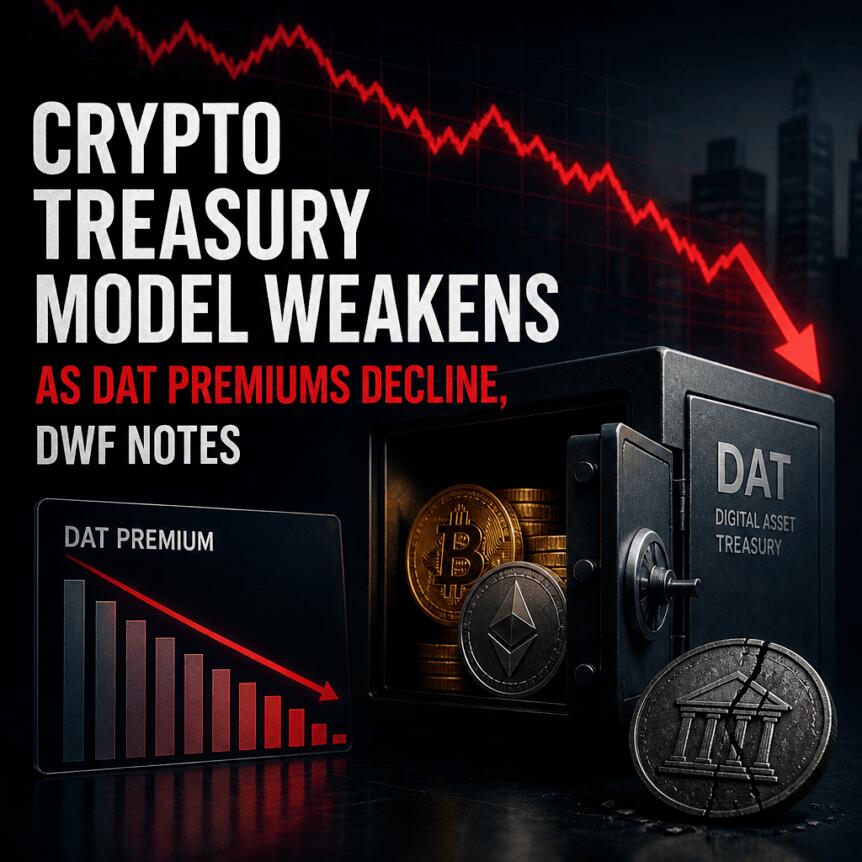
Digital asset treasury (DAT) companies—public vehicles that hold crypto and aim to finance growth through a trading premium over their crypto holdings—are losing much of their early advantage, according to a report released this week by DWF Ventures.
In its analysis of the 20 largest DATs by assets under management, DWF found that only four trade above their “mNAV,” a metric that compares a company’s market value to the value of its underlying crypto holdings. The implication is straightforward: investors appear less willing to pay extra for crypto exposure through listed balance sheets, shrinking one of the model’s key funding mechanisms.
Key takeaways
Only four of the 20 largest digital asset treasuries trade above mNAV, meaning most trade at discounts to their crypto holdings. DWF links the shift to investors no longer pricing DAT shares at a persistent premium for crypto exposure. DAT stocks have generally struggled to outperform simply holding the underlying cryptocurrency, with the reported advantage—when it exists—often modest. External warnings about “mNAV collapse” predate the latest market weakening, including concerns raised by Standard Chartered and Galaxy Digital.Most DATs now trade below their crypto holdings
DWF’s report, published Thursday, examined the largest DAT companies by assets under management and found that just four trade above an mNAV of 1—where market value exceeds the value of held crypto. Those firms are Bit Digital, Strive, Hyperliquid Strategies, and BitMine.
For investors, discounts like these matter because DAT growth strategies typically rely on issuing equity at prices above the value of existing holdings. When shares trade at a premium, companies can raise capital and add to their crypto exposure without diluting existing shareholders’ effective value. When that premium disappears—or flips into a discount—new share issuance becomes less attractive and can dilute shareholders rather than strengthen the treasury.
DWF characterizes the widespread discounts as a sign that the market is no longer willing to pay the same premium for publicly traded crypto exposure.
The “treasury premium” appears to have peaked
DWF points to Strategy, the Bitcoin treasury model pioneer, as an early benchmark for how the premium worked when the approach first captured investor attention. According to the report, the general pattern across DATs has been that mNAV premiums peaked when the strategy was new and demand for the structure was strongest.
DWF highlights Strategy’s mNAV peak in late 2024 during a Bitcoin rally, when demand for leveraged BTC exposure was reported to be particularly strong. The broader framing from DWF is that, as the novelty and momentum around BTC treasury structures faded, the premium investors were willing to pay weakened as well.
DWF also notes that while some DATs have outperformed the underlying cryptocurrency at times, the outperformance has typically been small compared with what investors could have achieved by simply holding the crypto directly.
Earlier coverage from Cointelegraph described how Michael Saylor’s Strategy helped popularize the Bitcoin treasury approach beginning in 2020, setting the template DATs later tried to follow.
Real-world evidence: Sequans exits its BTC treasury
The DWF findings arrive alongside a concrete example of a company moving away from the treasury approach. Sequans Communications, a French semiconductor firm that launched a Bitcoin treasury strategy last year, disclosed that it sold its remaining 314 BTC, completing an exit process.
As reported by Cointelegraph, the exit began with a redemption of its convertible debt in May and concluded with the sale of the remaining Bitcoin. After the transaction, Sequans said it holds no cryptocurrency on its balance sheet, according to the report linked by Cointelegraph: Sequans exits bitcoin treasury strategy after selling remaining 314 BTC.
While a single exit does not determine whether DATs as a category will fail, it underscores the practical consequences of a structure that depends on continued investor support. If share prices fail to sustain a premium over NAV, the cost of raising and maintaining exposure via equity becomes harder to justify.
Warnings about mNAV collapse preceded the latest market stress
DWF’s report is not the first to question whether the DAT model can keep functioning without a persistent equity premium. Standard Chartered reportedly raised concerns in September 2025, when Bitcoin and the broader crypto market were described as booming. The bank warned that an “mNAV collapse” could trigger consolidation among digital asset treasuries.
Galaxy Digital made a similar argument, stating that the model “critically depends on a persistent equity premium to NAV.” In Galaxy’s view, that premium is what allows companies to issue shares and buy more crypto while avoiding dilution of existing holders. If shares trade below NAV, raising new equity can become dilutive and undermine the strategy’s financing logic.
In research cited by Cointelegraph, Galaxy analyst Will Owens wrote that “if the premium collapses, or worse, flips to a discount, the model begins to break.”
These concerns align with the timing and direction of market movement. The source notes that Bitcoin fell from a record high of more than $126,000 in October to below $60,000 before recovering to around $86,000, creating conditions in which treasury premiums and leveraged demand could plausibly weaken.
In other words, the issue raised by the earlier institutional warnings has not gone away: it appears to be a structural dependence on investor willingness to pay above NAV, not just a temporary valuation adjustment.
Why the discount trend matters now
For traders and longer-term investors, the shift toward widespread DAT discounts changes how the category should be evaluated. If most treasuries trade below their underlying holdings, the “equity as growth capital” thesis becomes less reliable, and performance may converge toward the crypto market itself—minus whatever inefficiencies arise from the stock wrapper.
It also raises the question of what happens when premiums do not recover quickly. DWF’s findings suggest that the model’s early advantage—capital accessibility driven by investor enthusiasm—has faded, leaving fewer companies able to compound holdings through share issuance without eroding shareholder value.
Investors watching DATs next should focus on whether any remaining premiums can stabilize and on how companies respond when share prices do not justify continued equity-funded purchases—especially as market volatility continues to pressure crypto-linked balance sheets.
This article was originally published as Crypto Treasury Model Weakens as DAT Premiums Decline, DWF Notes on Crypto Breaking News – your trusted source for crypto news, Bitcoin news, and blockchain updates.





 Bengali (Bangladesh) ·
  English (United States) ·