
 1 month ago
27
1 month ago
27 
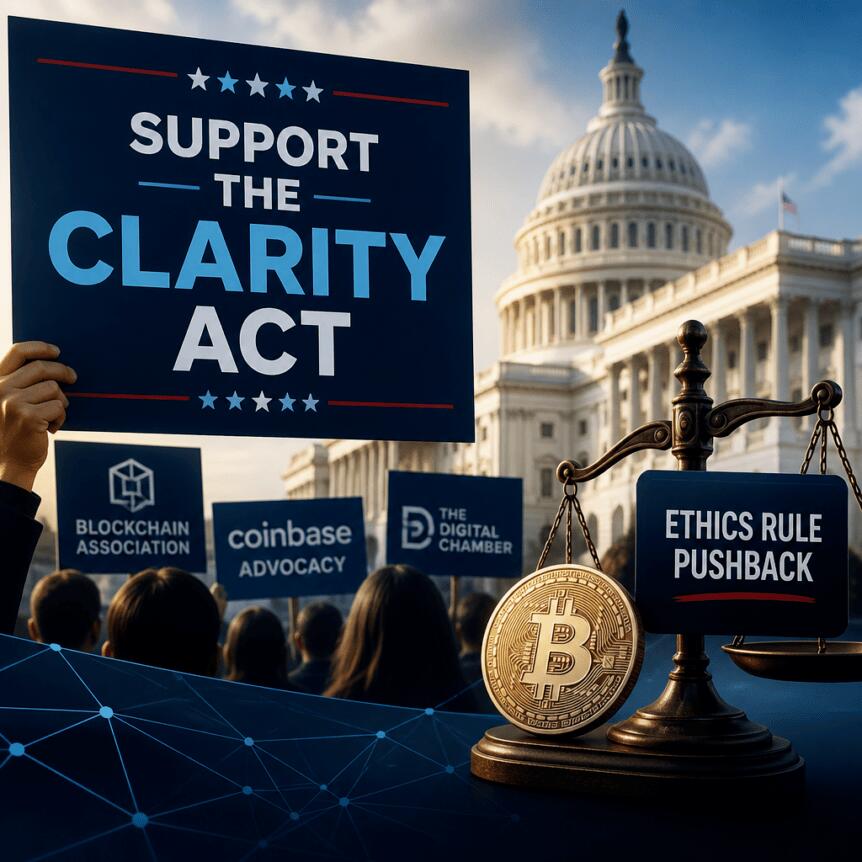
Three major crypto advocacy groups have urged U.S. Senate leaders to allow the Digital Asset Market Clarity (CLARITY) Act to receive “floor consideration,” pushing for a full vote before the chamber departs for state work periods in August. In a joint letter sent Friday to Majority Leader John Thune and Minority Leader Chuck Schumer, the organizations said bipartisan negotiations are still underway and asked senators to keep discussions moving.
The appeal lands as the bill has cleared the Senate Banking and Agriculture committees, but the political math and remaining policy disputes have left uncertainty around timing. With Republicans holding a 52–47 majority over Democrats in the Senate, passage would require 60 votes—meaning cross-party support remains essential.
Key takeaways
Crypto advocacy groups are requesting Senate leadership schedule the CLARITY Act for a floor vote (“floor consideration”) before August recess. The bill has progressed through the Senate Banking and Agriculture committees, but some lawmakers plan to delay voting until specific provisions are addressed. Republicans released the CLARITY market structure text earlier this week, including ethics provisions aimed at public corruption concerns. Democrats have criticized the ethics package as insufficient, raising the odds of stalled negotiations and a delayed vote. Markets are already pricing in uncertainty: Kalshi event contracts showed about a 40.3% chance of a Senate vote before the August recess as of Friday.Advocates press for a floor vote amid legislative uncertainty
In their letter, the Crypto Council for Innovation, the Digital Chamber, and the Blockchain Association urged senators to prioritize bringing CLARITY to the floor. The groups acknowledged that “constructive bipartisan negotiations remain underway” and encouraged lawmakers to continue good-faith discussions between both parties.
Committee progress does not guarantee that the bill reaches the chamber in time. While the legislation has advanced through Senate banking and agriculture panels, the letter suggests that political leaders are still weighing whether the final language will satisfy key concerns. The timing matters: if senators fail to vote before the August recess, the debate could spill into the weeks leading up to the 2026 U.S. midterms, potentially reshaping the incentive structure for lawmakers on both sides.
Ethics and market structure provisions become the sticking point
CLARITY is widely framed as one of the most consequential U.S. bills for the crypto sector, in part because it aims to provide clearer rules for digital asset markets. The latest Republican effort included ethics provisions designed to bar public officials from issuing or sponsoring cryptocurrencies, according to reporting that referenced the bill text released earlier this week.
However, those measures appear to be at the center of Democratic skepticism. Politico reported that Senator Ruben Gallego criticized the GOP’s counterproposal as not matching what Democrats said had been promised during negotiations. Gallego said, according to Politico, that after extensive work with Republican colleagues, the new offer did not reflect a serious attempt to address concerns raised during earlier bargaining.
“[…] After all the work that we’ve done with our Republican colleagues, that they would take the months and months of work and somehow interpret that and turn around and think what they offered was even remotely close.”
That criticism underscores a central tension: even as the bill’s broader market-structure goals gain traction, lawmakers may be reluctant to move without stronger agreement on ethics and enforcement-related safeguards.
Industry groups argue CLARITY matters for both compliance and innovation
While the legislative fight focuses heavily on ethics provisions, industry leaders are also emphasizing what they see as CLARITY’s practical impact on how the U.S. regulates digital assets—especially outside traditional custody models.
Coinbase CEO Brian Armstrong argued that the U.S. still lacks a comprehensive federal framework and that the absence of such rules has allowed harmful behavior to reach customers while business activity migrates beyond U.S. oversight. In a Wednesday X post, Armstrong said the bill would provide consumer protections, tools for law enforcement, and a path for the country to lead in the industry.
Orest Gavryliak, chief legal officer of DeFi platform 1inch, discussed the bill on Cointelegraph’s Chain Reaction podcast on Friday. He said CLARITY would help recognize a legal framework for non-custodial protocols, contrasting that approach with what he described as regulators trying to fit decentralized systems into custodial frameworks. Gavryliak’s argument was that rules designed for custodial models do not translate cleanly to non-custodial protocols—an issue he said makes passage “very important.”
What markets are signaling about timing—and what to watch next
Even with committee approvals, reaching the 60-vote threshold remains the main challenge. That requirement creates a built-in incentive for lawmakers to negotiate hard on unresolved provisions rather than accept a narrow coalition. The result is that procedural timing—whether leadership can secure enough alignment to schedule a floor vote—may become as consequential as the final bill text itself.
As of Friday, Kalshi’s event contracts offered users a 40.3% chance that the Senate would vote on the CLARITY Act before the August recess, reflecting a market view that passage may not be immediate even if the bill is moving.
For investors, traders, and developers, the next key question is not simply whether the CLARITY Act survives procedural hurdles, but what changes—if any—are made as senators try to reconcile ethics-related disagreements. If the ethics language remains the primary point of contention, negotiations could continue to expand rather than converge. Conversely, if the Senate leadership finds a pathway to unify enough support for floor consideration, CLARITY could become a central reference point for U.S. crypto compliance planning well before lawmakers turn to the broader midterm political cycle.
This article was originally published as Crypto Advocacy Groups Back CLARITY Passage Amid Ethics Rule Pushback on Crypto Breaking News – your trusted source for crypto news, Bitcoin news, and blockchain updates.




 Bengali (Bangladesh) ·
  English (United States) ·