

In a galaxy far, far away, two lightsabers are buzzing with energy. In this face-off, a pair of enemies are swinging these weapons toward one another. As their blades clash, tiny sparks fly off.
Star Wars lightsabers are perhaps the coolest gadgets in science fiction. These high-energy weapons can melt, cut and burn through almost anything — and with minimal resistance. But when one lightsaber meets another, they clash against each other, blade against blade, creating epic duels.
A lightsaber may be a great weapon to wield if you’re a Jedi or Sith, but could one exist in the real world? It turns out that making a beam of light behave like a solid sword is far, far trickier than it looks on the big screen.
Passing through
These weapons have no real-world equivalent. They have been hypothesized to be made from both lasers and plasma. Lasers produce highly focused beams of light. Plasma is extremely hot gas that becomes electrically charged. (Lightning is a form of plasma).
Both lasers and plasma face the same fundamental problem in re-creating one of the lightsaber’s signature effects: They can’t smash into things like solid objects.
Consider something solid, such as a tennis ball. When tennis balls collide, they bounce off each other because the atoms in one ball push against the atoms in the other.
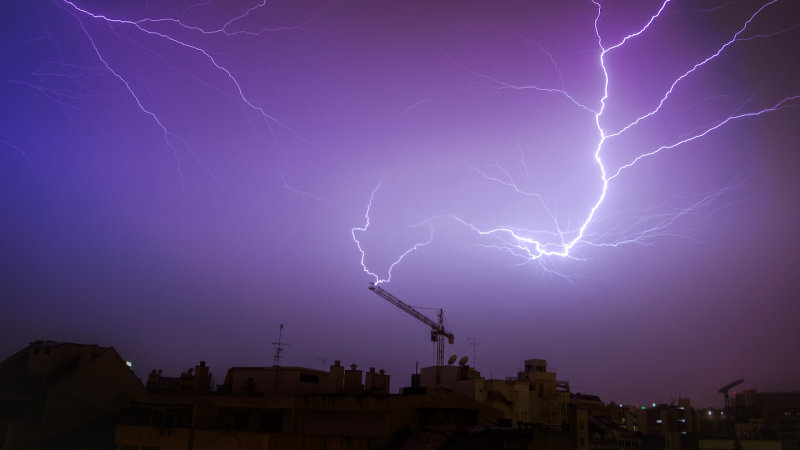 Lightning bolts are good examples of plasma in action.André Dias Duarte/Getty Images Plus
A laser, though, is made of photons. These are the massless, chargeless particles that make up light. When one beam of photons meets another, they pass through each other. Imagine trying to duel with a pair of flashlights — the beams would just pass through each other. Without mass or charge, there’s simply nothing for photons to push against.
Plasma faces a similar problem. While made of matter, plasma consists of charged particles. These could be shaped by magnetic fields into a glowing, lightsaber-shaped column. In fact, plasma torches already exist. They create directed streams of hot plasma. However, without some extraordinary circumstances, they would still behave like a gas.
“Having a sword battle with two plasma torches would be just as effective as having a battle of air columns from two leaf blowers. The columns of gas or plasma would just go right through each other,” says physicist David Schaffner. He studies plasma physics at Bryn Mawr College in Pennsylvania.
What would it take?
In 2019, physicists Jean-Sebastien Gagnon and François Fillion-Gourdeau explored the possibility of lightsabers in a study published in the European Journal of Physics. Gagnon works at Norwich University in Northfield, Vt. Fillion-Gourdeau works in Canada at Infinite Potential Laboratories in Waterloo, Quebec.
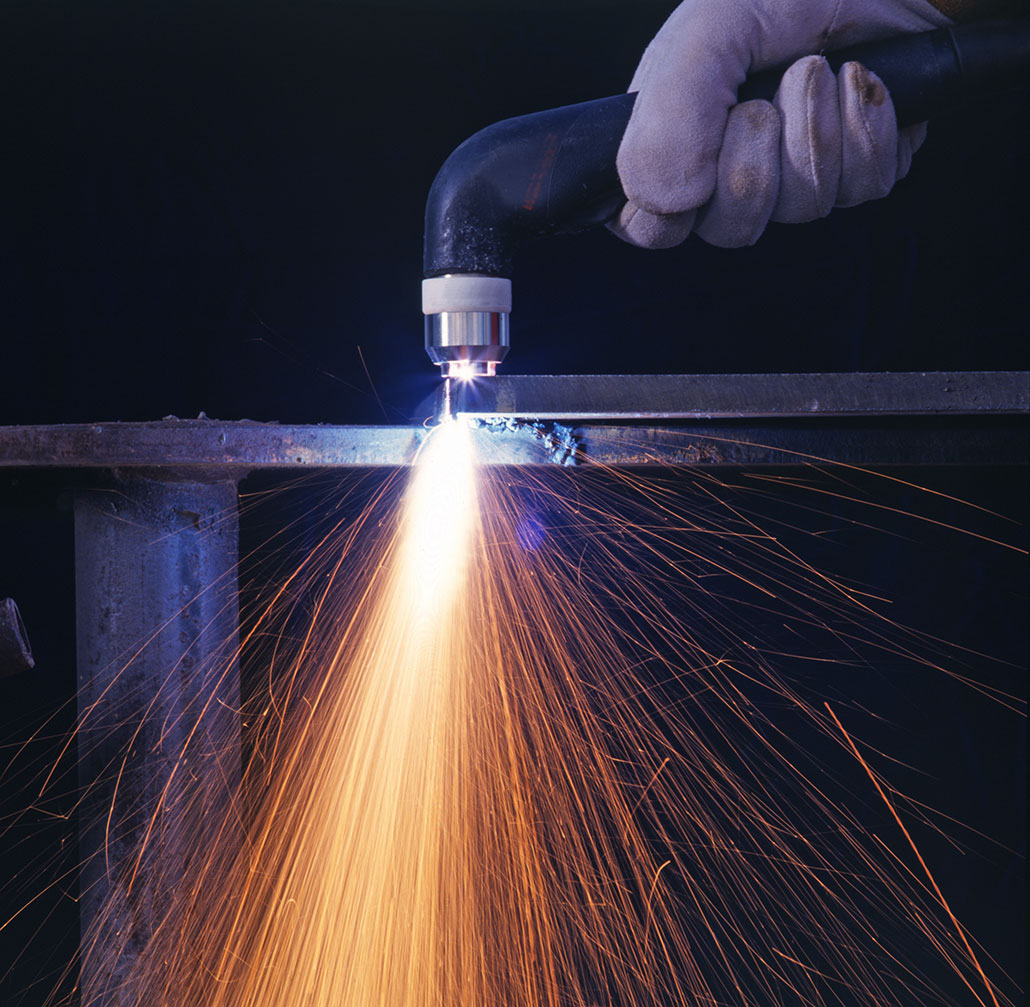 Plasma torches are often used to cut or weld metals. But they’d make a bad lightsaber.ALACATR/E+/GETTY IMAGES
Light-based lightsabers using extremely powerful lasers could theoretically work, they calculated. With the right conditions, two lightsaber blades could feel solid to each other and clash like in the movies. However, the laser intensities and energy levels needed are unrealistic.
Running such a lightsaber for one minute would need about one-thousandth of the sun’s power output in one second, they found. That would take fuel weighing about 10 times Egypt’s Great Pyramid of Giza.
All that fuel would make the lightsaber incredibly heavy. “The mere weight of the [light]saber is too high for any human to wield. In other words, only a Jedi using the ‘Force’ could actually use it,” the researchers joked in an email.
Plasma might work better. It faces its own challenge, however: containment.
Creating plasma requires a huge amount of energy to first rip electrons from atoms. To stay stable in open air, though, plasma must maintain super-high temperatures. And that would take a huge amount of energy.
Do you have a science question? We can help!
Submit your question here, and we might answer it an upcoming issue of Science News Explores
“It’s like trying to keep soup boiling in a snowstorm. The heat leaks into the surrounding air incredibly fast,” explains Jhovanna Garcia. She studied nuclear engineering at the University of Tennessee, Knoxville. Like boiling that soup, keeping plasma stable is possible. It just takes a lot of energy. She equates it to running 1,000 toasters at once.
Scientists have found a workaround using a technique called Z-pinch. Here, powerful electric currents create magnetic fields. These fields squeeze plasma into shape. They also maintain the required temperatures.
Despite this workaround, there is another problem: practicality. Current plasma-containment devices only work inside sealed vacuum chambers. In open air, a plasma would instantly cool down and disappear.
Reality strikes back
Plasma torches are the closest devices we have to a real lightsaber. This torch produces a hot, highly directed flow of plasma that can slice through various materials, including aluminum and stainless steel. Welders use them to fuse or cut metals in factories and workshops.
But plasma torches don’t measure up to movie lightsabers.
The beams produced by a plasma torch are only several centimeters (a few inches) long. That’s far from the meter (roughly three-foot) long blades seen in the Star Wars movies. Plasma torches also need thick cables to supply them a constant stream of gas and electrical power. This makes them impossible to wield like a sword.
Most importantly, the “blades” would simply pass through each other rather than clashing dramatically.
So while we won’t see any real Jedi and Sith with glowing lightsabers, plasma research continues to advance. This brings us closer to understanding the limits of physics.
Until then, the fiction will have to remain strong with the movies.




 Bengali (Bangladesh) ·
  English (United States) ·