
 4 hours ago
1
4 hours ago
1 
And it keeps getting worse on paper. The token is down 7.40% over the past seven days at the time of writing, with a market cap sitting just under $9.6 billion. For context, Cardano used to be comfortably planted in the top five – in 2021 it surpassed USDT and BNB and hit a $39 billion market cap, and took the number 3 spot. Now, tokens like Hyperliquid (HYPE) and Binance Coin (BNB) have surpassed ADA. These two altcoins weren’t even in the conversation a couple of years ago.
The broader crypto market hasn’t been kind to altcoins, but Cardano has consistently underperformed even within that weak context.
What the On-Chain Data Actually Says
Sentiment analytics firm Santiment recently published findings that are worth paying attention to.
According to their data, average wallets that have been active on the Cardano network over the past year are sitting at roughly -43% returns. That tracks with a -71% price decline since September. But Santiment’s point isn’t doom – it’s context. In their framework, this level of negative MVRV (Market Value to Realized Value) historically signals that an asset is sitting in what they call an “opportunity zone.” The logic: when the average participant is deeply underwater, there’s less selling pressure left, and the statistical tendency is for prices to eventually revert.
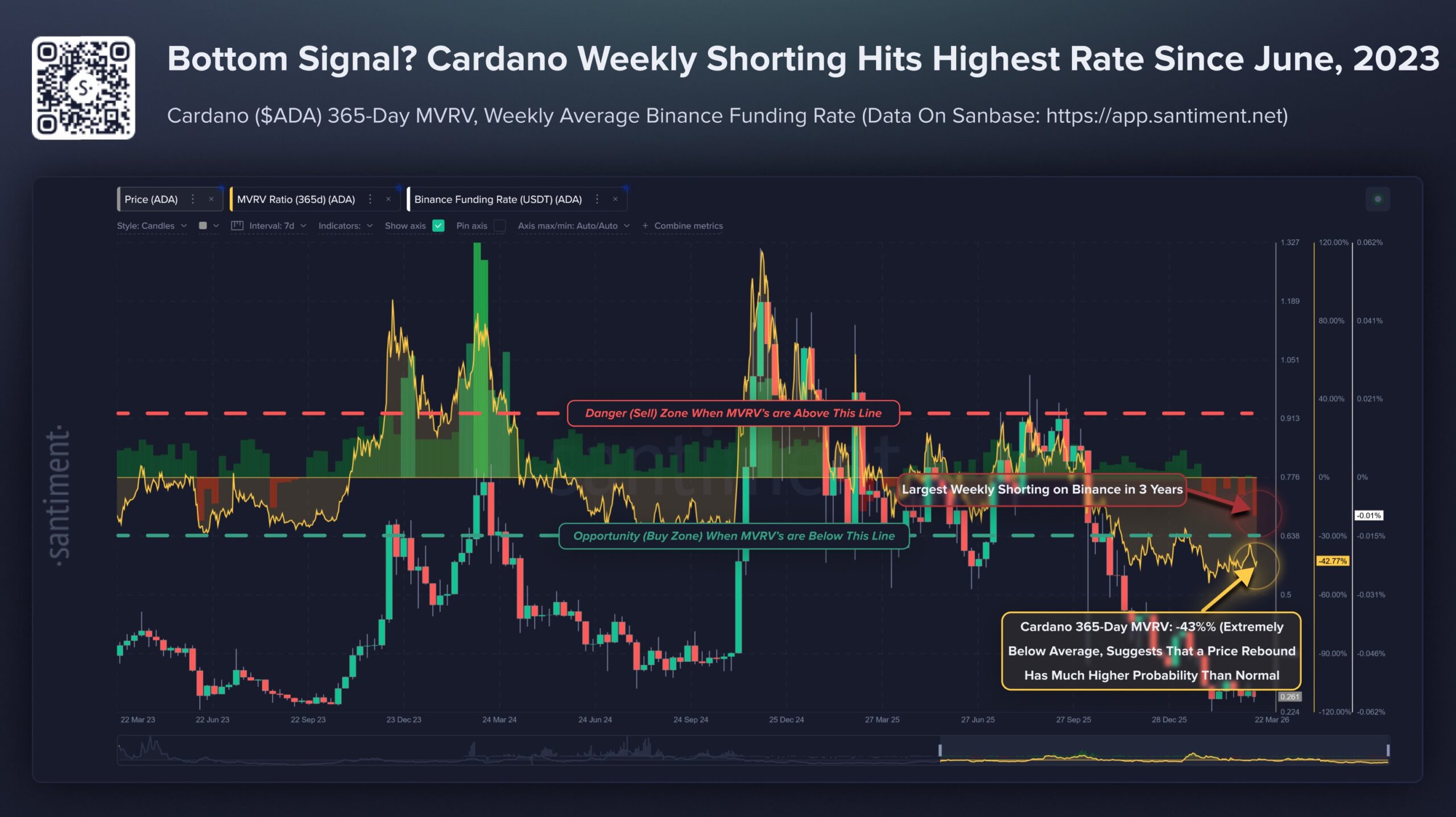
They also flagged Cardano’s funding rate on Binance as hitting its highest short-to-long ratio since June 2023. That’s a crowded short trade – and crowded trades have a habit of unwinding violently. Funding rates, by design, tend to punish consensus positions.
None of this is a guarantee. But it suggests the risk/reward at current levels looks different than it did when ADA was trading at $1.50 on the way down.
On the regulatory side, the SEC and CFTC have introduced a new classification framework that places Cardano alongside several other altcoins in a “digital commodities” category – a distinction that may matter for institutional appetite and exchange listings down the line.
What’s Actually Being Built
Price performance aside, Cardano’s development pipeline in 2026 is arguably the most technically ambitious it’s been.
Two major upgrades are on the horizon, and they represent a shift from laying infrastructure to actually scaling it.
Van Rossem Hard Fork – April 2026
The Van Rossem upgrade (Protocol 11) is scheduled for April 2026. It’s classified as an “intra-era” fork, meaning it bolts new features onto the existing Conway ledger era without breaking current transaction formats – a cleaner upgrade path than prior hard forks.
The practical impact is mostly felt by developers. The upgrade adds new built-in functions to Plutus, Cardano’s smart contract language, making complex mathematical operations dramatically cheaper to run on-chain. Two additions stand out: Modular Exponentiation (CIP-109), which underpins advanced cryptographic proofs, and Multi-Scalar Multiplication (CIP-133), which accelerates performance for BLS12-381 curves – a prerequisite for serious zero-knowledge (ZK) applications. There’s also native Array support coming to Plutus, which addresses a long-standing performance issue with how the language handles data lists. Cardano Node 10.7.0 is the designated release for this fork and is currently in pre-release benchmarking ahead of mainnet activation.
Ouroboros Leios – Mid-to-Late 2026
Leios is the bigger story. It’s a fundamental redesign of how Cardano’s consensus mechanism works – moving from sequential block processing to a parallel model.
Right now, Cardano handles somewhere between 10 and 20 transactions per second. Leios is targeting 1,000 to 1,500 TPS on the base layer, with theoretical peaks in optimized conditions reaching up to 10,000 TPS. To get there, it introduces a three-tier block structure: Input Blocks that absorb large volumes of transaction data, Endorsement Blocks where nodes validate those inputs, and Ranking Blocks that finalize transaction order on the permanent chain. The architecture is designed to eliminate idle time in the network.
As of January 2026, the Leios blueprint (CIP-0164) is finalized and engineering is roughly 67% complete. A dedicated stress-test environment nicknamed “Face Melting Net” – which will use AI agents to hammer the protocol – is planned for mid-2026 before any full rollout.
Technical Picture: Cautiously Watching
On the 4-hour chart, ADA/USDT is trading at approximately $0.2654 as of this writing, sitting below both the 50-period SMA ($0.2701) and essentially right at the 100-period SMA ($0.2658). That’s a structurally weak position – price hasn’t been able to reclaim either moving average with conviction.
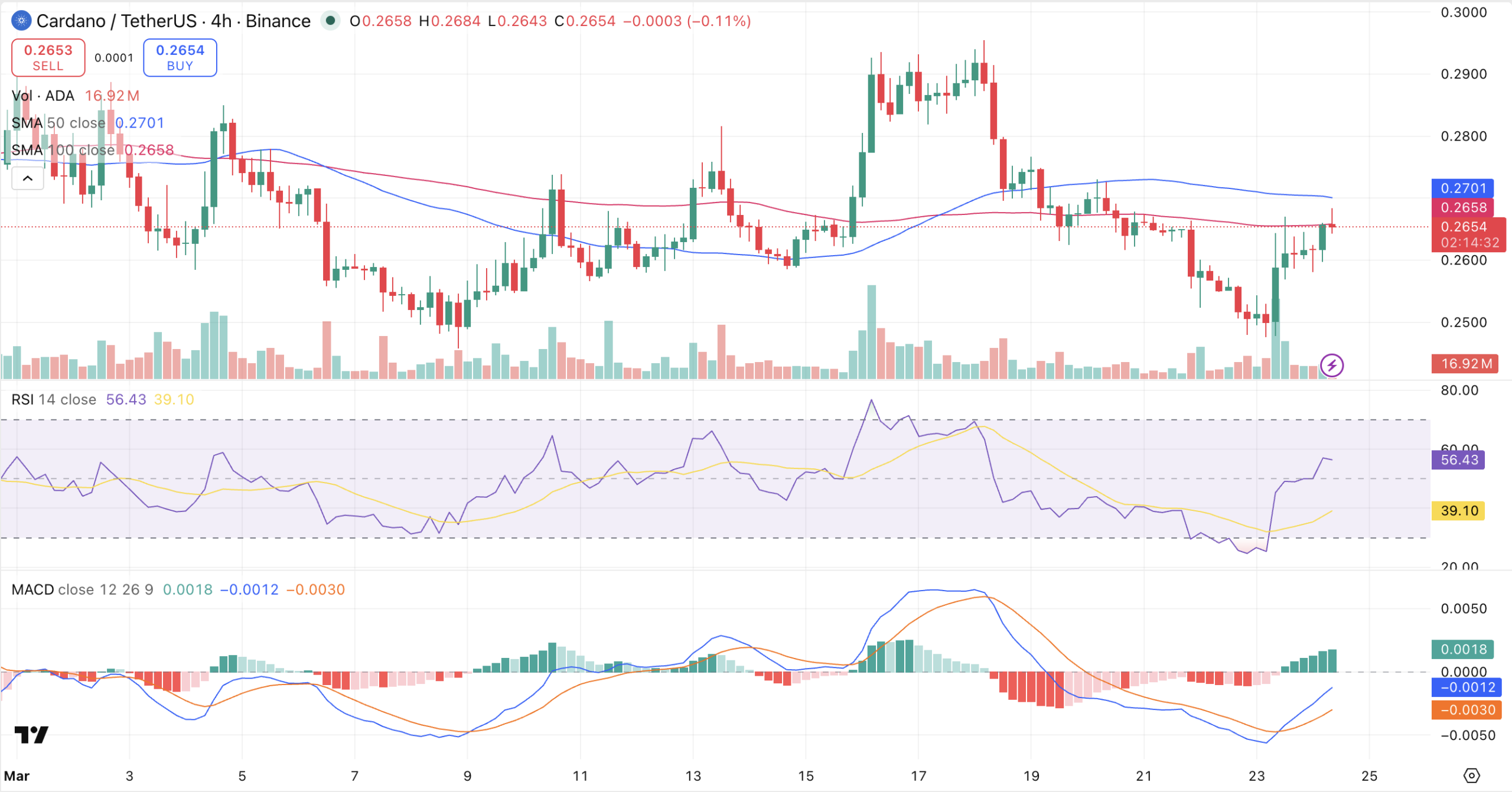
The RSI is at 56.43, which sounds neutral but represents a sharp recovery from the 39.10 level hit just days ago. That kind of RSI bounce from near-oversold territory while price holds flat is worth noting – it suggests buying pressure is quietly building beneath the surface.
MACD tells a similar story. The MACD line (0.0018) has crossed above the signal line (-0.0012), and the histogram is turning green after an extended bearish phase. It’s an early signal, not a confirmed breakout. Volume on the most recent candles has ticked up to 16.92M ADA – not a massive surge, but enough to suggest the move isn’t just noise.
The key level to watch on the upside is $0.27–$0.2750, where the 50 SMA and prior consolidation resistance converge. A clean close above that range on elevated volume would be the first technically meaningful development in weeks. To the downside, a break below $0.25 would likely accelerate selling toward the $0.23–$0.24 zone.
Is Cardano Dead?
By definition, ADA is not dead, but it’s in a very difficult place, where many investors are losing hope.
The development roadmap is real and technically credible. Leios, if it delivers, would make Cardano genuinely competitive on throughput – something it hasn’t been able to claim against Solana or newer L1s. Van Rossem quietly expands what developers can build without a disruptive network break. These aren’t vaporware announcements.
The problem is execution timeline versus market patience. Crypto moves fast, narratives shift faster, and Cardano has been promising “soon” for a long time. The community and the remaining holders know this. So does anyone watching from the outside.
The on-chain data suggests a floor may be forming. The technical chart hints at early momentum. The upgrades – if delivered on schedule – give ADA a legitimate story to tell in the second half of 2026.
Additionally, the silver lining here is that many of ADA’s investors bought the top. And even if they bought at lower prices, besides the first adopters, almost everyone is under water. This means that it is less likely to have a massive exodus of funds at the moment, since the people who would want to offload their holdings at a loss are most likely a minority.
The information provided in this article is for educational purposes only and does not constitute financial, investment, or trading advice. Coindoo.com does not endorse or recommend any specific investment strategy or cryptocurrency. Always conduct your own research and consult with a licensed financial advisor before making any investment decisions.
The post Cardano Is Down Over 91% From Its Peak – Is ADA a Dead Coin? appeared first on Coindoo.




 Bengali (Bangladesh) ·
  English (United States) ·