

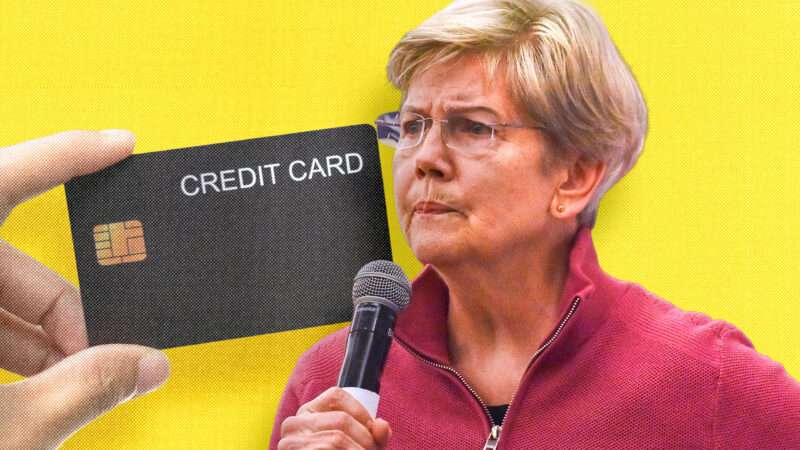
Even in these divided times, some ideas are so bad that both major political parties support them. That's certainly the case with proposals to let the government put a cap on the interest rates charged by credit card companies. It's a scheme that seems considerate to those who run up debt but would instead deny riskier borrowers access to legitimate credit, and it could drive many people to lenders—some underground—who charge more. That is, it's a plan stupid enough to draw backing from Democrats and Republicans alike.
Bipartisan Economic Idiocy
"President Trump himself said that he wants to reduce interest rates on credit cards to 10 percent," Sen. Elizabeth Warren (D–Mass.) told CBS's Margaret Brennan on Sunday. "I got the bill, I'm ready to go."
Sure enough, back in January, President Donald Trump posted on Truth Social, "Please be informed that we will no longer let the American Public be 'ripped off' by Credit Card Companies that are charging Interest Rates of 20 to 30%, and even more….Effective January 20, 2026, I, as President of the United States, am calling for a one year cap on Credit Card Interest Rates of 10%."
The two nominally hostile politicians discussed cooperation on the issue earlier this year, though nothing concrete has come of it so far. It's enough to make you wonder if the issue is enough to bridge political divides for these two as they flirt over their shared interest in idiotic economic populism.
And the idea of capping credit card interest rates really is idiotic, unless you're trying to deny options to higher-risk borrowers and drive them to more expensive alternatives like payday lenders and loan sharks. We don't have to speculate on the impact of such caps; there's plenty of evidence that trying to forcibly lower borrowing costs for consumers cuts them off from legitimate credit.
In 2021, the Federal Reserve Board published a paper by Gregory Elliehausen, Simona M. Hannon, and Thomas W. Miller Jr., examining the impact of a 17 percent interest rate cap in Arkansas. They found that "consumer finance companies, traditionally a source of credit for nonprime consumers, do not have offices in Arkansas because, being subject to the usury ceiling, they cannot profitably lend to risky consumers." Because of its impact on riskier borrowers, the cap was loosened for banks to "allow consumers to escape restrictive effects of the low Arkansas rate ceiling." Even so, "results of our analysis suggest that nonprime consumers in Arkansas were rationed" in terms of access to credit.
Notably, the paper described the 17 percent cap as "very restrictive." The 10 percent cap currently contemplated by politicians of both major parties would be that much tighter and could be anticipated to further restrict access to credit.
'An Interest Rate Cap Does Not Make Loans Less Expensive; It Makes Loans Less Available'
"A federal-government-imposed cap on credit card annual percentage rates (APRs) as severe as 10 percent would likely upend the credit card industry's current business model," American Enterprise Institute senior fellow Paul H. Kupiec warned in a report published earlier this year that delved into precisely that proposal. "Issuers would cancel most existing near-prime and subprime accounts. While some issuers might offer current cardholders new account terms with high fees and collateral requirements, many issuers would just outright cancel accounts with weak credit scores."
Or as Miller, a finance professor at Mississippi State University, told the U.S. Senate Committee on Banking, Housing, and Urban Affairs in 2021, "an interest rate cap does not make loans less expensive; it makes loans less available."
Some advocates of interest rate caps argue that this isn't a bad outcome. They insist that the poor borrow themselves into worse circumstances and that making credit less available will save people from their own bad instincts.
But that's not how the world works. If people want to borrow money for reasons of necessity or desire, they'll navigate barriers of convenience and legality to get what they want. If they find a lender—and they often do—they usually end up paying more for their trouble.
Driving High-Risk Borrowers to Expensive and Sometimes Illegal Lenders
"Consider the tough, life-impacting decisions affected consumers must make if they do not have access to credit," Miller added. "Perhaps people will delay going to the doctor, or the dentist, or a taking a pet to the veterinarian. Perhaps they will not buy needed school supplies for their children. Perhaps they will defer necessary maintenance or repairs to their home or vehicle, or they might bounce a check to pay a utility bill. They might even seek the much-needed credit from illegal loan sharks."
There's plenty of support for such concerns. Writing in March of this year for the International Center for Law and Economics, senior scholar Julian Morris pointed out that "after Japan tightened rate caps under the 2006 revision of the Money Lending Business Act, consumer-finance balances fell sharply, while illegal lending expanded. Some illegal lenders reportedly charged rates as high as 10% per week—equivalent to an APR of 14,104%."
The experience from South Korea is similar, he continued. "After progressively lowering its statutory maximum rate to 20% by 2021, one study estimates that a single 2018 rate reduction pushed roughly 659,000 borrowers into informal or illegal credit channels."
That's not to say that higher-risk borrowers all end up going to loan sharks. Markets are responsive, and alternatives to credit cards already exist. These include installment loans, payday lenders, and buy now, pay later (BNPL) arrangements. BNPL is the least expensive option for those who qualify, since they're often financed by retailers. But they're very limited in application and best for small purchases. Other legal sources of credit charge as much as or far more than credit card companies.
Understandably, people are attracted by the idea of politicians waving their magic wands of legislation to lower prices, and interest rates are the prices paid for borrowing money. But lenders participate in the credit market to make profits, and the prices they charge reflect their perceptions of risk in dealing with different borrowers and the possibility that they won't get paid back. Ordering credit card companies to lower rates doesn't lower riskier borrowers' prices; it cuts them off from credit.
Credit has a price, and those prices don't budge without serious consequences just because politicians want them to. You either let borrowers and lenders come to mutually agreeable terms, or you force consumers to turn to alternatives that are riskier and more expensive.
The post Capping Credit Card Interest: An Idea So Bad that Both Democrats and Republicans Support It appeared first on Reason Magazine.





 Bengali (Bangladesh) ·
 English (United States) ·