

Canton (CC) trades at $0.13443 on Saturday morning, 15.64 percent higher than 24 hours earlier. That makes CC the strongest mover among the 25 largest crypto assets. Anyone looking to turn that into a purchase, however, runs into a peculiarity that is rare at rank 25: the market is large, but very little is traded inside it. A market capitalisation of $5.34 billion comes with $50.4 million in daily turnover. That is 0.94 percent, and this figure decides how you sensibly structure an order.
Canton Rises to $0.13: What the 24-Hour Numbers Show
The figures in this article come from CoinGecko's public market data interface, retrieved on September 26, 2026 at 03:45 UTC (HTTP 200). At that point CC was quoted at $0.13443, or 0.117314 euros. Within 24 hours the low was $0.114686 and the high $0.135294. Between those two marks lie 18.0 percent.
Over seven days the gain stands at 19.99 percent, over 30 days at 15.32 percent. The move of the current day therefore carries almost the entire monthly balance. The all-time high is $0.194152, dated February 3, 2026. From the current price, 30.8 percent are missing to get there, or put differently, a factor of 1.44.
The market capitalisation of $5.34 billion equals 4.67 billion euros and puts CC in 25th place among the largest crypto assets by market value. CoinGecko assigns the network to the Layer 1, Smart Contract Platform and Privacy Blockchain categories. The project itself describes itself on the Canton Network project page as „the only public chain with privacy“ and names the US settlement house DTCC as its most prominent partner. CC is the network token of this chain, not a share in a company and not a claim against a bank.
Trading Volume and Market Cap: Why a 0.94 Percent Turnover Stands Out
Turnover describes the ratio between a single day's trading volume and the total market capitalisation of a crypto asset. The figure says which share of the circulating supply actually changes hands in a day. It is the simplest available metric for the question of how easily a position can be unwound again.
For CC this turnover is 0.94 percent: $50.39 million in daily volume, of which 44.11 million euros, against $5.34 billion in market value. For comparison, the direct neighbour in the ranking: NEAR Protocol sits in 22nd place with a market capitalisation of $6.38 billion, a similar order of magnitude, yet turns over $1.60 billion a day. That works out to 25.15 percent turnover, roughly 27 times as much as CC.
What a Low Turnover Says About a Market
A low turnover is not a verdict on the quality of a project. It describes how many holders are willing to sell, and at what price. On institutionally shaped chains a large part of the supply is tied up long term and never appears in daily trading. For a retail investor this has one practical consequence: the price reacts more strongly to individual orders, and it does so in both directions.
Why the 18 Percent Daily Range Fits
Between the daily low and the daily high lie 18.0 percent. For an asset that turns over only one percent of its market value per day, such a range is the logical consequence and not an outlier. Anyone entering on a day like this with a market order does not know, at the moment of submission, where in that range they will land.
How cryptoticker.io Counted Turnover Across the Top 25
To put this in context we calculated turnover for all 25 largest crypto assets and not only for CC. Method: retrieval of CoinGecko's market data interface for the top 25 by market capitalisation, then, for each entry, the 24-hour volume divided by the market capitalisation. We stripped out the four assets with a fixed price, namely Tether, USDC, USDS and Figure Heloc, because their turnover carries a different meaning. That leaves 21 crypto assets examined, and the collection date is September 26, 2026, 03:45 UTC.
The result: the median turnover across these 21 assets is 4.65 percent. CC, at 0.94 percent, comes to about a fifth of that and thereby takes the third-lowest place. Less is turned over only in LEO Token, for which the interface reports no meaningful volume, and in Rain at 0.17 percent. At the upper end stand NEAR at 25.15 percent, Uniswap at 17.60 percent and Litecoin at 13.22 percent. Bitcoin itself sits at 2.03 percent, which shows that a low figure on its own says nothing about respectability: with Bitcoin the denominator is simply very large.
What this count cannot do: verify the reported volumes for authenticity. Exchanges report their own turnover, and individual venues are suspected of flattering these numbers. The ranking order remains broadly unaffected, because an exaggeration distorts turnover upwards and thus makes CC look better rather than worse. Also left out is over-the-counter trading, which can play a role in institutional networks and appears in no public statistic. This analysis was conducted by cryptoticker.io itself on September 26, 2026.
 A wide bed and little water: this is what a market looks like in which a lot of capital is tied up and little of it changes hands each day.
Slippage and Limit Orders: What Thin Liquidity Means for Your Buy Order
Slippage is the difference between the price you see when submitting an order and the price at which it is ultimately filled. It occurs when there is not enough of the other side sitting at the desired price level in the order book and the order eats its way through several levels.
The order of magnitude can be estimated from the daily data. At 44.11 million euros in daily turnover, an order of 1,000 euros accounts for 0.0023 percent of daily volume, one of 10,000 euros for 0.0227 percent and one of 50,000 euros for 0.1134 percent. For 10,000 euros you get roughly 85,200 CC at the current price. Smaller amounts are therefore unremarkable relative to daily turnover. What matters, however, is not daily turnover but the depth of the order book at the moment you buy, and on a day with an 18 percent range that is considerably less stable than on a quiet one.
In practice this means: place a limit order with a price you set yourself, instead of a market order that is filled at the next best price. Before submitting, check the distance between the best bid and the best ask level, the spread. If it exceeds half a percent on an asset like CC, entering and exiting alone costs you more than the trading fee. And split larger amounts across several orders instead of putting everything into one.
Exchange Distribution: Why Two Venues Carry More Than Half of CC Volume
The CoinGecko interface lists 35 trading pairs for CC. The distribution of turnover across them is decidedly uneven. By the recorded exchange turnover, Bybit leads with $17.40 million, which is 34.6 percent. Behind it follows Temple Digital Group with $10.06 million, or 20.0 percent. Together the two carry 54.6 percent. Next come OKX at 8.4 percent, Upbit at 7.2 percent, Gate at 6.9 percent, Kraken at 6.8 percent, KuCoin at 4.4 percent and CoinW at 3.8 percent.
This concentration has two practical consequences. First: the price you see at a smaller exchange need not match the price on the main market, because too little capital arbitrages between the venues. Second: if one of the two large venues goes down for maintenance, because of an outage or as a result of a regulatory order, more than half the liquidity in this asset disappears for the duration of the outage.
For an investor in Germany the line with Kraken is the most important one, even though it carries only 6.8 percent. Among the large venues this line is the only one belonging to a trading place you can use regularly in the EU. Bybit, Upbit and CoinW are either not reachable for you at all or only under noticeable restrictions, and a trading venue on which you have no rights in the event of a dispute is unsuitable for investment.
Buying Route Under MiCA: Which Exchange in Germany Lists CC at All
Since the EU regulation on markets in crypto assets, MiCA for short, trading platforms may only offer their services in the EU with an authorisation as a crypto asset service provider. What that means in detail for providers is something we have broken down in our overview of the MiCA obligations for crypto companies. For you as a buyer, the authorisation is the first criterion to check, ahead of the fee.
Kraken lists CC on its Canton price page with four trading pairs and reports a MiCA authorisation via the Irish central bank on its own Europe pages, alongside a MiFID licence for derivatives via the Cypriot regulator. A route therefore exists to buy CC out of Germany from an authorised provider. Crypto.com also lists the asset, though at $94,267 in daily turnover, an order of magnitude too small for a predictable fill.
Before you place an order anywhere, it is worth comparing the terms via our comparison of the best crypto exchanges, and if authorisation is the decisive criterion for you, our overview of regulated crypto exchanges leads straight to the providers with permission in the EU. In both cases, pay attention to whether the provider actually carries CC, because more exotic network tokens are missing at many regulated houses.
Circulating Supply and Unlock Risk: What 39.7 Billion CC in Circulation Means
The interface reports a circulating supply of 39,686,475,109 units for CC and the same figure as the total supply. Both values are identical, so the circulating amount equals the entire recorded supply. At the current price that is 4.66 billion euros.
This match is good news and still needs a caveat. The good news: there is no known tranche that drops into the market on a fixed date and dilutes the price. Releases of exactly that kind are the most common reason for sudden setbacks in young networks. The caveat: a chain that rewards its participants with new tokens keeps issuing more of them. The fact that circulating and total supply appear equally high in the statistics only means that no locked reserve is recorded, and not that the amount is fixed. So check in the project's official document how many tokens are newly created per unit of time before you calculate a return over years.
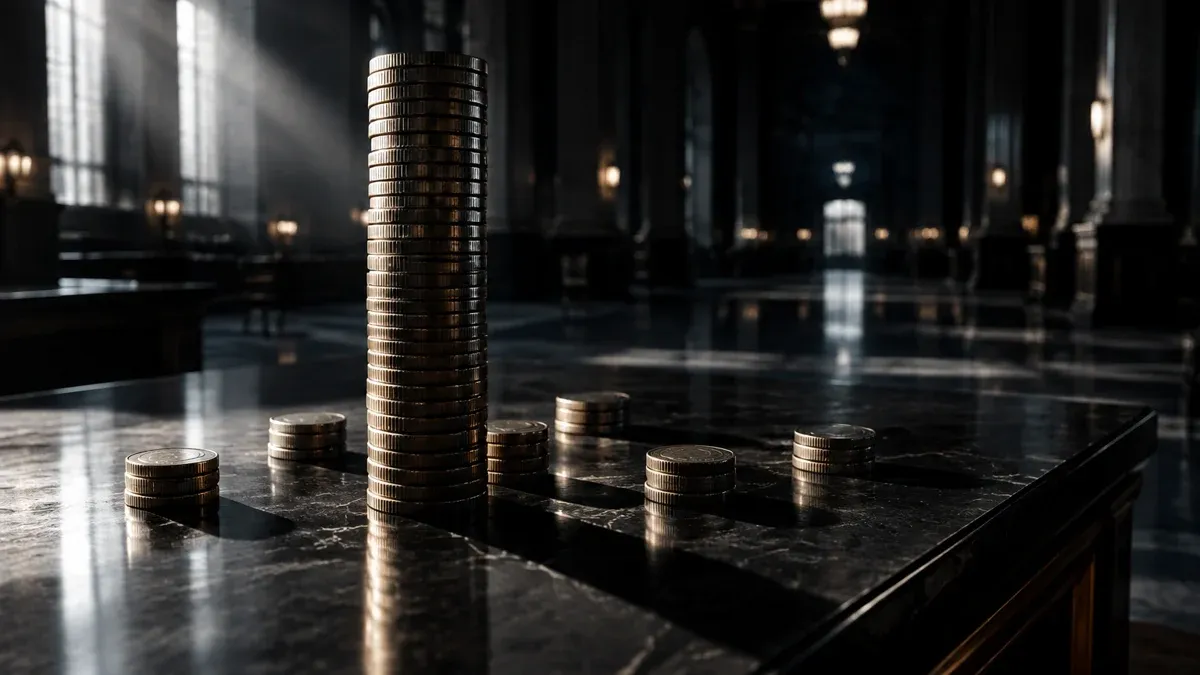 One tower and many small piles: more than half of the recorded CC turnover runs through just two trading venues.
Holding Period and Tax: How Germany Treats CC Gains
A gain from selling CC is a private disposal transaction in Germany. If you sell within one year of buying, the gain is taxable at your personal income tax rate as soon as the sum of all such gains in the calendar year exceeds the 1,000 euro exemption threshold. If you hold for longer than a year, no income tax arises on the sale. This one-year holding period is politically up for debate; we have summarised where that stands in our article on the crypto holding period in the coalition agreement.
Two points tend to be overlooked with an asset like CC. First, the period starts anew with every additional purchase; each tranche has its own date. Anyone spreading a large order across several days to push down slippage thereby creates several holding periods. Second, a swap counts as a sale: if you buy CC against a stablecoin and swap back later, that is a tax-relevant event, even if euros never reach your account. With 85,200 units across several partial purchases, this allocation is barely manageable by hand. Our overview of crypto tax software and portfolio trackers shows how to get it automated.
Storing CC: Why the Usual Hardware Wallet Routine Is Not a Given Here
With Bitcoin and Ethereum the custody question is answered before it is asked: every widespread hardware device supports both. With a network token like CC that does not hold automatically. Canton is its own Layer 1 chain with a data model designed for confidentiality, and support from wallet manufacturers usually trails such chains by a wide margin.
So check before the purchase and not after whether your device carries CC at all. If you find no support, two routes remain. Either you hold the position at an authorised exchange and accept the counterparty risk that comes with it, or you forgo the position. How robust the protection promises of the trading venues are in such a case is something we verified for the large providers in our calculation on the protection funds of the crypto exchanges. The result there works as a yardstick for position size; reassuring it is not.
If you do leave the holding at the exchange, then at least use the means available there: two-factor authentication via an app and not via SMS, a withdrawal address list, and a separation between the account you trade on and the one holding the long-term position.
Levels Up and Down: The Numbers to Measure the Move Against
On the upside the first verifiable level is the daily high at $0.135294. If it is not reached again over the course of the day, the move has lost its momentum, without anything dramatic having had to happen. The next hard number is the all-time high at $0.194152 from February 3, 2026, 30.8 percent above the current price. Anyone translating that distance into an expectation should keep in mind that it was not covered for seven months.
On the downside the daily low at $0.114686 is the first level. It sits 14.7 percent below the current price. A fall back there would wipe out the entire daily move and, at 0.94 percent turnover, would be no surprise. The second quantity to watch is volume and not price: if daily turnover stays at $50 million or above in the coming days, the move has a foundation in trading. If it falls back to the level seen before, the jump was above all a consequence of thin books.
We leave out price targets from individual analysts here. For CC we have no forecast attributable by name from a reliable source, and a number without a sender is, in case of doubt, an invented number.
Checking the Canton Price Jump: What to Take Away
Settle the buying route first, then the price. CC is tradable at a provider authorised in the EU, but only at a few, and the largest part of the volume lies outside your reach. Compare authorisation, fee and product range before you place an order: comparison of the best crypto exchanges. Match the order to the liquidity. At 0.94 percent turnover and an 18 percent daily range, every order belongs in as a limit order and, for larger amounts, spread across several partial purchases. Each partial purchase starts its own holding period, and you need to be able to document it: crypto tax software and portfolio trackers. Tie the position size to custody. As long as you cannot get CC onto your own keys, the holding sits at an exchange and carries its counterparty risk. Set the amount so that a failure of this provider remains bearable for you, and choose it accordingly: best regulated crypto exchanges.(As of September 26, 2026. This article is not investment advice. Prices and fee structures change; check the terms with the provider before you buy.)




 Bengali (Bangladesh) ·
  English (United States) ·