

The Bitcoin price jumped above $80,000 on Wednesday, November 4, 2026, one day after Democrats won both chambers of the US Congress and handed Donald Trump a clear defeat. At 20:26 UTC, Bitcoin cost $80,159 according to CoinGecko, 3.2 percent more than 24 hours earlier, after an election-night low of $75,618 on Bitstamp and a day high of $81,004. The move came with a rally on Wall Street, a slide in oil on hopes for an end to the Iran war, and $378 million in short liquidations within one hour.
Bitcoin above $80,000: the key points
Price: first above $80,000 at 15:05 UTC, 35 minutes after the Wall Street open; CoinGecko's day high is $81,004.Drivers: WTI crude below $93 a barrel, the Dow up 1,511 points at 20:00 UTC, short sellers forced out.Liquidations: $378.09 million in shorts in one hour, 81 percent of all forced closures in that hour.ETF money: about $1.16 billion left the US spot funds in the three sessions before the result.Selling zone: Bitfinex sees potential sellers between $84,000 and $85,500.Biggest risk: an escalation in Iran would remove the oil argument.Bitcoin price on November 4: from the election-night low to above $80,000
The night began with a fall. As the results came in, Bitcoin slid to $75,618 on Bitstamp, a level last seen on September 16, according to Cointelegraph. In CoinGecko's five-minute data the low came at 03:10 UTC at $75,740, just as the first networks called the House for the Democrats. We looked at that night in our election-night analysis of the Bitcoin price.
During the European morning the price recovered slowly to about $78,500. The jump came with US trading: at the Wall Street open at 14:30 UTC Bitcoin stood at $78,270, at 15:05 UTC it crossed $80,000, a gain of 2.2 percent in 35 minutes. Since then it has traded close to that level, at $80,159 at 20:26 UTC.
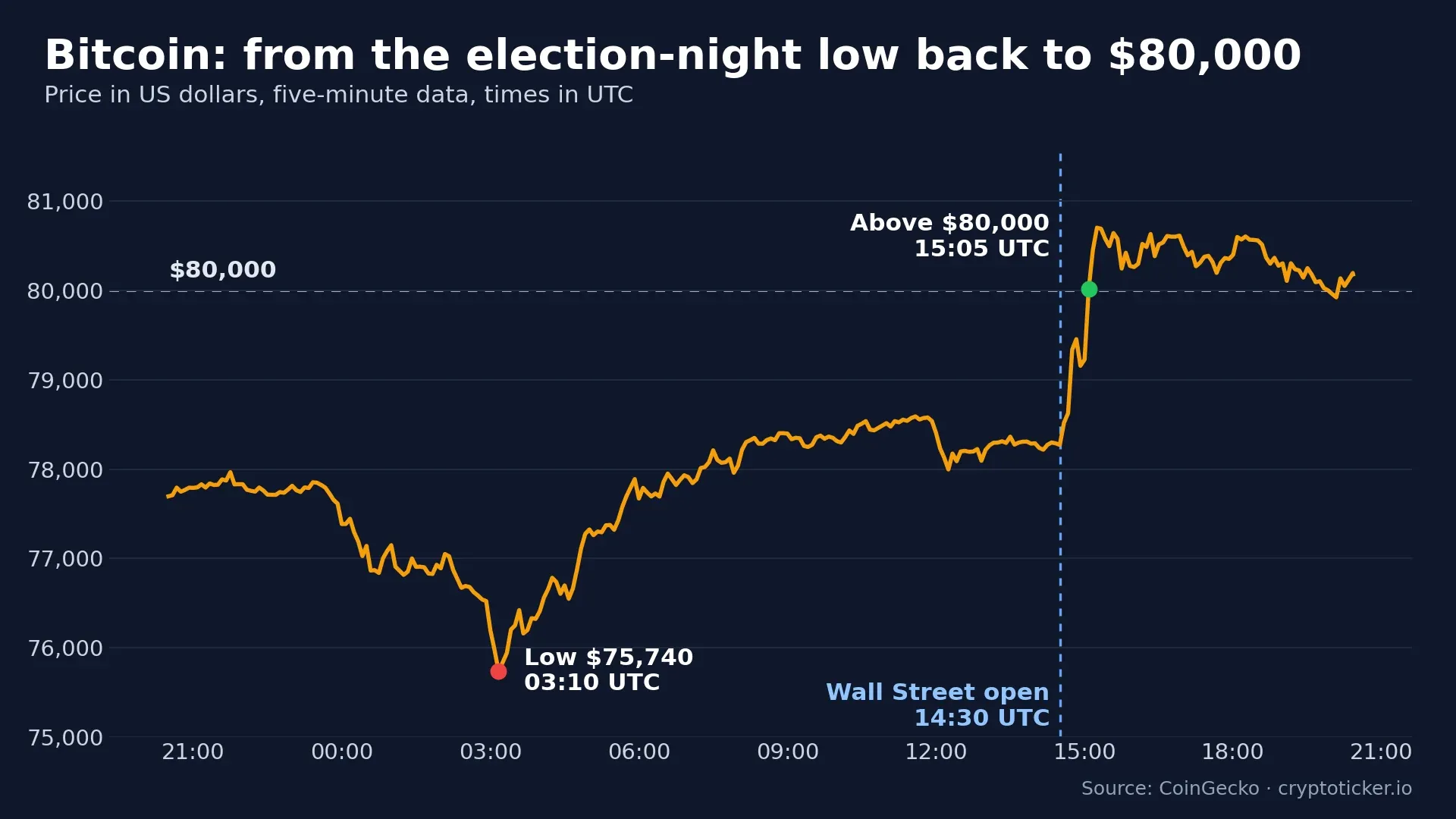 Five-minute data from CoinGecko. Single trades went further: $75,618 on Bitstamp at the low, $81,004 on CoinGecko at the high.
Over seven days Bitcoin is still 1.2 percent lower, and it sits 36.4 percent below its record of $126,080 from October 6, 2025. The jump repairs the dip of election week, not the fall since the record.
Why is Bitcoin up today? Oil, stocks and the end of uncertainty
Bitcoin is up because oil fell, stocks rose and the election risk disappeared. The result itself was no shock: an hour before the first polls closed, Polymarket gave Democrats a 73.5 percent chance of winning both chambers. Kelly Ye of trading platform Talos told Cointelegraph that Bitcoin moved about 1.7 percent after the polls closed, close to the roughly 1.8 percent options had priced: "markets had largely prepared for it".
Oil did the real work. US crude WTI fell below $93 a barrel, down as much as 11.9 percent on the week, and Brent approached sub-$100 levels for the first time since October 7, according to Cointelegraph. Iran's parliament speaker Mohammad Bagher Ghalibaf wrote on X that voters had "said NO TO WAR, and we endorse this message." James Butterfill, head of research at CoinShares, draws the line to Bitcoin: "We are seeing oil prices plummet, relieving some inflationary pressure and consequent rate hike expectations could moderate."
Wall Street moved with it. S&P 500 futures first fell to 7,490 points, the lowest since July 31, then reached 7,690; The Kobeissi Letter called that a "textbook bear trap". At 20:00 UTC, one hour before the close, the Dow was up 1,511 points or 2.9 percent, on pace for its best day since April 9, 2025, and the S&P 500 was up 1.8 percent, according to CNBC. Jay Woods of Freedom Capital Markets told CNBC: "there will be gridlock and historically this is good for the market."
Why would Bitcoin rise when Trump loses? Because rates and liquidity move the price more than Washington does. Butterfill again: "For Bitcoin, real yields, dollar liquidity and ETP flows still carry more weight than the elections." What the defeat means for Trump himself and for crypto rules is in our article on Trump after the midterms.
Bitcoin, Ethereum and the Trump coin compared: the gap after the midterms
The comparison shows where the money went. At 20:26 UTC, Bitcoin was up 3.2 percent over 24 hours and Ether, which we analysed separately, up 5.8 percent, while the Trump coin was down 17.6 percent, all according to CoinGecko. The market bought the large coins that gain from cheaper oil and fewer rate fears, and sold the coin most directly tied to the president.
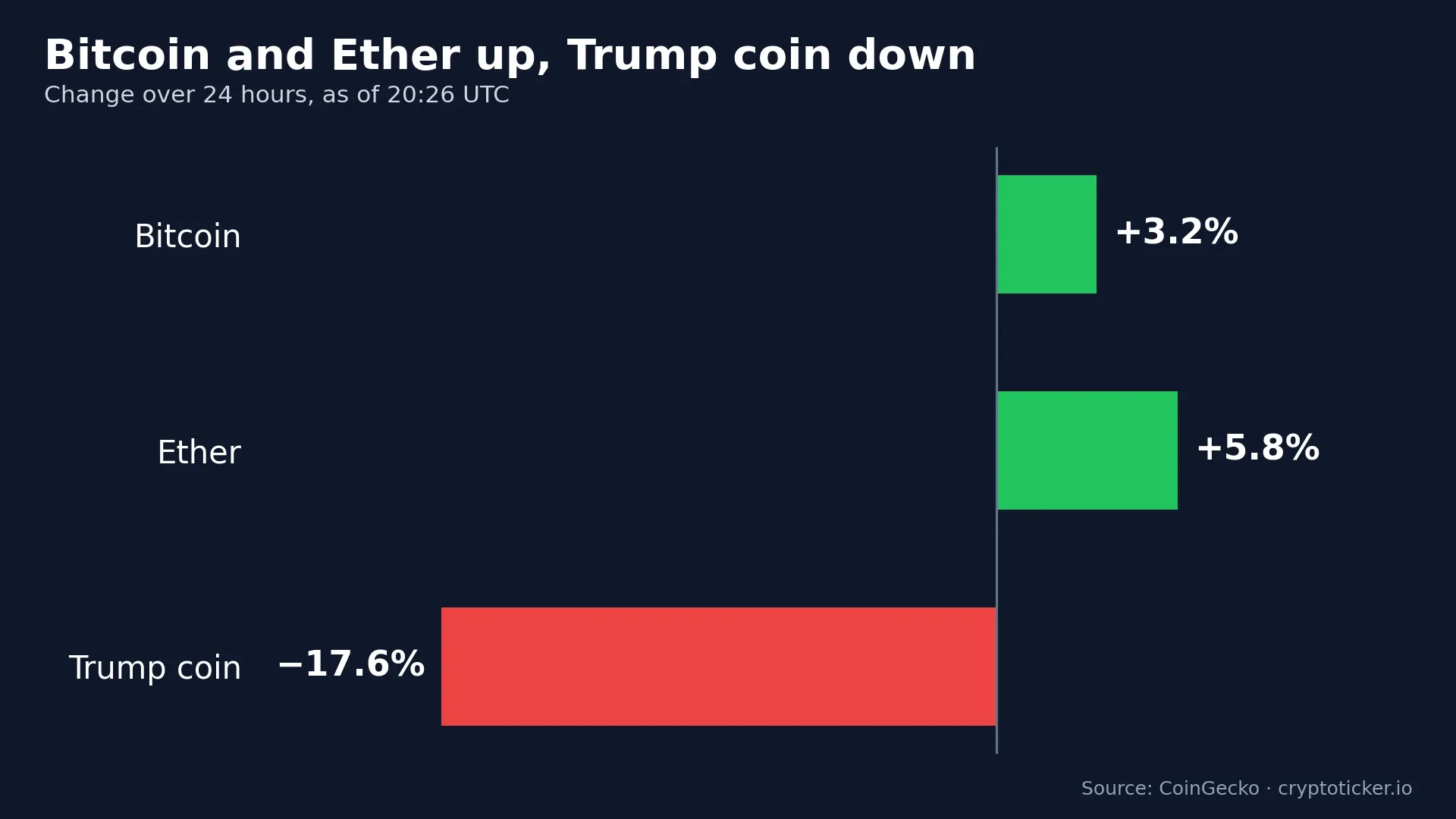 Source: CoinGecko, as of 20:26 UTC.
| Bitcoin | $80,159 | +3.2% | −1.2% | 36.4% |
| Ether | $2,415 | +5.8% | +2.2% | 51.2% |
| Trump coin | $1.30 | −17.6% | −24.5% | 98.2% |
Bitcoin short liquidations: $378 million in one hour
A liquidation is the forced closure of a leveraged position when the collateral no longer covers it. When the price jumps, it hits short positions, the bets on falling prices. Closing them means buying, which pushes the price further.
According to CoinGlass data reported by crypto.news, shorts worth $378.09 million were liquidated across the crypto market in one hour, 81 percent of the $466.33 million in forced closures in that hour. Over four hours the short total was $386.16 million, so nearly all of it fell into that single hour.
Two things help when reading these numbers. They cover the whole crypto market, not only Bitcoin. And they count closed positions, not fresh purchases in the spot market. Part of the jump was therefore mechanical, and the coming days will show how many real buyers stay.
Bitcoin ETFs and options: what the big money shows
The funds have not confirmed the rise yet. US spot Bitcoin ETFs lost $643.3 million on October 30, $398.6 million on November 2 and $115.6 million on November 3, about $1.16 billion in three sessions, as shown in our analysis of the ETF outflows. All of that happened before the result, and the figures for Wednesday only arrive after the US close. Bitfinex sets a clear test on crypto.news: "Three straight inflow days of similar size would be the first sign demand is back."
The options market is calmer. On Deribit, open interest at 20:26 UTC stood at 203,200 BTC in calls, the bets on rising prices, against 132,900 BTC in puts, a put/call ratio of 0.65. The largest call positions sit at $80,000, $90,000 and $85,000, the largest puts at $60,000 and $72,000. Deribit's volatility index DVOL, which shows the swings option traders expect, stood at 38.0. Funding, the balancing payment on perpetual futures, was positive but small at Deribit, OKX and Bybit, below 0.01 percent per period. The Fear and Greed Index rose from 26 to 34 and remains in fear territory. That is a market with hope but without euphoria.
Bitcoin price levels: the marks above and below $80,000
Above the current price the next marks lie close together, and a denser selling zone starts at $84,000. Below it, the election-night low and two long-term averages form a tight floor. The averages are cryptoticker.io calculations based on CoinGecko daily prices.
| $126,080 | All-time high, October 6, 2025 | CoinGecko |
| $90,000 | Second-largest call position | Deribit |
| $84,000 to $85,500 | Potential sellers near their purchase price | Bitfinex, crypto.news |
| $81,911 | 50-day average | cryptoticker.io |
| $81,004 | 24-hour high | CoinGecko |
| $80,321 | 20-day average | cryptoticker.io |
| $80,159 | Current price | CoinGecko |
| $80,000 | Round number and largest call position | Deribit |
| $78,000 to $79,000 | Bids grew to about $42 million from $24 million in mid-October | Bitfinex, crypto.news |
| $76,663 | 100-day average | cryptoticker.io |
| $75,733 | 50-week average when reported | Cointelegraph |
| $75,618 | Election-night low on Bitstamp | Cointelegraph |
| $73,163 | 200-day average | cryptoticker.io |
Two marks stand out. Bitfinex counted 2.26 million BTC bought between $81,000 and $85,500 in its report from November 2, and holders close to their purchase price could sell into a recovery. On the downside, Keith Alan of Material Indicators calls the 50-week average a line in the sand; failing to defend it could mean a "deeper correction ahead", as he told Cointelegraph. Chart levels are reference points, not guarantees.
Our take on the Bitcoin price: the rise hangs on oil, not on Washington
We read the jump above all as a rates trade. The chain runs like this: hope for an end to the war, cheaper oil, less inflation pressure, less pressure for rate hikes, more room for risk assets, Bitcoin included. Every link is plausible, and every link is still an expectation. The end of the war is a hope, not an agreement, and the 10-year Treasury yield was still around 4.9 percent on Wednesday, according to CNBC.
Three things would tip the picture:
Iran: economist Robin Brooks names the core of it on Cointelegraph: "The key question now is whether this causes the President to dial back on war with Iran or whether he escalates." An escalation would lift oil and break the first link.ETF flows: if the outflows continue despite the higher price, the buyer that counts most is missing. Bitfinex's test of three inflow days is a good yardstick.Selling zone: without fresh demand, the rise could run out of steam between $84,000 and $85,500. A fall back below $75,618 would erase the whole move.Until these points are clear, we see what Butterfill calls a possible "relief rally", not a change of trend. This is our assessment, not a forecast.
Buying Bitcoin after the jump: platform, taxes and leverage
If you want to buy after the jump, check the platform first. Under the EU's MiCA regulation, crypto service providers need authorisation as a crypto-asset service provider, and the public register of the European securities regulator ESMA shows who has it. Our comparisons of regulated crypto exchanges and crypto brokers give an overview. On days like this, a limit order sets the highest price you will pay, while a market order can fill well away from the last price shown.
If you are taxed in Germany, gains are tax-free once more than one year lies between purchase and sale; before that your personal income tax rate applies as soon as all private disposal gains of the year reach the €1,000 limit. Rules differ elsewhere, so record the date and price of every purchase. A crypto tax tool matches purchases and sales automatically.
Leverage is the part to treat with most respect. CoinGecko shows 7 percent between Wednesday's 24-hour low and high. With 10x leverage, a move of that size against you costs about 70 percent of your collateral before fees, and 10 percent wipes it out. Buying without leverage is the clearer route for most private investors, because a falling price then lowers the book value without forcing a sale.
As of November 4, 2026. This article is not investment advice. Title photo: Tim Reckmann, licence CC BY 2.0, cropped.





 Bengali (Bangladesh) ·
 English (United States) ·