
 22 hours ago
2
22 hours ago
2 
Key Takeaways
Large-holder growth points to stronger hands. Custody shifts complicate the on-chain signal. ETF demand supports institutional resilience. Equity decoupling strengthens diversification appeal. Price still has to confirm accumulation.Santiment reported on August 10 that the number of wallets holding at least 10,000 BTC has climbed to 90, its highest level in six months. That is six more wallets than eight weeks ago, an increase of 7.1%, while holdings among smaller wallets have been falling during August.
Santiment sees that combination as potentially bullish. Supply is becoming more concentrated among the largest holders at a time when U.S. spot Bitcoin ETF demand has also improved. The funds attracted about $853 million last week, including $693.7 million for BlackRock’s IBIT, per SoSoValue data.
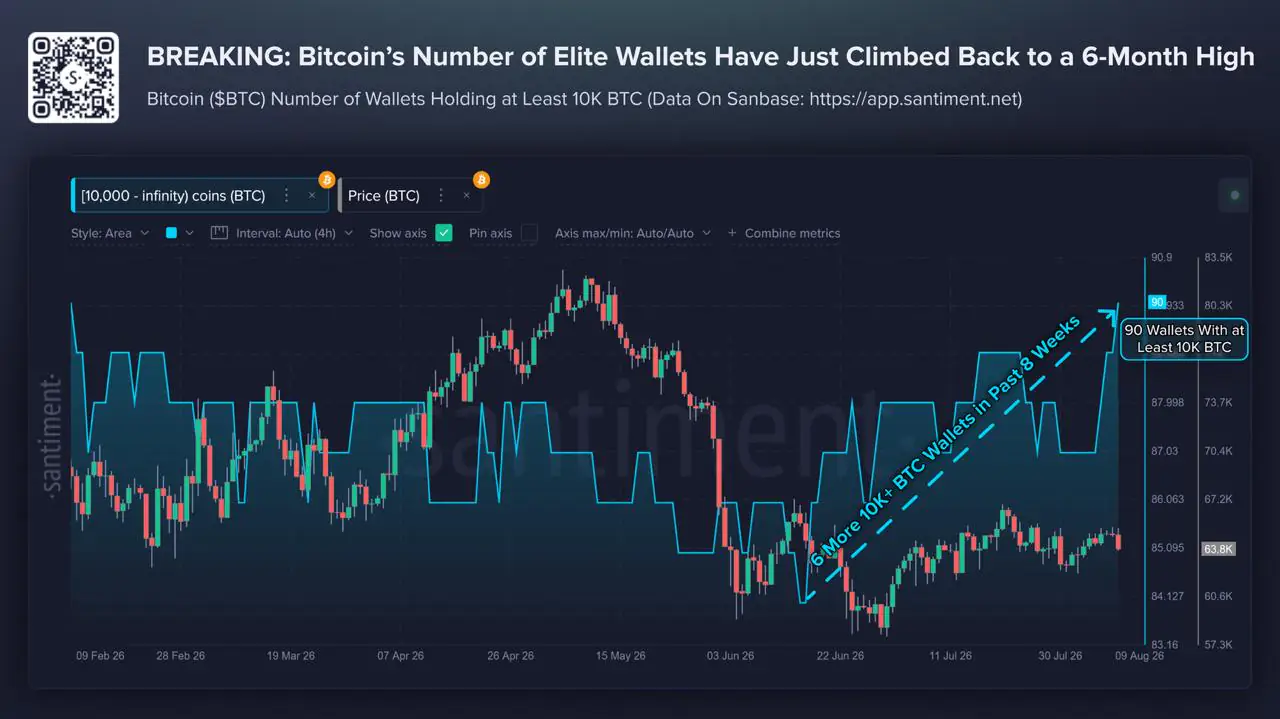 Santiment chart showing Bitcoin elite wallets holding at least 10K BTC climbing back to a 6-month high.
The question is whether those two trends are showing genuine accumulation beneath the consolidation, or whether recent changes in how investors hold Bitcoin are making the on-chain picture look stronger than it really is.
Why Santiment Sees the Shift as Bullish
Santiment’s argument is based on the direction of supply between different wallet groups.
When smaller traders increase their share while large holders distribute coins, the market can become more vulnerable to selling pressure. The current pattern is moving the other way, with micro-wallet holdings falling while the largest address tier gains presence.
That leaves more supply in what Santiment describes as stronger hands. Historically, the analytics firm views that distribution as more favorable ahead of major market moves, particularly when larger holders continue increasing their share while retail participation weakens.
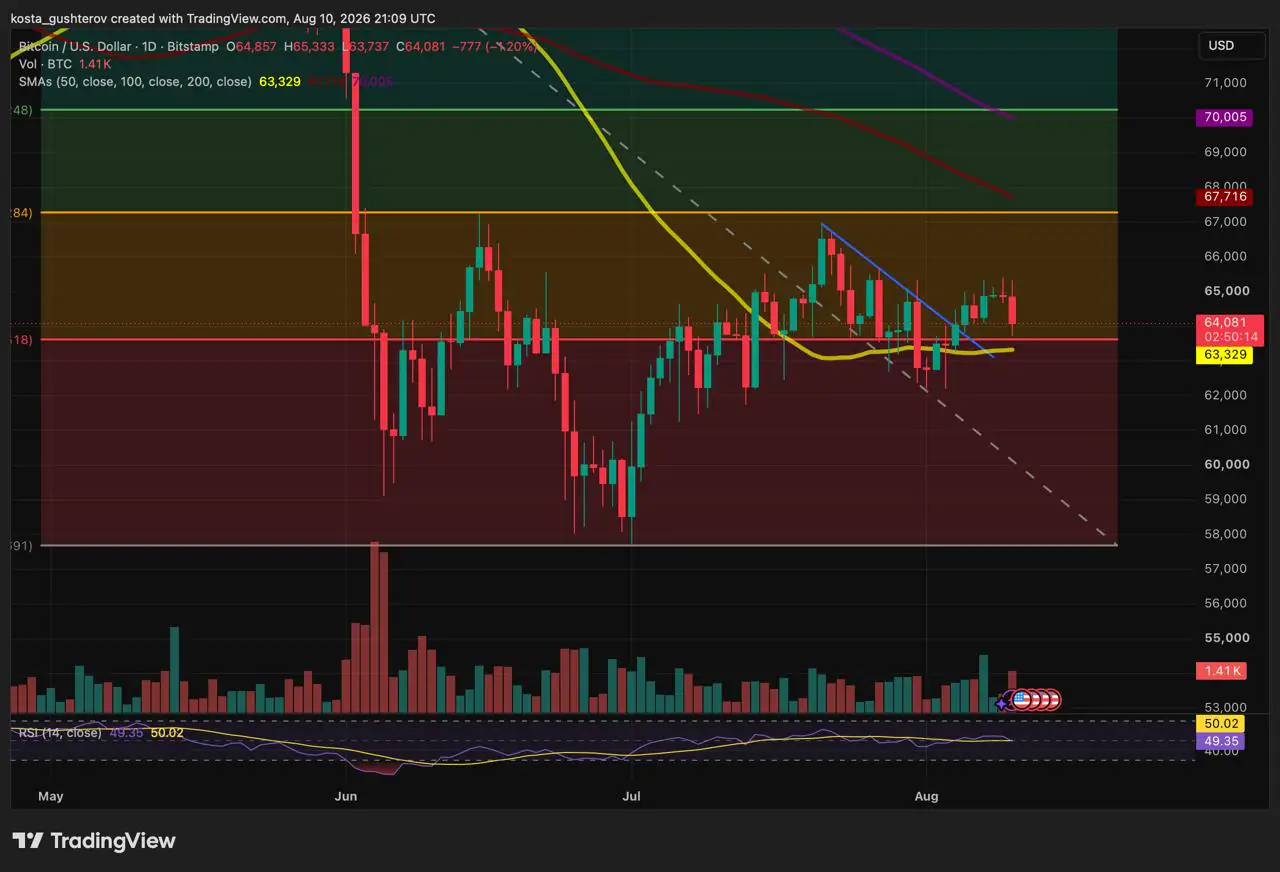 Daily chart showing BTC stuck between $58,000 and $67,000 – Source: TradingView
The interpretation is useful, but the wallet count cannot tell us exactly who sits behind every address.
A wallet holding more than 10,000 BTC could belong to an individual investor, but it could also represent an exchange, custodian or infrastructure serving institutional products. That distinction has become especially important after the recent Coldcard security scare.
Coldcard Makes the On-Chain Picture Less Clean
The Coldcard flaw has revived the Bitcoin wallet versus ETF debate while also prompting users to move funds and reconsider how they store their coins.
That kind of activity can distort wallet-based signals in the short term.
If Bitcoin moves from one self-custody address into another, or becomes consolidated under a larger custodian, the blockchain records a meaningful change in wallet distribution even though no new investor necessarily entered the market.
This does not invalidate Santiment’s observation that smaller holders are losing share while larger addresses gain it. It does make the reason behind the shift harder to isolate.
Some of the movement may be fresh accumulation. Some may simply reflect investors reorganizing custody after the security scare. On-chain wallet counts alone cannot cleanly separate the two.
BlackRock Is Seeing a Shift Among Investors Too
BlackRock is seeing another change that may help explain why institutional demand has remained resilient despite Bitcoin’s stagnant price.
Robert Mitchnick, the asset manager’s Head of Digital Assets, said sentiment has changed in a noticeable but subtle way as Bitcoin has begun behaving more independently from equities.
He pointed to July, when AI-related stocks suffered a sharp pullback while Bitcoin held up considerably better.
That matters for portfolio managers because Bitcoin becomes more useful as a diversifier when it does not simply follow the same moves as the equities they already own. A period of lower correlation strengthens the case for treating BTC as a separate allocation rather than another version of the same risk trade.
Mitchnick has also described Bitcoin ETF investors as predominantly long-term, buy-and-hold holders. The latest flows fit that profile: demand returned even without a strong upside move in BTC, and BlackRock’s IBIT captured most of the week’s net inflows.
That kind of behavior looks less like traders chasing momentum and more like investors maintaining exposure through a weak market.
What the Market Still Has to Prove
The on-chain and ETF data give the accumulation argument some support, but they have not settled it.
A continued decline in smaller-holder balances alongside persistent ETF inflows would make Santiment’s stronger-hands thesis more convincing. The signal would become harder to dismiss if large-wallet growth also continues after the disruption caused by Coldcard fades.
Price is the missing confirmation.
A breakout from Bitcoin’s long-running range would suggest that the supply absorbed during the consolidation is finally translating into enough demand to move the market. If wallet distribution keeps changing while BTC remains trapped, custody redistribution becomes a more important part of the explanation.
For now, the data shows that Bitcoin is changing hands. The next meaningful price move should tell us whether those hands are actually stronger.
The post Bitcoin Is Stuck, but Something Underneath Is Changing appeared first on Coindoo.





 Bengali (Bangladesh) ·
  English (United States) ·