

Institutional demand for Bitcoin and Ethereum appears to be returning—but anyone looking only at crypto prices might not notice.
U.S. spot Bitcoin and Ethereum ETFs attracted approximately $1.1 billion in combined net inflows during the first full trading week of August. Despite this apparent wave of institutional demand, Bitcoin remains below $65,000 while Ethereum is struggling to move decisively beyond $1,900.
The disconnect raises an important question: If institutions are buying again, why are crypto prices barely moving?
Bitcoin and Ethereum ETFs Record a Strong Week
According to updated data from Farside Investors, U.S. spot Bitcoin ETFs recorded approximately $865 million in net inflows between August 3 and August 7.
Some earlier estimates placed the weekly figure closer to $853.5 million because of differences in reporting times and later data revisions. Either figure represents a significant reversal from the previous week’s outflows.
The most notable part was the consistency. Bitcoin ETFs recorded positive net flows during all five trading sessions:
August 3: $170.1 million
August 4: $211.5 million
August 5: $244.4 million
August 6: $137.6 million
August 7: $101.7 million
BlackRock’s IBIT accounted for approximately $693.5 million of the weekly total, representing around 80% of all Bitcoin ETF inflows.
Ethereum ETFs also had one of their strongest weeks in months. Farside’s Ethereum ETF data shows approximately $244 million in net inflows, despite beginning the week with a small outflow.
Together, Bitcoin and Ethereum ETFs attracted more than $1.1 billion.
Why Did Bitcoin and Ethereum Barely React?
The first explanation is scale.
Bitcoin currently has a market capitalization of approximately $1.3 trillion. While $865 million is a substantial amount of institutional capital, it remains relatively small compared with Bitcoin’s total valuation and daily global trading volume.
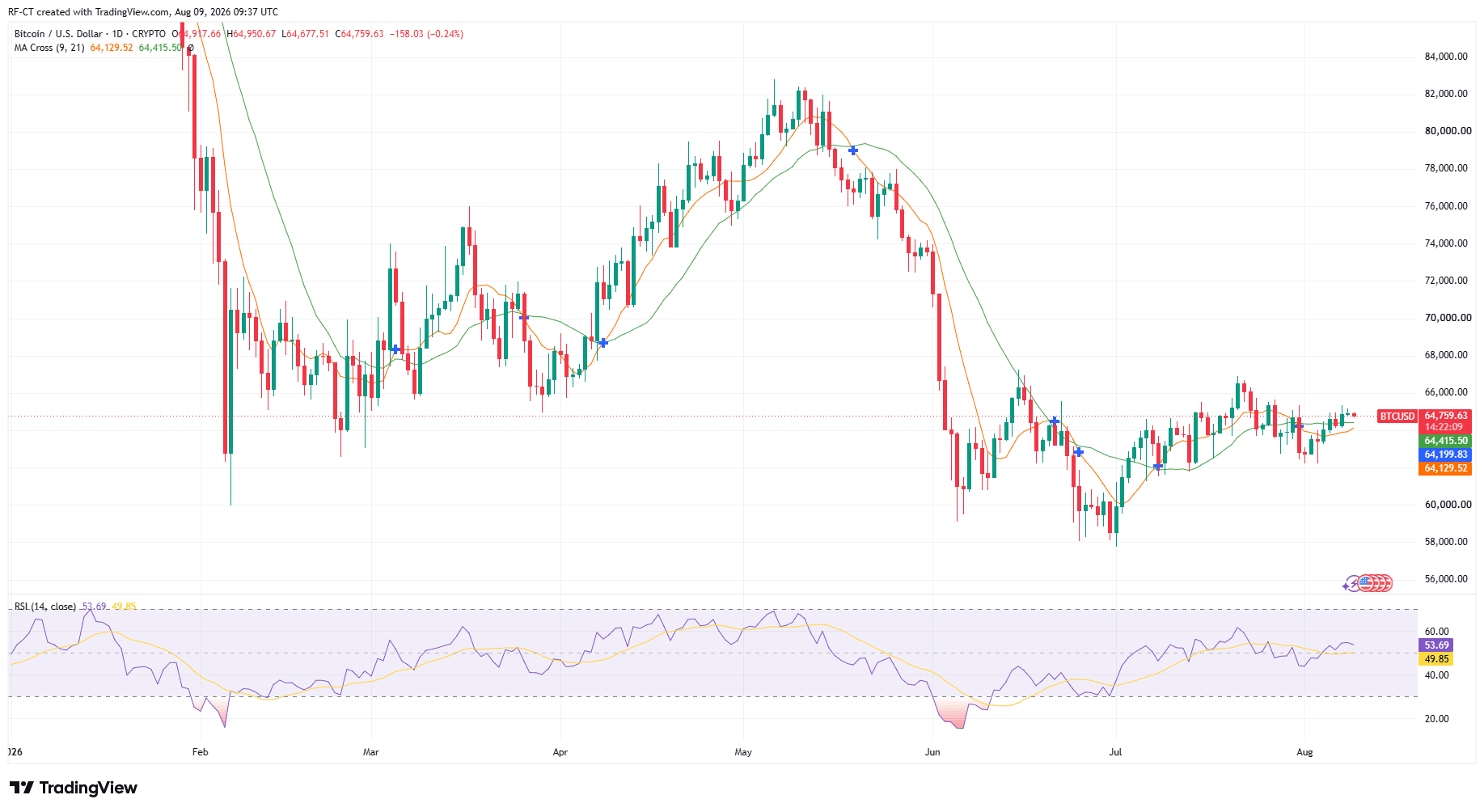 By TradingView - BTCUSD_2026-08-09 (YTD)
ETF demand also represents only one part of the market. Selling on centralized exchanges, over-the-counter desks and derivatives platforms can absorb the buying pressure created by ETF inflows.
In other words, ETFs may be buying, but other investors are still selling.
This could explain why Bitcoin has remained trapped around $64,000 to $65,000 instead of immediately breaking higher. The inflows may be supporting the price and preventing a deeper correction without being large enough to overcome the supply waiting near resistance.
Ethereum has reacted slightly better. ETH climbed from approximately $1,845 at the beginning of the week to around $1,914. However, it has yet to break decisively above the $1,920 resistance area or challenge the psychological $2,000 level.
ETF Inflows Do Not Always Mean Immediate Price Growth
Another factor is how institutional investors use ETFs.
Not every ETF purchase represents a simple bullish bet on rising crypto prices. Some professional investors use ETF shares as part of hedged positions, arbitrage strategies or longer-term portfolio allocations.
This means ETF inflows can increase without generating the same immediate price pressure associated with direct spot purchases from investors who withdraw their coins from exchanges.
Institutional accumulation also tends to be less emotional than retail activity. Large investors can gradually build positions over several weeks instead of chasing a sudden breakout.
The recent inflows may therefore be an early signal rather than an immediate price catalyst.
Is This Silent Accumulation or a Warning?
The optimistic interpretation is that institutions are quietly accumulating Bitcoin and Ethereum while prices remain relatively low.
Five consecutive days of Bitcoin ETF inflows suggest that demand is not based on a single large transaction. The concentration of capital in Bitcoin and Ethereum also shows that institutional investors continue to favor the two largest cryptocurrencies over more speculative altcoins.
If these flows continue, available selling pressure could eventually weaken and allow prices to move higher.
However, there is also a more cautious interpretation. If more than $1.1 billion in ETF inflows cannot push Bitcoin beyond $65,000 or Ethereum toward $2,000, the market may be facing stronger overhead supply than the headline numbers suggest.
In that scenario, ETF demand is being absorbed by sellers rather than creating a genuine breakout.
What Happens Next?
For Bitcoin, the $65,000 to $66,000 area remains the immediate test. A sustained break above this zone, supported by another week of positive ETF flows, would suggest that institutional demand is finally beginning to influence the broader market.
Failure to break higher could keep Bitcoin trapped inside its current range. Losing the $64,000 area would weaken the argument that ETF demand is providing reliable support.
Ethereum must first establish itself above approximately $1,920. A successful breakout could open the path toward $2,000, while rejection would leave ETH vulnerable to another test of the $1,880 to $1,860 area.
The $1.1 billion ETF week is undoubtedly positive, but it has not yet produced a confirmed market breakout. For now, institutional demand appears to be supporting crypto prices—not driving them.





 Bengali (Bangladesh) ·
  English (United States) ·